
Ancient Mathematics and Astronomy in India
Reference library · 1023 words

Indian mathematics began, so far as surviving texts allow us to say, with the problem of building an altar correctly. The Sulbasutras, ritual manuals composed in Sanskrit in the first millennium BCE, set out how to construct sacrificial altars of prescribed shape and area using cord and peg. To do that the authors needed to transform a square into a circle of equal area, to double a square, and to relate the sides of a right triangle. The texts state, in effect, the theorem associated with Pythagoras, and give a strikingly accurate rational approximation to the square root of two. This is geometry as practical construction rather than as deductive proof, and the distinction matters: Indian mathematics developed a computational and algorithmic character from the start, where Greek mathematics developed an axiomatic one.
A second and less expected root lies in poetics. Around the third or second century BCE, Pingala's treatise on Sanskrit metre needed to enumerate all possible arrangements of long and short syllables in a line. Solving that problem produced binary representation of numbers, a systematic method of combinations, and the triangular array of binomial coefficients later known in Europe as Pascal's triangle, which Indian commentators called the meru prastara. Mathematics arriving through grammar and prosody rather than through commerce or surveying is one of the genuinely distinctive features of the tradition.
Zero, place value and the great transmission
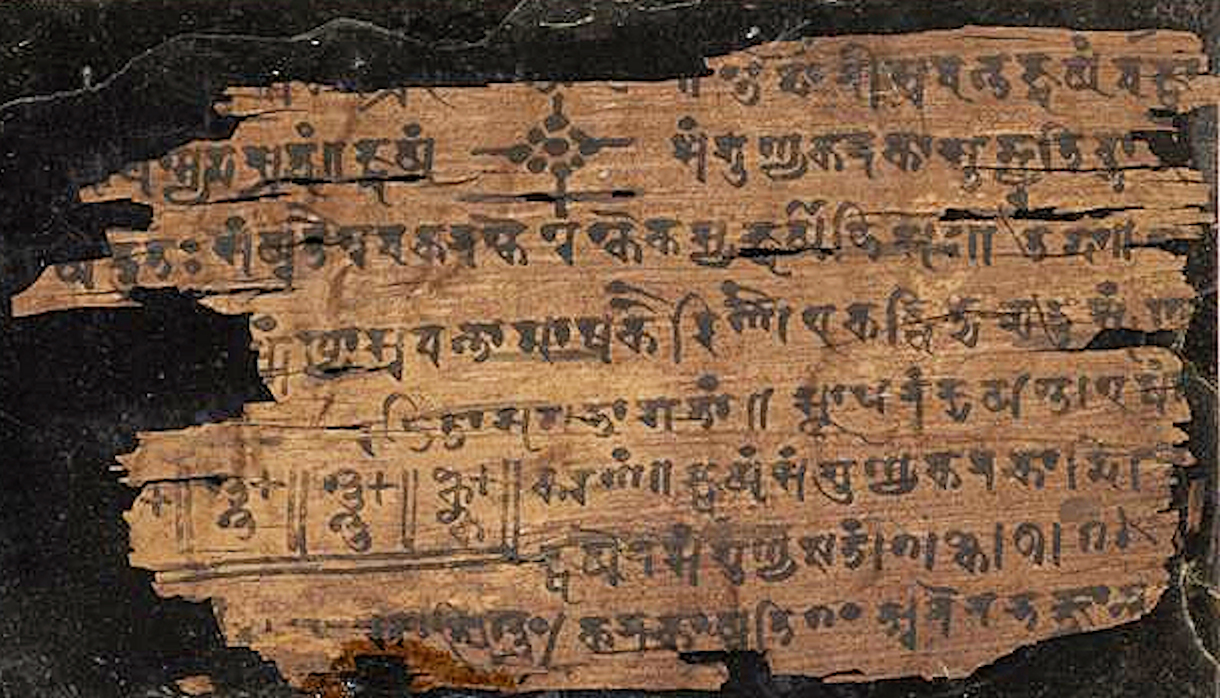
The innovation with the widest consequences was the decimal place value system with a symbol for zero. Positional notation of some kind was in use in India well before it was written down in the forms we now recognise, and Sanskrit verse encouraged it, since numbers were frequently expressed as words in ascending order of place. Dating the written zero precisely is contested. The Bakhshali manuscript, a birch bark mathematical text found near Peshawar in 1881 and held at the Bodleian Library, contains dot symbols used as placeholders, but radiocarbon results published in 2017 gave widely separated dates for different folios, and several historians have argued that the manuscript cannot be treated as a single object of one date. What is not disputed is that Brahmagupta, writing the Brahmasphutasiddhanta in 628 CE, treated zero as a number in its own right and gave rules for arithmetic with zero and with negative quantities, which he described in terms of fortunes and debts. His attempt to define division by zero was unsuccessful, which is itself evidence that he was working the problem seriously.
Astronomy was the discipline that consumed most of this mathematics. Aryabhata, born in 476 CE, composed the Aryabhatiya in 499, a work of extreme compression: a few hundred verses covering arithmetic, algebra, trigonometry and planetary theory. It contains a table of half chords, the ancestor of the modern sine function, whose Sanskrit name jya passed through Arabic transliteration into the Latin sinus. It gives a value for the ratio of circumference to diameter equivalent to 3.1416 and, unusually, describes it as approximate. Most strikingly, Aryabhata argued that the apparent daily westward motion of the stars is caused by the rotation of the Earth on its own axis, and explained solar and lunar eclipses as shadows cast by the Earth and the Moon rather than as the work of the demons Rahu and Ketu. Later astronomers, including Brahmagupta, rejected the rotating Earth, so this was a contested claim within the tradition, not an accepted one.
The tradition was never sealed. The Yavanajataka and the works of Varahamihira in the sixth century show clear absorption of Hellenistic material, including Greek astrological doctrine and geometrical models, and Varahamihira's Pancasiddhantika explicitly summarises five earlier astronomical systems, one of them Greek in origin. Traffic ran the other way with even greater effect. In the eighth century an Indian astronomical work reached the Abbasid court in Baghdad and was translated as the Sindhind, and al-Khwarizmi's account of calculation with Indian numerals, transmitted through Latin, is why Europeans called the system algorism and the numerals Arabic. Fibonacci's Liber Abaci of 1202 argued their commercial superiority to Roman numerals for a European audience.
The Kerala school and the limits of what we know
Indian mathematics did not stop with the classical period. Bhaskara II, who lived in the twelfth century, wrote the Lilavati on arithmetic, the Bijaganita on algebra and the Siddhanta Shiromani on astronomy, and refined the chakravala or cyclic method for solving indeterminate quadratic equations of the type later studied in Europe as Pell's equation. His work included statements about instantaneous motion and about the behaviour of quantities as a divisor becomes very small that some historians read as anticipating differential ideas, though how far that reading is fair is debated.
The most remarkable later development occurred in Kerala. Madhava of Sangamagrama, who worked around the turn of the fifteenth century, derived infinite series expansions for the sine, cosine and arctangent functions, including the series for the ratio of circumference to diameter that in Europe is credited to Gregory and Leibniz two and a half centuries later, together with correction terms that made the slowly converging series practically usable. His successors carried the work forward: Nilakantha Somayaji's Tantrasangraha of 1501 proposed a planetary model in which Mercury and Venus orbit the Sun while the Sun orbits the Earth, and Jyesthadeva's Yuktibhasa, written in Malayalam prose around 1530, sets out demonstrations rather than bare results, which is why it is sometimes described as a text of calculus in substance if not in name.
Whether any of this reached Europe before Newton and Leibniz is genuinely unresolved. Jesuit missionaries were active in Kerala in the sixteenth century and were interested in local calendrical astronomy, which makes a route conceivable, and some scholars have argued for it forcefully. No document has yet been produced showing transmission, and most historians therefore treat the European and Kerala developments as independent until evidence appears. That caution is worth preserving, because the achievement does not need the claim. A tradition that produced positional notation, the sine function, systematic rules for zero and negative numbers, and convergent infinite series has enough to stand on without borrowing credit for anyone else's.
References
- University of St AndrewsMacTutor History of Mathematics Archive
- Encyclopaedia BritannicaAryabhata
- Encyclopaedia BritannicaBrahmagupta
- Bodleian Libraries, University of OxfordBodleian Libraries
- Encyclopaedia BritannicaSouth Asian mathematics
This is a reference article, written from the sources above. It is background, not news reporting.