

How Bollywood Became a Global Industry
Reference library · 1050 words

The word Bollywood is a portmanteau of Bombay and Hollywood, it is disliked by many of the people who work in the industry it describes, and it is routinely used to mean something far larger than it is. Strictly, it refers to the Hindi language film industry based in Mumbai. India also sustains major film industries in Telugu, Tamil, Malayalam, Kannada, Bengali, Marathi and several other languages, and by number of films produced and tickets sold the non Hindi industries together are the larger part of Indian cinema. Even so, the Mumbai industry is the one that first found a global audience, and the story of how it did so explains a good deal about how Indian culture travels.
Indian cinema begins conventionally with Dadasaheb Phalke's Raja Harishchandra in 1913, a silent mythological made in Bombay. Sound arrived in 1931 with Alam Ara, and it changed the industry's structure permanently, because sound meant language, and language meant that a single national market immediately fractured into regional ones. It also meant songs. From the 1930s Indian commercial films carried music as a structural element rather than an ornament, and by the 1940s the playback system had taken hold, in which professional singers record the songs and actors mime to them on screen. That arrangement created a parallel star system of singers whose voices were as recognisable as any actor's face, and it made film music synonymous with popular music across the subcontinent.
Golden ages and the finance problem
The 1950s are usually described as the industry's first great period, when Raj Kapoor, Guru Dutt, Bimal Roy, Mehboob Khan and others made films that combined melodrama with social argument about poverty, land and modernity. Some of these travelled remarkably far. Raj Kapoor's Awaara, released in 1951, became enormously popular in the Soviet Union, in Turkey and across the Middle East, its title song familiar to audiences who spoke no Hindi. Mehboob Khan's Mother India was nominated for the Academy Award for best foreign language film. In the 1970s the register changed, with the rise of the multi genre masala film and of Amitabh Bachchan's angry young man persona, in an era of inflation, unemployment and political crisis. Sholay, released in 1975, ran in theatres for years and remains the reference point for Hindi cinema's popular imagination.
What held the industry back was money. For decades film production in India was not recognised as an industry, which meant it could not access ordinary bank finance, insurance or institutional investment. Films were financed privately, at very high interest, often from opaque sources, and the industry's entanglement with organised crime in Mumbai through the 1980s and 1990s was a real and documented problem rather than a tabloid invention. The formal grant of industry status at the end of the 1990s changed the underlying economics: banks could lend, films could be insured, corporate studios could be capitalised, and accounting became something closer to conventional. Corporatised producers and distributors emerged, and with them recognisable release strategies, marketing budgets and rights markets.
The diaspora becomes a market
The other transformation was demand side and began at almost the same moment. India's economic liberalisation from 1991 opened satellite television, and the arrival of private channels created a huge new appetite for film content and a new revenue stream in broadcast rights. Simultaneously, the Indian communities built up in Britain, North America, the Gulf and Australasia had reached a size and an income level at which they constituted a commercially significant audience, and one that paid in hard currency at ticket prices several times the Indian level.
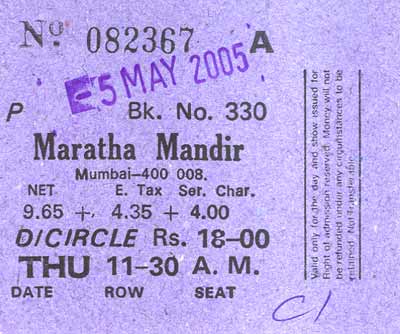
The film that crystallised this was Aditya Chopra's Dilwale Dulhania Le Jayenge, released in 1995, whose protagonists are second generation Indians in London negotiating between British lives and Punjabi family expectations. It was a vast hit both in India and abroad, and it ran continuously at the Maratha Mandir cinema in Mumbai for well over two decades, an extraordinary theatrical run by any international standard. It also established a template that the Mumbai industry worked for the following fifteen years: the family drama in which diaspora settings, foreign locations and consumer aspiration are combined with an insistence on tradition. Overseas box office, once a rounding error, became a line item that could determine whether a film was profitable.
Distribution followed. Indian films acquired regular screens in Britain, the United States, Canada, Australia, the Gulf states, Malaysia and Singapore, and Indian titles have repeatedly appeared in weekly box office charts in those markets. In Australia in particular, where the Indian born population has grown very fast, mainstream chains now programme Hindi, Telugu and Tamil releases on opening weekend rather than treating them as specialist bookings. Meanwhile Hindi cinema retained older non diaspora audiences in the former Soviet republics, in parts of Africa, and in the Middle East, where dubbed and subtitled versions circulate widely.
Two more recent shifts are still working themselves out. The first is streaming. International platforms entered India from around 2016 and commissioned original Indian series and films at scale, creating an outlet for material that would never have survived a theatrical release, including crime drama, political satire and long form storytelling without songs. This has expanded what Indian screenwriters can attempt while also exposing them to the country's censorship and outrage politics in new ways, since online content sits in a different and shifting regulatory space from theatrical film, which is certified by the Central Board of Film Certification.
The second is the rise of southern Indian cinema as the country's most commercially aggressive export. Telugu and Tamil productions with very large budgets and pan Indian dubbed releases have in several recent years outgrossed anything from Mumbai, and one Telugu film's song won the Academy Award for original song in 2023. Whether this represents a durable shift in the centre of gravity of Indian cinema or a cyclical run of hits is genuinely argued about within the industry. What is not in doubt is that the older assumption, that Hindi cinema is Indian cinema and everything else is regional, no longer describes the market. For audiences abroad, the practical consequence is that the label on the marquee matters less than it used to: what has gone global is Indian popular film, in several languages at once.
References
- British Film InstituteIndian cinema
- Encyclopaedia BritannicaBollywood
- Ministry of Information and Broadcasting, Government of IndiaCentral Board of Film Certification
- National Film Archive of IndiaIndian film heritage collections
This is a reference article, written from the sources above. It is background, not news reporting.