Malayalam: Language of Kerala's Coast
Reference library · 1082 words

Malayalam is the language of Kerala, the narrow strip of land pressed between the Western Ghats and the Arabian Sea on India's southwestern coast. It is spoken by roughly 35 million people as a first language, and it is the official language of the state of Kerala, of the Lakshadweep islands, and of Mahe, a small enclave that was once French. The name is a compound of two Dravidian roots, mala meaning hill or mountain and alam meaning place or region, which is a fair description of a territory defined by the mountain wall behind it and the sea in front. That geography matters for the language itself: the Ghats cut Kerala off from the Deccan interior while the sea connected it to Arabia, Persia, China and eventually Europe, so Malayalam absorbed vocabulary from Arabic, Syriac, Portuguese, Dutch and English while remaining structurally quite conservative.
Malayalam belongs to the Dravidian family, which is unrelated in ancestry to Sanskrit, Hindi or English, although Malayalam has borrowed Sanskrit words on a scale that outstrips almost every other Indian language. Its closest relative is Tamil, and the question of how the two separated is one of the genuinely contested problems in Indian linguistics. The older view held that Malayalam descended from a medieval form of Tamil, splitting off somewhere between the ninth and the thirteenth centuries as the Chera country on the west coast drifted politically away from the Tamil heartland. A competing view, now widely held, is that both languages descend from a common ancestor usually called Proto Tamil Malayalam, and that the western dialects were already distinct early on rather than being a late offshoot. Evidence is mixed because the earliest west coast inscriptions are hard to assign cleanly to either language. What is not disputed is the most striking grammatical difference: Malayalam verbs dropped agreement with the subject, so a Malayalam verb does not change according to whether the actor is I, you or they, while Tamil verbs still do.
A literature between Sanskrit and Tamil
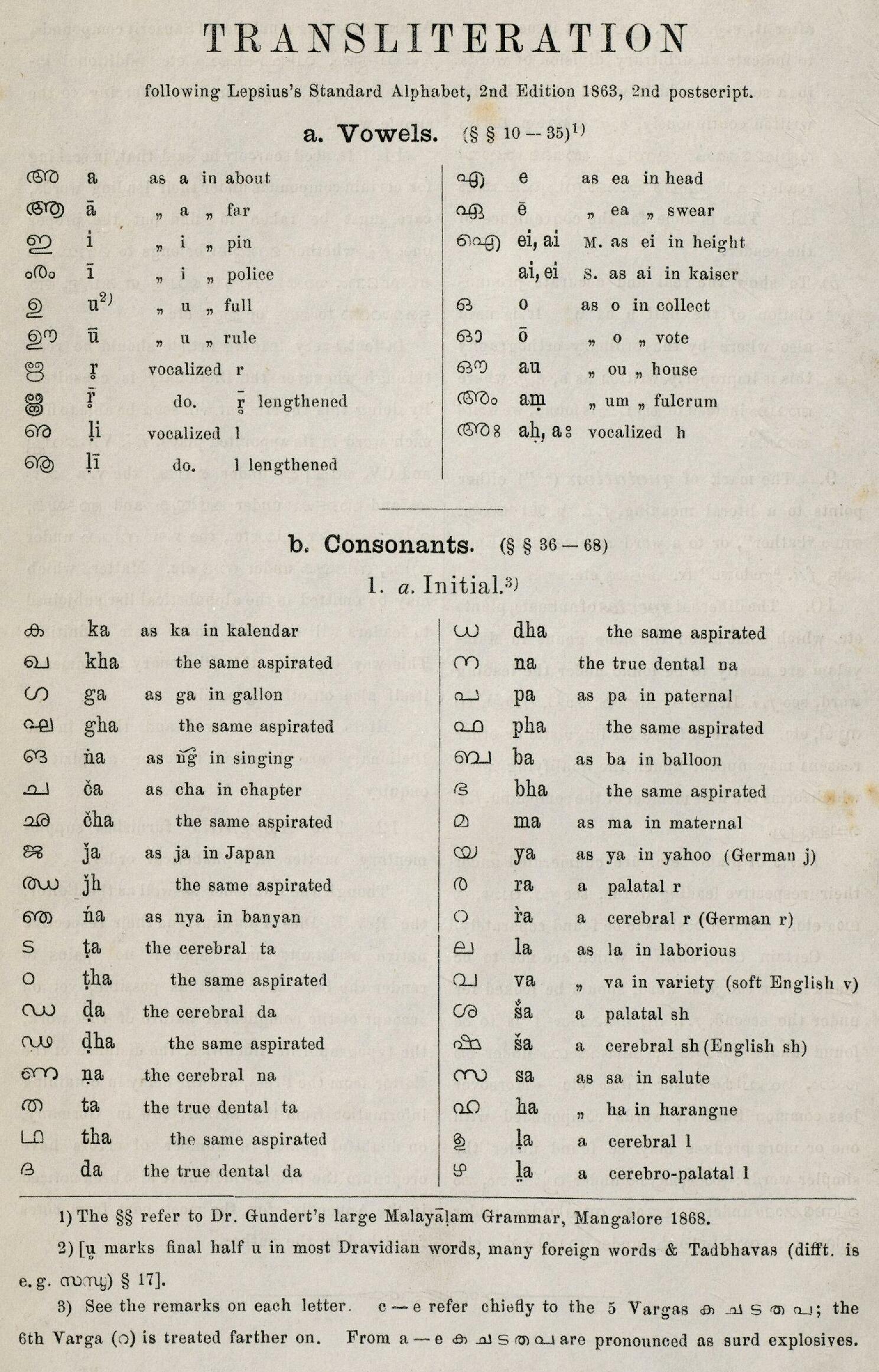
The script grew out of the Grantha alphabet, which was devised in the Tamil country to write Sanskrit, with older local systems called Vatteluttu and Kolezhuthu used alongside it for centuries. The modern alphabet has a large inventory of letters and, in its traditional form, a great many conjunct shapes where consonants stack together. In 1971 the Kerala government adopted a reformed set of letterforms, commonly called the new script, which unstacked many of those conjuncts so that the language could be handled by typewriters and mechanical typesetting. Traditionalists disliked the change, digital typography has since removed the technical reason for it, and both older and newer forms remain in circulation.
The earliest long literary work usually claimed for Malayalam is the Ramacharitam, a poem on the war chapter of the Ramayana, generally dated somewhere between the twelfth and fourteenth centuries; Tamil scholars have often claimed the same text, which tells you how close the two languages still were. From roughly the same period comes a distinctive courtly style called Manipravalam, literally gems and coral, which deliberately braided Sanskrit words and grammar into a Malayalam frame. A fourteenth century treatise written in Sanskrit, the Lilatilakam, set out the rules of that style and is the oldest surviving grammar of the language. The decisive turn towards a written form ordinary people could follow came in the sixteenth century with Thunchaththu Ezhuthachchan, conventionally called the father of modern Malayalam, whose retelling of the Ramayana in the parrot song form, the Adhyatmaramayanam Kilippattu, is still recited in Kerala homes during the month of Karkidakam. In the eighteenth century Kunchan Nambiar turned the same instincts to satire, writing verse for the solo dance form Ottanthullal that mocked landlords and priests in plain speech.
Print, prose and the modern standard
Printing changed the language quickly. Benjamin Bailey, a Church Missionary Society printer working at Kottayam in the 1820s, cut the first practical Malayalam metal type and produced Bible translations and dictionaries. Hermann Gundert, a German missionary of the Basel Mission based near Thalassery, launched what is generally regarded as the first Malayalam newspaper, Rajyasamacharam, in 1847, and published a Malayalam and English dictionary in 1872 that remains a scholarly reference. Secular prose followed. O. Chandu Menon's Indulekha, published in 1889, is usually called the first major Malayalam novel and is as much a commentary on caste, English education and matrilineal Nair households as it is a romance. C.V. Raman Pillai turned to historical fiction about the Travancore court in the same decade.
The twentieth century tied the language tightly to Kerala's social reform movements and to an unusually intense reading culture. Devotional and reform figures wrote in Malayalam for mass audiences, library networks spread through villages under a state supported library association, and literacy campaigns in the late 1980s and early 1990s pushed Kerala's literacy rate to the highest in India. Two Malayalam dailies, Malayala Manorama and Mathrubhumi, are among the largest circulation newspapers in the country, which is remarkable for a language with a relatively small speaker base. Kerala became a state on the first of November 1956 when the States Reorganisation Act redrew India's internal map along linguistic lines, joining Travancore, Cochin and the Malabar district of the old Madras Presidency.
Malayalam beyond Kerala
Since the oil boom of the 1970s, Malayalam has become one of the most widely heard South Asian languages in the Gulf. Large communities in the United Arab Emirates, Oman, Saudi Arabia, Qatar and Kuwait sustain Malayalam newspapers, radio stations and film distribution, and remittances from those workers have reshaped the Kerala economy, funding housing, education and small business at home. Older communities exist in Singapore and Malaysia, and newer ones in Britain, Ireland, the United States, Canada and Australia, built substantially on the migration of Kerala trained nurses. Australian census data has repeatedly listed Malayalam among the fastest growing languages spoken at home.
The Government of India granted Malayalam classical language status in 2013, a designation that carries research funding and considerable prestige. The everyday pressures are more mundane. English medium schooling is dominant among aspirational families, and a 2017 state law made Malayalam a compulsory school subject in Kerala in response. The language is in no danger of disappearing, but the balance between the language of the home, the language of the classroom and the language of work overseas is an argument that Kerala families have been having for two generations and are unlikely to settle soon.
References
- Encyclopaedia BritannicaMalayalam language
- Government of KeralaOfficial Portal of the Government of Kerala
- Ministry of Culture, Government of IndiaClassical Languages of India
- Office of the Registrar General and Census Commissioner, IndiaCensus of India: Language
- SOAS University of LondonSouth Asian Languages
This is a reference article, written from the sources above. It is background, not news reporting.