

Baisakhi: Harvest, Faith and New Beginnings
Reference library · 1051 words

Baisakhi, also written Vaisakhi, falls on 13 or 14 April and is three things at once: an agricultural festival marking the ripening of the winter wheat crop in Punjab, a solar new year observed under different names across much of India, and the anniversary of the single most consequential event in Sikh history. It is also, because of what happened at Amritsar in 1919, a date in the history of Indian nationalism. Very few festivals carry that much weight, and the layers do not always sit comfortably together.
The astronomical basis is the sun's entry into the sign of Mesha, conventionally Aries, which in the sidereal reckoning used by Indian calendars now occurs in mid April. Because this is a solar rather than a lunar event, the date barely moves from year to year, unlike Diwali or Holi. The same solar transition is the new year in a broad band of regional calendars: Puthandu in the Tamil country, Vishu in Kerala, Pohela Boishakh in Bengal, Bohag Bihu in Assam, Pana Sankranti in Odisha, and the new year in Nepal, Thailand, Myanmar, Cambodia, Laos and Sri Lanka, where the water throwing festivals of Songkran and Thingyan mark the same passage. Anyone who has wondered why Thai new year happens in April now has the answer.
In Punjab the immediate meaning is the harvest. The rabi crop, sown in autumn and dependent on winter rain and irrigation, is wheat, and by mid April it is standing ripe. Historically this was the point at which a year's labour turned into either security or debt, and the celebration reflects that: fairs, wrestling bouts, the vigorous drumming and dance forms bhangra and giddha, and the settling of accounts. Landlord dues, sharecropping settlements and moneylender repayments were traditionally reckoned around this time, which is why the festival carries a strong sense of a cycle closing and another opening.
1699 and the founding of the Khalsa
The Sikh significance dates from Baisakhi in 1699 at Anandpur Sahib, in the Shivalik foothills of Punjab. Guru Gobind Singh, the tenth Sikh Guru, is recorded as having called a large assembly and asked who among them was prepared to give his head. According to the traditional account, one man came forward and was taken into a tent; the Guru returned with a bloodied sword and repeated the demand, four more times. The five who had offered themselves emerged alive, dressed in new robes, and became the panj piare, the five beloved ones. The Guru administered to them an initiation using amrit, water sweetened with sugar crystals and stirred with a double edged sword while scripture was recited, and then, in a gesture whose radicalism is easy to underestimate, asked the five to initiate him in turn.
What was founded that day was the Khalsa, a body of initiated Sikhs bound by a code of conduct and by the five articles of faith: uncut hair, a comb, a steel bracelet, a specific undergarment and a small sword. Initiated men took the name Singh, meaning lion, and women the name Kaur, meaning princess, a step that cut across the caste surnames by which social rank was read. The Khalsa gave the Sikh community a defined membership, a discipline and a military capacity at a time of severe conflict with the Mughal state, and the institution remains the organising centre of Sikh religious life. Anandpur Sahib and Damdama Sahib at Talwandi Sabo both hold major Baisakhi gatherings, and initiation ceremonies are commonly held on this day.
The public form of the festival is the nagar kirtan, a procession through the streets in which the Guru Granth Sahib is carried on a decorated float, preceded by five initiated Sikhs representing the panj piare, accompanied by hymn singing and by displays of gatka, the Sikh martial art. Free food, langar, is served throughout, prepared and distributed by volunteers to anyone who comes, seated on the floor in rows without distinction of rank, which is itself a doctrinal statement.
Amritsar, 1919
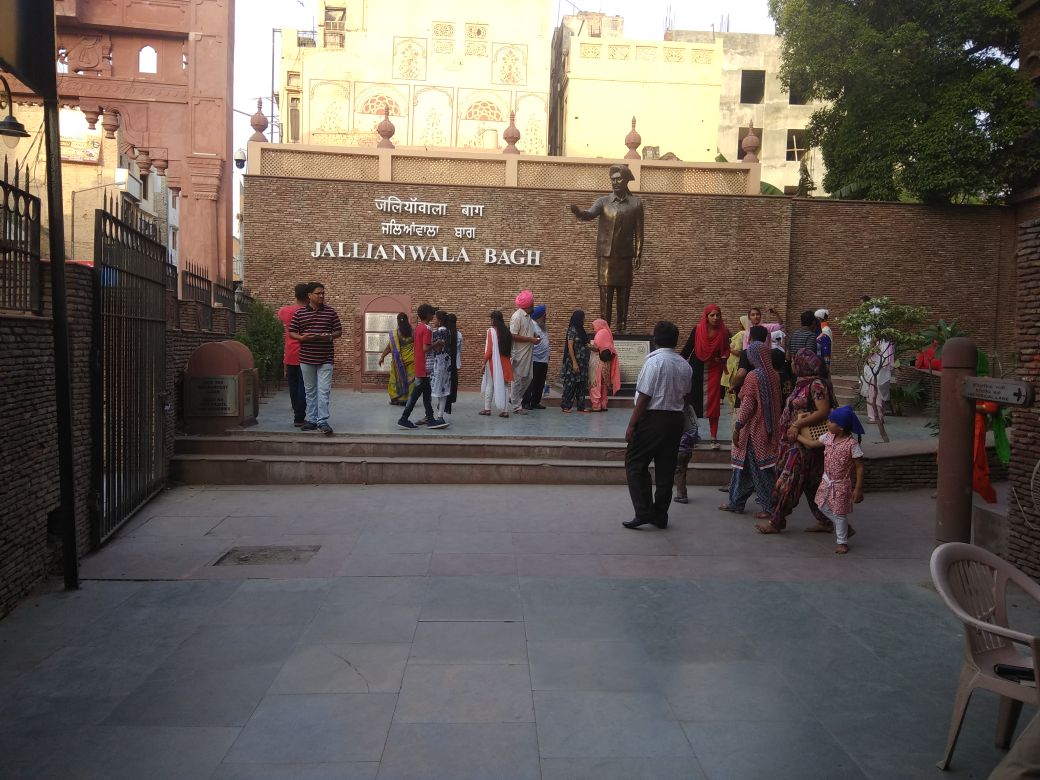
On 13 April 1919, a crowd gathered in Jallianwala Bagh, a walled enclosure near the Golden Temple in Amritsar. Some had come for Baisakhi, some for a political meeting protesting the Rowlatt Act, which extended wartime emergency powers into peacetime, and the arrest and deportation of local leaders. Public assembly had been prohibited by proclamation, though it is disputed how widely that proclamation had been circulated. Brigadier General Reginald Dyer arrived with troops, blocked the main entrance, and ordered firing without warning into the confined space. The shooting continued for around ten minutes until ammunition ran low.
The casualty figures have never been agreed. The official inquiry, the Hunter Committee, put the dead at 379 with roughly 1,200 wounded. The Indian National Congress conducted its own inquiry and concluded the toll was well over a thousand. Dyer was relieved of command but faced no criminal charge, and a public subscription raised in Britain for him was, for many Indians, more damaging than the massacre itself. The event moved a generation of moderates towards non cooperation and is conventionally treated as a turning point in the independence movement. British prime ministers have expressed regret at the site; no formal apology has been issued, and the question periodically returns to public debate.
Because Baisakhi carries this second meaning, Sikh commemorations in April frequently combine celebration with remembrance, and the political charge of the date has not faded. In the twentieth century the festival also became an occasion for political gatherings, and events at Anandpur Sahib in the 1970s and 1980s were closely tied to Punjab's political conflicts.
Abroad, Baisakhi is the largest annual public expression of Sikh presence. The nagar kirtan through Surrey in British Columbia draws crowds in the hundreds of thousands and is among the biggest Sikh gatherings outside India, with comparable events in Brampton, in Southall in west London, and in Melbourne, Sydney and Brisbane. In Australia and Canada these processions have become part of the municipal calendar, with local politicians attending and roads closed by arrangement. For families a few generations removed from the wheat fields of Doaba, the harvest meaning has receded and what remains is the founding of the Khalsa, the langar and the visible fact of a community occupying public space in a country its grandparents were once barred from entering.
References
- Encyclopaedia BritannicaBaisakhi
- BBC ReligionSikhism: Vaisakhi
- The National Archives, UKThe Amritsar Massacre
- Encyclopaedia BritannicaJallianwala Bagh Massacre
This is a reference article, written from the sources above. It is background, not news reporting.