

Bollywood's Global Diaspora Audience
Reference library · 970 words


For most of the twentieth century, Hindi cinema's foreign audience was an accident rather than a strategy. Films made for Indian towns found their way abroad through distributors nobody in Mumbai controlled, and became popular in places nobody had targeted. Raj Kapoor's Awaara, released in 1951, was an enormous success in the Soviet Union, where its tramp figure and its songs made Kapoor one of the most recognised foreign performers in the country. Hindi films circulated widely in West Africa, the Middle East, Central Asia, Fiji, Mauritius and the Caribbean, often subtitled poorly or not at all, carried by the fact that a musical melodrama is comprehensible without much dialogue. Almost none of this revenue reached the producers.
The Indian diaspora entered the picture through the same informal channels. In Britain, where South Asian settlement grew rapidly from the 1950s onward, Hindi films were screened in hired cinemas on Sunday mornings in Southall, Bradford and Leicester. From the late 1970s the video cassette transformed access: shops in Wembley or in Gulf labour camps rented tapes, most of them unlicensed, and a generation of diaspora children learned Hindi from them. Piracy was the distribution system, and although it earned the industry nothing directly, it built the audience that later became commercially valuable.
The moment the industry noticed
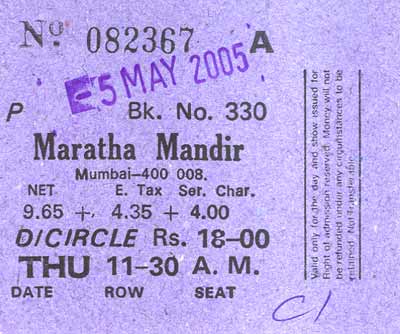
Two films in the mid 1990s changed the calculation. Hum Aapke Hain Koun, released in 1994, was a wedding film almost without a villain, and its extended ritual sequences played extraordinarily well with audiences abroad for whom the rituals were the point. Dilwale Dulhania Le Jayenge, released by Yash Raj Films in 1995, went further: it was about diaspora life. Its protagonists are young Indians raised in London, its central conflict is between a father's attachment to Punjab and his daughter's British upbringing, and its resolution insists that Indianness can be preserved outside India. It became the defining diaspora film and ran at the Maratha Mandir cinema in Mumbai for well over two decades, a record no other Indian film approaches.
The industry restructured around what followed. Overseas became a named theatrical territory with its own distributors and its own release strategy rather than an afterthought. Yash Raj Films and other studios established overseas distribution arms, prints were struck for simultaneous release in London, New York, Toronto, Dubai, Sydney and Melbourne, and Hindi films began appearing in the published weekly box office charts in Britain. The timing was helped by a domestic reform: in 1998 the Indian government formally accorded the film business industry status, which opened access to bank finance and insurance and pushed producers toward corporate accounting, exactly the discipline needed to manage international releases. Films of the following decade were made with the overseas audience visible in the script. Kabhi Khushi Kabhie Gham in 2001 and Kal Ho Naa Ho in 2003 placed Indian families in London and New York and treated migration itself as the emotional subject.
Locations followed the money. Yash Chopra's habit of setting song sequences in the Swiss Alps made Interlaken and the Jungfrau region a fixture of Indian tourist itineraries, and Swiss tourism bodies acknowledged the debt publicly. Australia entered the same trade deliberately: Salaam Namaste, released in 2005 and shot largely in Melbourne with support from the Victorian screen agency, was pitched as the first mainstream Hindi film made substantially in Australia, and Victoria followed it by establishing the Indian Film Festival of Melbourne, which has run annually since the early 2010s with state government backing. These arrangements are tourism and trade policy conducted through cinema, and the states that pursue them say so openly.
Streaming, and the end of Bollywood as shorthand
Two developments since the mid 2010s have reshaped the diaspora audience again. The first is streaming. Netflix and Amazon Prime Video both launched Indian services in 2016, commissioning original Indian series and licensing large film libraries, while Indian platforms and YouTube channels made older catalogues available globally with proper subtitling. For a diaspora viewer, the practical change was enormous: instead of waiting for a cinema release or a cassette, everything became available immediately, including regional-language material that had never travelled. Subtitles also opened Indian content to viewers with no family connection to India at all.
The second is the rise of southern cinema, which has quietly made the word Bollywood inadequate. The Telugu-language Baahubali films, released in 2015 and 2017, were dubbed into Hindi and several other languages and outperformed most Hindi productions across Indian and overseas markets. RRR, another Telugu film, released in 2022, achieved sustained international attention and won the Academy Award for Best Original Song in 2023 for Naatu Naatu. Tamil, Telugu, Malayalam and Kannada films now have their own substantial diaspora circuits, particularly in North America, the Gulf, Singapore, Malaysia and Australia, tied to the same regional migration chains that produce Telugu and Tamil associations in those countries. Overseas releases are frequently scheduled around specific community audiences rather than a generalised Indian one.
What the diaspora audience actually wants is a more contested question than the industry's confident marketing suggests. One view holds that overseas revenue pulled Hindi cinema toward glossy, affluent, sentimentally traditional family films that flattered migrant nostalgia while drifting away from Indian social reality. Another holds that the same audience, particularly its second generation, has proved willing to support unsentimental and formally ambitious work, and that streaming has rewarded exactly the films the theatrical overseas market would once have rejected. The evidence is mixed, and it varies sharply by destination country and by generation. What is not in dispute is the direction of causation over time. Indian cinema was once exported by accident; then it was made partly for export; and it is now made in the knowledge that a substantial part of its audience has never lived in India and may never do so.
References
- British Film InstituteIndian cinema at the BFI
- Encyclopaedia BritannicaBollywood
- Academy of Motion Picture Arts and SciencesOscars: awards database
- Indian Film Festival of MelbourneIFFM festival information
- Yash Raj FilmsYash Raj Films
This is a reference article, written from the sources above. It is background, not news reporting.