Community Feasting: Food as Shared Celebration
Reference library · 989 words
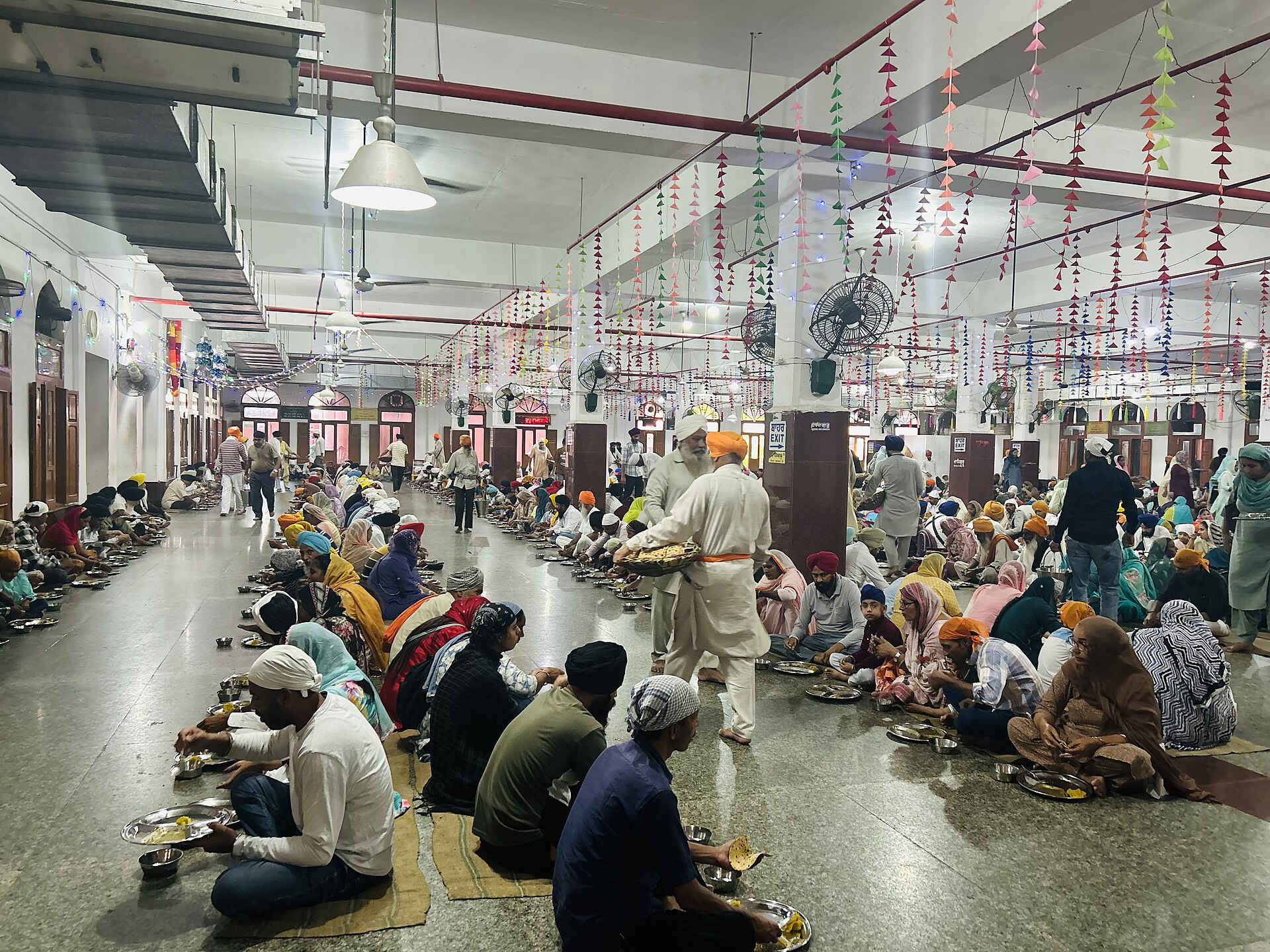

In much of the world, a feast is a meal for invited guests. Across large parts of India, the more characteristic form is different: a meal cooked in bulk by volunteers, served free to anyone who arrives, seated on the floor or on the ground in rows, with no distinction of payment and, at least in principle, none of rank. This institution appears under many names and in several religious traditions, and it is one of the most durable pieces of Indian social technology, exported intact to every country the diaspora has settled.
The langar and the theology of the shared row
The best documented example is the Sikh langar. Guru Nanak, the first of the Sikh gurus, born in 1469 in what is now Pakistan, established the practice of a free communal kitchen, and it was institutionalised by later gurus, notably Guru Amar Das, the third guru, who is recorded as requiring visitors to eat in the langar before meeting him. The point was doctrinal rather than charitable. In a society organised by rules about who may eat with whom and who may accept food from whom, requiring a Brahmin and a labourer to sit in the same row, called the pangat, and eat identical food from identical vessels was a direct attack on the ritual logic of caste.
The practice continues at every gurdwara worldwide. The kitchen at the Golden Temple, the Harmandir Sahib in Amritsar, serves free meals continuously and on a scale that runs to many tens of thousands of people a day, rising far higher on festival days, with the cooking, serving and dishwashing done substantially by volunteers performing seva, or selfless service. The food is vegetarian, which is a practical decision as much as a religious one: a vegetarian menu allows people of any dietary tradition to eat without inquiry. That single design choice is why the institution travels so well.
Sikh langar has become internationally visible in disaster relief. Volunteer organisations have run field kitchens after earthquakes, floods and hurricanes, and during the coronavirus pandemic gurdwaras in Britain, Canada, Australia and the United States distributed very large numbers of meals to people who had no connection to the faith. In Australia, gurdwara kitchens and Sikh volunteer groups have provided meals during bushfire and flood emergencies, and this has become one of the most publicly recognised contributions of the Indian origin community.
Other traditions of the mass meal
The Sikh version is the most systematic but not the only one. Hindu temples have long traditions of annadanam, the gift of food, and prasadam, food offered to a deity and then distributed. The temple at Tirumala in Andhra Pradesh distributes enormous quantities of its famous laddu prasadam and runs free meal services for pilgrims. The Jagannath temple at Puri in Odisha maintains what is often described as one of the largest traditional kitchens in the world, cooking in earthen pots stacked over wood fires, the food known as mahaprasad and sold and shared in the adjoining market in a manner that historically crossed caste lines within the temple precinct.
In Kerala, the sadya is a different model again: a formal vegetarian banquet of many dishes served on a banana leaf in a fixed order, associated above all with Onam, the harvest festival held in the Malayalam month of Chingam, usually falling in August or September. Onam sadya is served in homes, in temples, in workplaces and in community halls, and its detailed rules about which dish sits where on the leaf make it a piece of transmitted knowledge as much as a meal.
Muslim traditions in India contribute the iftar, the breaking of the Ramadan fast, which in cities such as Hyderabad, Lucknow, Delhi and Mumbai spills out of homes into streets and mosque courtyards, with dates, haleem and fruit distributed publicly and often across religious lines. Jain communities practise their own forms of collective dining with strict dietary rules. Sufi shrines, including the dargah of Moinuddin Chishti at Ajmer in Rajasthan, maintain large cooking cauldrons, the degs, from which food is distributed to pilgrims of all backgrounds.
What the practice does, and its limits
Mass feeding solves several problems at once, which is why it persists. It feeds the poor without the humiliation of a means test, because everyone in the row is receiving the same thing on the same terms. It converts surplus into status for donors, who fund a day of langar or sponsor a temple meal and receive religious merit rather than a plaque. It provides an occasion for physical labour by volunteers, which builds the social ties that keep a congregation functioning. And it feeds pilgrims, without whom major shrines could not sustain the crowds they attract.
It should not be romanticised into a claim that Indian society solved social exclusion by cooking. Caste practices around food remain real and are documented in contemporary surveys: significant proportions of Indian households still report restrictions on who may enter their kitchen or share their meal, and reports of discrimination in school midday meal programmes, where cooks of particular castes have been rejected by parents, appear regularly in the Indian press. The shared row is an aspiration enforced within the walls of the institution, not a description of the society outside it. Its power lies precisely in that contrast: the practice makes a visible, weekly, edible argument against the ordering it refuses.
For the diaspora, the institution has taken on an extra function. A gurdwara langar or a temple annadanam in Melbourne, Vancouver or Birmingham is where new arrivals find a first meal, a first contact, information about housing and work, and a room where their language is spoken. Governments in host countries have gradually come to understand these kitchens as genuine community infrastructure, capable of scaling from a Sunday congregation to an emergency relief operation within a day, staffed by people who have practised doing exactly that every week for years.
References
- Shiromani Gurdwara Parbandhak CommitteeSri Harmandir Sahib, Amritsar
- Shree Jagannatha Temple AdministrationMahaprasad and the temple kitchen, Puri
- Tirumala Tirupati DevasthanamsAnnaprasadam and free meal services
- Pew Research CenterReligion in India: Tolerance and Segregation
This is a reference article, written from the sources above. It is background, not news reporting.