
Diaspora Cuisine: Adapting Recipes Abroad
Reference library · 971 words
_(48146796502).jpg)
Every migrant cuisine is a record of what could be carried, what could be bought, and what had to be replaced. Indian food abroad is an unusually rich example, because Indian migration has happened in several distinct waves over nearly two centuries to places with radically different climates, agricultures and food regulations. The result is not one diaspora cuisine but many, some of which have drifted so far from any Indian regional original that they are now local dishes with an Indian ancestry rather than Indian dishes served overseas.
Substitution as the engine of change
The mechanics are simple and they operate everywhere. A cook needs an ingredient that is unavailable, expensive, seasonal or prohibited at the border, and finds the nearest local equivalent. Over a generation the substitute stops being a compromise and becomes the recipe. Fresh curry leaves, drumsticks, bitter gourd, fresh coconut, unripe green mango and specific varieties of rice and lentil were all difficult to obtain outside India for most of the twentieth century, and each absence pushed cooking in a particular direction.
Dairy illustrates the pattern well. Paneer, the fresh unaged cheese central to north Indian vegetarian cooking, can be made at home from any milk with acid and a cloth, so it travelled easily and became the default vegetarian protein in restaurant menus abroad even in regions of India where it is not traditional. Ghee, being clarified and shelf stable, travelled well too. Fresh curd, which in India is set daily from unpasteurised or lightly treated milk with a spoon of the previous day's culture, behaves differently with ultra pasteurised supermarket milk, which is why diaspora households frequently report that their curd will not set the way it did at home.
Meat is the sharper break. Halal and jhatka slaughter requirements, the availability or absence of goat, the abundance and cheapness of chicken breast in Western supermarkets against the Indian preference for bone in cuts, and the near total unavailability of certain freshwater fish all reshape a menu. Goat, the default meat of much Indian cooking, is a specialty item in Australia, Britain and North America, sold through halal butchers and Caribbean or Latin American shops, so lamb frequently stands in. Bengali cooking, built around freshwater fish such as hilsa and rohu, has adapted using frozen imports where import rules permit and local substitutes where they do not, and the difference is noticed and discussed at length in Bengali households abroad.
The famous hybrids
Some substitutions produced entirely new cuisines. Chicken tikka masala, a dish of tandoori chicken in a creamy tomato sauce, is a British creation of uncertain and disputed authorship, commonly attributed to South Asian restaurateurs in Britain, with a strong claim made for Glasgow. A British foreign secretary once described it as a national dish. Its ancestry is real, tandoori cooking and Punjabi butter gravies, but the dish as served is a British invention responding to British palates.
Indian Chinese cuisine, the style behind gobi manchurian, chilli chicken and schezwan fried rice, was created by the Chinese community of Kolkata, particularly around Tangra, whose ancestors arrived from the late eighteenth century onward. It uses Chinese technique and Indian heat and has now been re exported by Indian migrants to Australia, North America and the Gulf, where it appears on menus as a category of its own. Anglo Indian cooking, developed by a distinct community of mixed British and Indian descent, gave the world mulligatawny soup, from a Tamil phrase meaning pepper water, and country captain, and remains a living tradition in Kolkata and Chennai as well as in Anglo Indian families who resettled in Britain and Australia.
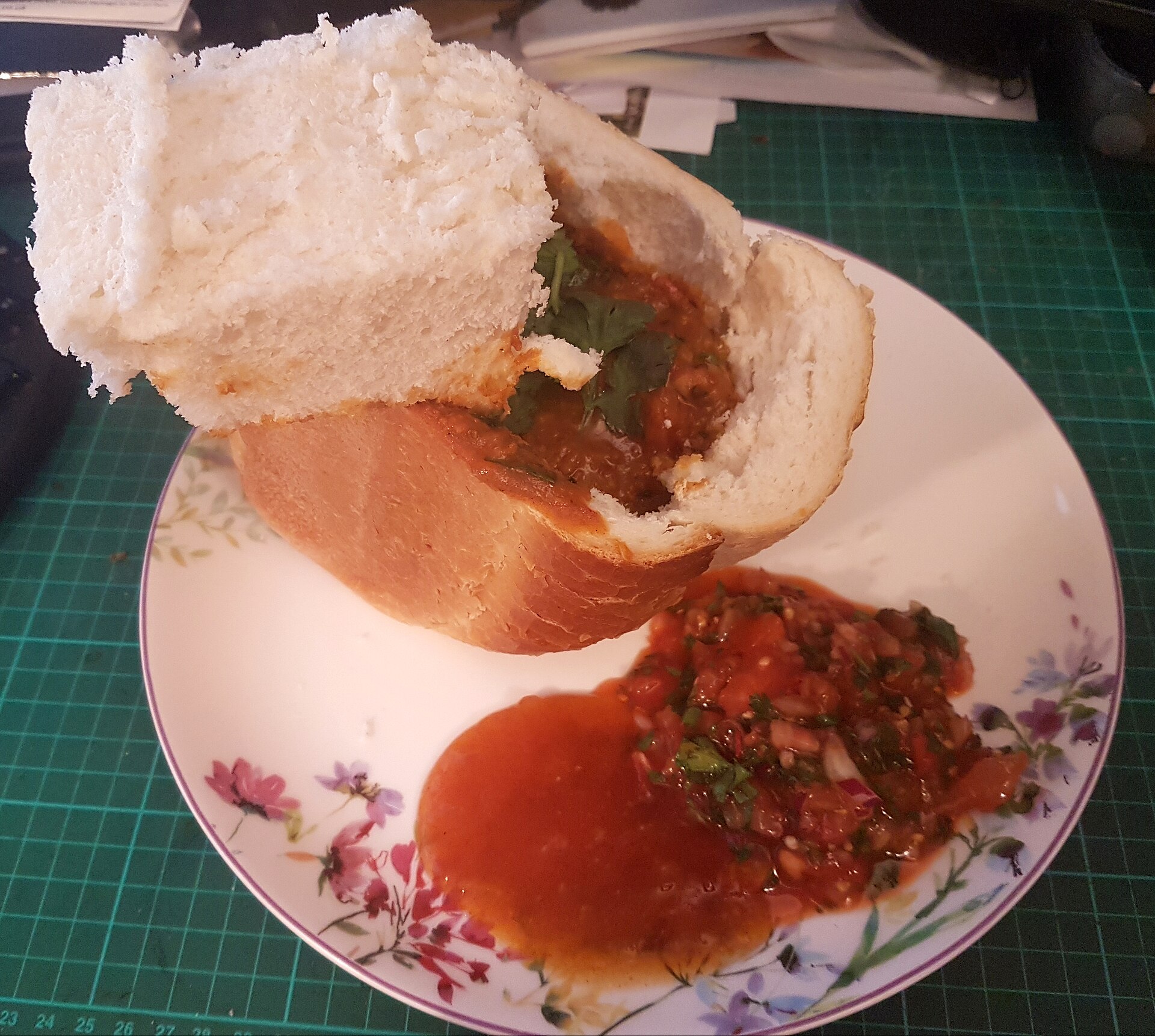
Older waves produced deeper hybrids still. Indian indentured labourers taken to the Caribbean, Fiji, Mauritius, South Africa and East Africa from the 1830s onward carried recipes that then evolved for a century and a half in isolation. Trinidadian doubles and roti, Guyanese curries, Durban's bunny chow, a hollowed loaf of bread filled with curry that emerged in South Africa's Indian community, and Fijian and Mauritian Indian cooking are all recognisably descended from Bhojpuri and Tamil village food but would be unfamiliar to a cook in Bihar today. Kenyan and Ugandan Indian cooking, carried onward to Britain after the expulsions of the early 1970s, added another layer.
The recent reversal
Something has changed in the past two decades. Global supply chains, larger diaspora populations and specialist retail have made the substitution problem far less binding. Indian grocery shops in Melbourne, Sydney, Toronto, London and the Gulf now stock fresh curry leaves flown in, several varieties of dal, regional pickles, idli batter, frozen paratha and the specific brands people grew up with. Curry leaf and moringa trees grow outdoors in Queensland and northern New South Wales and in glasshouses further south. Where an ingredient is barred at the border, and Australian biosecurity rules are among the strictest anywhere, home growing and local production have filled the gap.
The consequence is that diaspora cooking is becoming more regional rather than less. The generic north Indian restaurant menu of the 1980s, built for non Indian customers and constrained by supply, is being displaced by restaurants and home cooks doing specifically Keralan, Andhra, Chettinad, Gujarati, Bengali, Odia and Kashmiri food, cooked for people who know the difference. Video recipes from India, watched on a phone in another hemisphere, keep the transmission of technique alive in a way that letters and memory could not.
Both directions of drift now operate at once. Grandmothers' improvisations from the 1970s have become family canon and are defended fiercely by children who have since eaten the supposedly authentic original and preferred the adaptation. That is not a corruption of a cuisine. It is what a cuisine is: the accumulated record of what people cooked with what they could get, in the place they actually lived.
References
- Victoria and Albert MuseumFood and the South Asian diaspora in Britain
- National Archives (United Kingdom)Indian indentured labour records
- Department of Agriculture, Fisheries and Forestry, Australian GovernmentBiosecurity import conditions for food products
- Smithsonian InstitutionIndian American history and foodways
This is a reference article, written from the sources above. It is background, not news reporting.