Doordarshan and the History of Public Broadcasting
Reference library · 1026 words
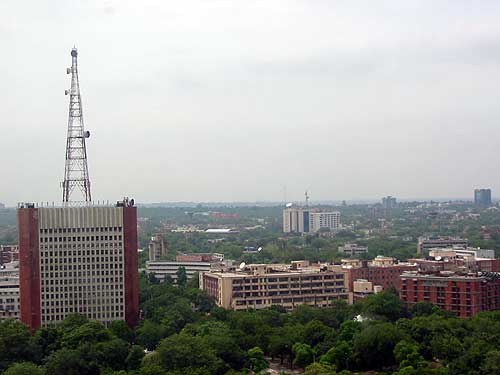

For about thirty years, if you watched television in India, you watched Doordarshan, because there was nothing else. That monopoly ended abruptly in the early 1990s and the network has been in relative decline ever since, but it remains the largest terrestrial broadcaster in the country and the only one obliged by statute to serve the whole population rather than the profitable parts of it. Its history is also, unavoidably, a history of the Indian state's relationship with information about itself.
Building a network before building an audience
Indian television began on 15 September 1959 as an experiment run from Akashvani Bhavan in Delhi, with equipment supplied by Philips and support from UNESCO, broadcasting twice a week to a few dozen community sets. The purpose was explicitly developmental rather than entertainment: programmes on health, civic duty and traffic sense. A daily news bulletin began in 1965, and Krishi Darshan, an agricultural programme aimed at farmers in villages around Delhi, started the following year and would run for decades.
The transformative episode came in the mid 1970s. The Satellite Instructional Television Experiment, conducted between August 1975 and July 1976, used an American satellite, ATS-6, lent to India for a year, to beam programmes directly to community receivers in roughly two thousand four hundred villages across six states. It was, at the time, the largest experiment of its kind anywhere. Its content covered agriculture, health, family planning and teacher training, and its real significance was that it convinced planners that satellite distribution could leapfrog the expense of building terrestrial transmitters everywhere.
Doordarshan was separated from All India Radio and constituted as a distinct service on 1 April 1976, in the middle of the Emergency, a period during which broadcasting was subject to direct censorship and which left a lasting suspicion about state control of the airwaves. A working group chaired by B. G. Verghese reported in 1978 recommending that broadcasting be placed under an independent trust; the recommendation was not acted on. Colour transmission arrived on 15 August 1982 in time for the Asian Games held in Delhi that year, and the national programme began around the same time. The combination of colour, a national feed and a rapid transmitter building programme took television from a metropolitan curiosity to a mass medium in a few years.
The serial years
The middle of the 1980s produced the programming that older Indians still measure television against. Hum Log, which ran from 1984, was India's first long running serial drama, built on a Mexican model of using entertainment to carry social messages, funded by sponsorship and closing each episode with an address to the audience from a well known actor. Buniyaad followed in 1986 with a family saga set against Partition. Alongside them came Malgudi Days, adapted from R. K. Narayan, the urban comedy Nukkad, the science programme Turning Point, the cultural magazine Surabhi, and film song compilations such as Chitrahaar that structured the weekly viewing habits of a generation.
The two mythological serials were a phenomenon of a different order. Ramanand Sagar's Ramayan ran from early 1987 into 1988, followed by B. R. Chopra's Mahabharat from 1988 to 1990. Contemporary reports of streets emptying on Sunday mornings, of viewers garlanding television sets and of shopkeepers closing early are well attested. Scholars have argued at length about the political consequences, with one influential line of analysis connecting the nationwide, simultaneous, devotional viewing of a Hindu epic on the state broadcaster to the political mobilisation around the Ayodhya dispute in the same years. That connection is asserted more often than it is demonstrated, and the causal claim remains contested, but the coincidence of timing is not in doubt and the serials undeniably changed what a shared national audience felt like.
Autonomy, competition and what remains
Two things happened almost at once at the start of the 1990s. The Gulf War of 1991 brought satellite news into Indian hotels and then, through enterprising local cable operators stringing wire between apartment blocks, into homes. STAR TV began transmitting into Asia the same year, and Zee TV launched in 1992 as the first Hindi language private satellite channel. Within a few years there were hundreds of channels, and Doordarshan's near total share of viewing in the cities collapsed. It had never had to compete for an audience and was poorly equipped to start.
The legislative response to the autonomy question finally arrived with the Prasar Bharati Act, passed in 1990 but not brought into force until September 1997, which converted Doordarshan and All India Radio into services of a statutory corporation with a board and a mandate to inform, educate and entertain in a balanced manner. Whether it delivered real independence is doubted by most observers. The corporation depends on government grants alongside advertising revenue, senior appointments involve the government, and the news output has been criticised under administrations of every party for closely tracking the official line. The Supreme Court's judgment in the 1995 cricket broadcasting case, which held that the airwaves are public property and that a government monopoly over broadcasting could not be justified, remains the strongest legal statement of the principle, and it was decided before Prasar Bharati was operational.
What Doordarshan retains is reach and obligation. It runs a national channel, a news channel, a farming channel launched in 2015, a sports channel, an international service and regional Kendras broadcasting in the major state languages, along with services in Urdu and in tribal languages. DD Free Dish, the free to air direct to home platform launched in the mid 2000s, requires no subscription beyond the cost of a dish and set top box and is estimated to serve tens of millions of households, disproportionately rural and low income; private broadcasters pay to place channels on it precisely because of that reach. Doordarshan also carries obligations that no commercial broadcaster does, including election related broadcasts and free airtime for recognised political parties, coverage of Parliament, and transmission during disasters when commercial signals fail. It is no longer the medium through which India sees itself. It is still the only one that is required to try.
References
- Prasar BharatiDoordarshan: About Us and History
- Ministry of Information and Broadcasting, Government of IndiaThe Prasar Bharati (Broadcasting Corporation of India) Act, 1990
- Indian Space Research OrganisationSatellite Instructional Television Experiment (SITE)
- Telecom Regulatory Authority of IndiaReports and Recommendations on Broadcasting and Cable Services
This is a reference article, written from the sources above. It is background, not news reporting.