
Festival Food: Sweets Made for Celebration
Reference library · 1039 words
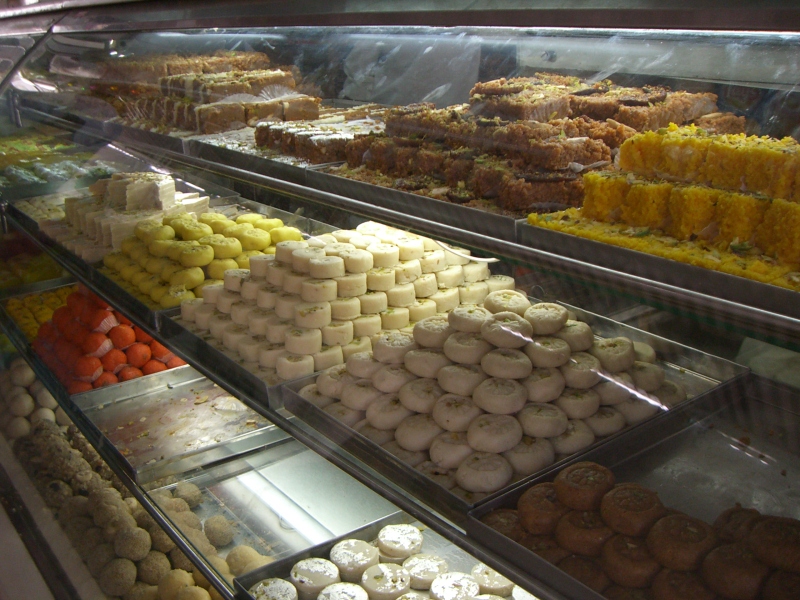

Indian sweets are not dessert. That single point of translation explains most of what confuses outsiders about them. A mithai is rarely the course that ends a meal; it is what you press into a visitor's hand at the door, what you distribute when a child passes an examination, what you take in a box to a colleague's house at Diwali, and, most importantly, what you offer to a deity and then eat because the deity has accepted it. The sweet is a medium of exchange between people and between people and gods. This is why sweets in India are made in vast quantity at particular moments in the calendar rather than in small elegant portions at the end of dinner, and why the professional sweet-maker, the halwai, occupies a distinct trade with its own equipment, its own vocabulary and its own seasonal rhythm.
The raw materials are narrower than the variety suggests. Almost all Indian sweets are built from some combination of six things: milk reduced by long boiling, sugar or jaggery, flour or ground pulse, ghee, nuts, and aromatics such as cardamom, saffron, rose and camphor. India has an old relationship with sugar; the English word derives, through Arabic and Greek, from the Sanskrit sharkara, and crystallised cane sugar was being produced in the subcontinent and exported westward in antiquity. Unrefined cane jaggery, gur, remains the preferred sweetener in many regional preparations, and in Bengal the winter tapping of date palms yields nolen gur, a seasonal jaggery with a distinct aroma that transforms the flavour of an entire month's sweets and cannot be replicated at any other time of year.
Two milk technologies, two halves of the country
The most important technical division in Indian sweet-making concerns what is done to milk. Across most of the north, west and south, milk is thickened by prolonged evaporation over heat into khoya or mawa, a dense solid that becomes the base for barfi, peda, gulab jamun and countless others. Deliberately splitting milk with acid was traditionally avoided, and older texts treat curdled milk as unsuitable for offering. In Bengal and Odisha the opposite convention prevails: milk is curdled with acid, the curds are drained and then kneaded into chhena, a soft fresh cheese that can be shaped, poached in syrup or cooked with sugar. From chhena come the entire Bengali and Odia repertoire, sandesh in dozens of forms, rasgulla, rasmalai, chomchom, chhena poda. Historians frequently connect the eastern acceptance of curdled milk to Portuguese settlement in Bengal from the sixteenth century, which introduced European cheese-making practice, though the evidence is suggestive rather than conclusive and Indian food historians disagree about how much was borrowed and how much was independently developed.
Ownership of the rasgulla became a genuine legal dispute. Odisha maintains that the sweet originated in the ritual life of the Jagannath temple at Puri, where it is offered to the goddess Lakshmi during Niladri Bije, the concluding rite of the annual chariot festival, and the state observes Rasagola Dibasa on that day. West Bengal maintains that the modern syrup-poached spongy version was developed in Kolkata's sweet shops in the nineteenth century. The Geographical Indications registry ultimately granted protection to both under distinct names, Banglar Rasogolla in 2017 and Odisha Rasagola in 2019, which is a reasonable outcome given that the two versions differ in colour, texture and preparation. It is also a good illustration of how seriously these traditions are held.
The festival calendar, written in sugar
Each major festival has its own sweets, and the association is usually functional rather than arbitrary. For Ganesh Chaturthi in Maharashtra the essential offering is the modak, a steamed rice-flour dumpling filled with fresh coconut and jaggery, made in quantity because it is the deity's favoured food. Makar Sankranti in mid-January, marking the sun's northward turn, brings sesame and jaggery preparations across the country, til gul in Maharashtra exchanged with the phrase asking the recipient to eat sweet and speak sweet, tilkut in Bihar, tilgul ladoo and chikki elsewhere; sesame and jaggery are warming foods, appropriate to the coldest weeks. The Tamil festival of Pongal, at the same moment, centres on chakkarai pongal, rice and lentils cooked with jaggery and ghee and allowed to boil over as a sign of abundance. Holi in the north brings gujiya, a fried pastry crescent filled with khoya and nuts, and malpua. Eid al-Fitr brings sheer khurma, vermicelli simmered in milk with dates, and in many households the day is known simply by the sweet. Onam in Kerala ends its banquet with payasam, and the version made with ripe plantain or with rice ada and jaggery is specific to the occasion. Teej in Rajasthan brings ghevar, a disc of lacy fried batter that is technically difficult and made only in the monsoon months.
Diwali is the largest of these by an enormous margin, and it is when the commercial sweet trade does a substantial share of its annual business. Households and companies distribute boxes of ladoo, kaju katli, barfi and dry fruit in numbers that strain supply chains for milk solids and ghee, which is precisely why food safety regulators run intensified inspection drives in the weeks before, targeting adulterated khoya and synthetic colouring. The pressure of that season has also driven a visible shift over the last two decades toward packaged chocolates and dry fruit assortments as gifts, partly for shelf life and partly because they read as premium.
Finally there is the temple category, where the sweet is inseparable from the sanctity of the place that makes it. The laddu distributed at Tirumala in Andhra Pradesh is prepared in the temple's own kitchen under a controlled recipe and holds a Geographical Indication in the name of the temple administration, which is unusual for a cooked food. At Puri the Mahaprasad is cooked in earthen pots over wood fire inside the temple and sold in the adjacent Ananda Bazar. In gurdwaras, karah prasad, made from equal measures of wholemeal flour, ghee and sugar, is served to every person present without distinction, which is the point of it. In each case the sweetness is the least interesting thing about the sweet.
References
- Geographical Indications Registry, Government of IndiaRegistered Geographical Indications for food products
- Food Safety and Standards Authority of IndiaStandards for milk and milk products
- Victoria and Albert MuseumFood and festivals in South Asia
- Tirumala Tirupati DevasthanamsSrivari Laddu prasadam
This is a reference article, written from the sources above. It is background, not news reporting.