
Holi: Colour, Spring and Renewal
Reference library · 1047 words
.jpg)
Holi is the festival most likely to be recognised by people who know nothing else about India, because of one image: crowds throwing coloured powder at each other in bright sunlight. That image is accurate and also incomplete. Holi is a two part festival with a fire on the first night and colour on the second day, it marks a specific point in the agricultural and lunar year, and the throwing of colour carries a social meaning that the photographs cannot convey. For a single day the ordinary rules governing who may touch whom, who may address whom familiarly and who must show deference are suspended. That inversion, not the pigment, is the substance of the festival.
The timing is fixed by the moon. Holi falls on the full moon, purnima, of the month of Phalguna, which places it in late February or March in the Gregorian calendar. In the agricultural year of northern India this is the point at which the winter rabi crop, principally wheat, barley, mustard and gram, is ripening or being harvested, and the older layers of the festival involve offering new grain to the fire. Winter has ended and the punishing heat has not yet begun. The festival is therefore a spring festival in the plainest sense, and its association with fertility, mischief and licence follows the pattern of spring festivals in many agrarian societies.
The fire and the story
The night before the colour is Holika Dahan, the burning of Holika. Communities build a pyre in a crossroads or an open ground over the preceding days, often with a pole at its centre, and light it after moonrise. People circle the fire, throw in grain and coconut, and carry embers home. The associated story comes from the Puranas and concerns Prahlada, the devoted son of the demon king Hiranyakashipu, who had obtained a boon making him nearly impossible to kill and demanded worship as a god. Enraged by his son devotion to Vishnu, the king enlisted his sister Holika, who was protected from fire, to sit in a blaze holding the boy. Holika burned and Prahlada was unharmed. The narrative resolves shortly afterwards with Vishnu appearing as Narasimha, the man lion, to kill the king in a manner that circumvents every clause of his boon. The bonfire commemorates the burning of Holika and, in the standard reading, the destruction of arrogance.
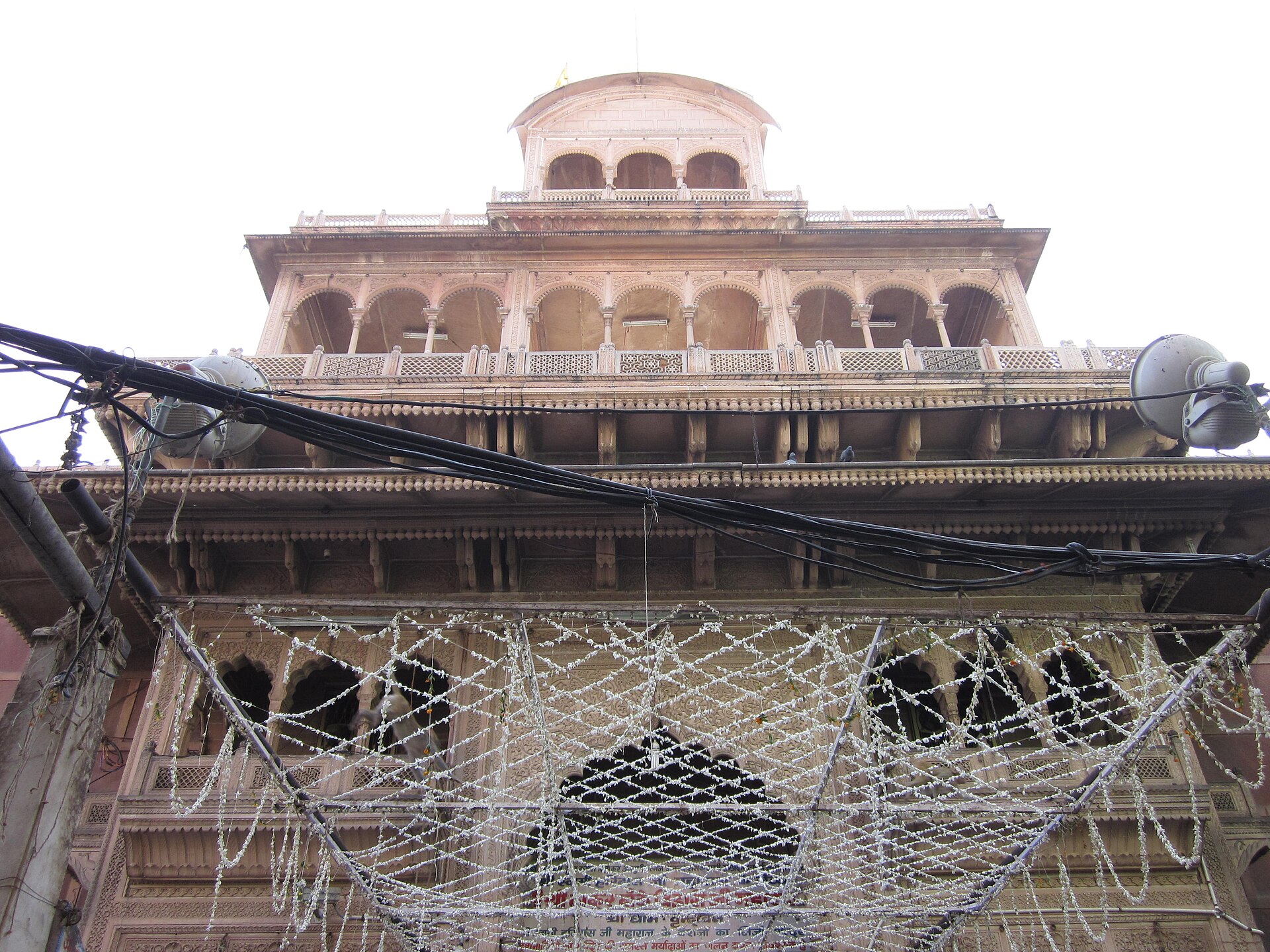
The second story belongs to the colour rather than the fire, and to a specific landscape. In the Braj region around Mathura and Vrindavan in Uttar Pradesh, Holi is Krishna festival. The tradition holds that Krishna, dark skinned, complained to his mother about the fair complexion of Radha, and was told to colour her face however he liked. The Braj celebrations run for well over a week and are the most elaborate anywhere. At Barsana, said to be Radha village, the women of Barsana drive off men from Nandgaon, Krishna village, with long staves in a ritualised encounter called Lathmar Holi, while the men defend themselves with shields. At the Banke Bihari temple in Vrindavan, priests throw flowers rather than powder in a celebration known as Phoolon wali Holi.
Regional versions
What is called Holi in Delhi is called something else, and done differently, elsewhere. In West Bengal and Odisha it is Dol Jatra or Dol Purnima, in which images of Krishna and Radha are carried in a swing in procession, a form associated with the sixteenth century Vaishnava saint Chaitanya Mahaprabhu, whose birth anniversary falls at the same time. Rabindranath Tagore instituted a stylised version, Basanta Utsav, at Santiniketan, with students in yellow performing songs and dances, and it remains a fixture there. In Goa the spring festival is Shigmo, with parades and folk performance. In Manipur it merges with the Yaosang festival and includes the local dance form thabal chongba.
For Sikhs, the day after Holi is Hola Mohalla at Anandpur Sahib in Punjab, an event established by Guru Gobind Singh, the tenth Guru, at the beginning of the eighteenth century as a martial gathering rather than a festival of play. The Nihang orders display horsemanship, swordsmanship and mock combat, and the multi day assembly serves communal food on an enormous scale. The deliberate contrast with Holi revelry was the point: a festival of discipline set against a festival of licence.
Abroad, Holi travelled with indenture. It is celebrated as Phagwah in Trinidad and Tobago, Guyana and Suriname, where it is a public holiday and where the singing of chowtal, a call and response form carried from the Bhojpuri districts in the nineteenth century, survives more robustly in some communities than in the villages of origin. Fiji, Mauritius and South Africa have their own versions. In Britain, Australia, Canada and the United States, Holi events now draw large crowds well beyond the Indian community, and the commercial colour run, a five kilometre fun run with powder thrown at intervals, is an unacknowledged and entirely secular descendant.
Pleasures and problems
Food and drink are integral. Gujiya, a sweet pastry filled with khoya and dried fruit, is the emblematic Holi sweet across the north. Thandai, a cold spiced milk drink with almonds, fennel and pepper, is the other, and in many places it is prepared with bhang, an edible preparation of cannabis whose use is traditionally sanctioned on this day and is regulated rather than prohibited in several states. Traditional colours were made from flowers, principally the orange red blossom of the flame of the forest tree, and from turmeric, sandalwood and dried herbs.
Modern practice raises genuine objections that Indians themselves debate every year. Cheap synthetic powders have contained industrial dyes, metallic salts and glass particles, causing skin and eye injury, and campaigns for natural colours are now widespread. Water play consumes large quantities in a season when many towns are already rationing. The phrase bura na mano, Holi hai, meaning do not take offence, it is Holi, has been used to excuse harassment of women and of unwilling passers by, and the licence that gives the festival its social meaning is precisely what makes that abuse possible. The honest account of Holi holds both things together: a genuinely joyful suspension of hierarchy, and an annual argument about where suspension becomes assault.
References
- Encyclopaedia BritannicaHoli, Hindu festival
- BBCReligions: Hinduism, Holi
- Ministry of Culture, Government of IndiaFestivals and cultural heritage
- Victoria and Albert MuseumSouth Asian art and festival collections
- Uttar Pradesh TourismBraj region and Holi in Mathura and Vrindavan
This is a reference article, written from the sources above. It is background, not news reporting.