


India's Renewable Energy Ambitions
Reference library · 1096 words

India occupies an awkward and important position in the world's energy transition. It is the most populous country on earth and among the largest emitters in absolute terms, yet its emissions per person remain far below those of the United States, Australia or the European Union, and hundreds of millions of its citizens use very little energy by rich country standards. Indian negotiators have made that arithmetic the foundation of their diplomatic position for three decades. The practical result has been a strategy of building renewable capacity at speed while continuing to burn a great deal of coal.
The targets and where they came from
The modern push dates to 2015, when the government raised its solar target dramatically and set a goal of one hundred and seventy five gigawatts of renewable capacity by 2022. That target was missed, though the build out it triggered was still enormous by any international comparison. At the Glasgow climate conference in November 2021, Prime Minister Narendra Modi announced a broader set of commitments: five hundred gigawatts of non fossil electricity generating capacity by 2030, half of installed capacity from non fossil sources by the same date, a substantial reduction in the emissions intensity of the economy, and net zero emissions by 2070. The 2070 date sits later than the mid century pledges of most wealthy countries, which India defends on the grounds that its development is decades behind theirs.
India announced in 2025 that non fossil sources had passed half of its installed generating capacity. That milestone needs a careful reading, because installed capacity is not generation. A solar farm produces power for a fraction of the day and a wind farm depends on season; a coal plant can run around the clock. Coal accordingly still supplies the majority of electricity actually generated in India, considerably more than its share of capacity would suggest, and closing that gap is a much harder engineering problem than adding panels.
The economics nonetheless changed decisively. In the early 2010s, solar power procured through Indian auctions cost well over ten rupees per unit and required heavy subsidy. Competitive reverse auctions run by central agencies, combined with the global collapse in module prices, drove winning tariffs below three rupees by the late 2010s and to record lows around two rupees in auctions held in 2020 and 2021. At those prices, new solar generation is cheaper than new coal generation in India, which removes the need for the moral argument entirely: utilities buy it because it is the cheap option.
The physical build and its constraints
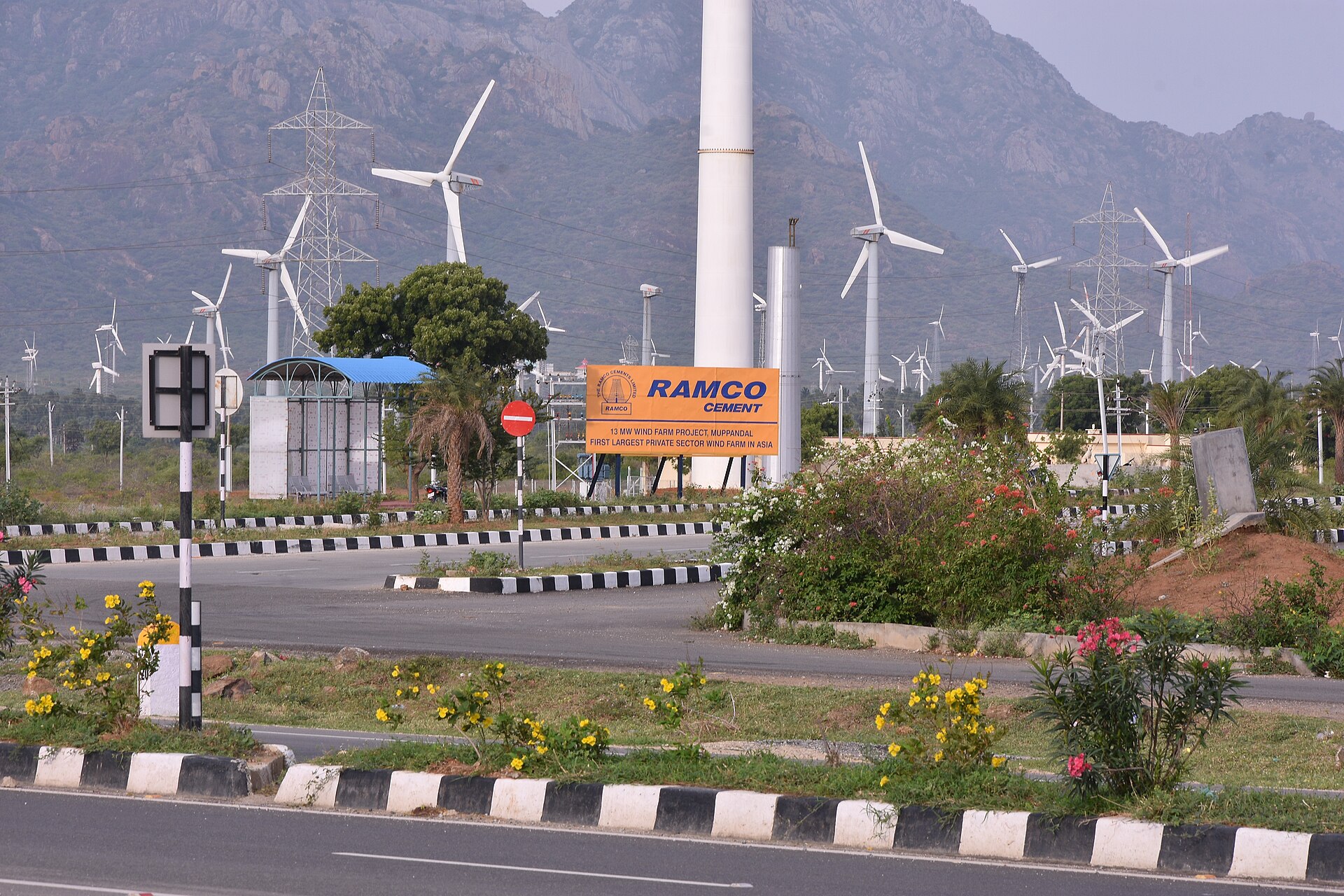
Scale is visible on the ground. The Bhadla Solar Park in the Jodhpur district of Rajasthan, spread across an expanse of desert where summer temperatures make almost nothing else viable, is one of the largest solar installations in the world at well over two thousand megawatts. The Pavagada park in Karnataka took a different approach, leasing land from hundreds of individual farmers on long term rents rather than acquiring it, which turned drought prone holdings into a source of steady income and has been widely studied as a fairer model. Wind capacity is concentrated in Tamil Nadu, notably around the Muppandal corridor where the Palghat gap funnels monsoon winds, and in Gujarat, Karnataka and Maharashtra.
The binding constraints now lie in the grid rather than in generation. Solar output peaks in the middle of the day while Indian demand peaks in the evening, which creates a mismatch that gets worse as solar share rises. Transmission has to move power from the sunny and windy west and south to the demand centres of the north and east, requiring high capacity corridors that take years to build and cross multiple states. And the finances of the electricity distribution companies, almost all owned by state governments, remain the sector's chronic weakness. They sell power below cost to farmers and households for political reasons, accumulate losses, and delay payments to generators, which raises the cost of capital for every new project. Successive central rescue packages, including a debt restructuring scheme in 2015 and a reforms linked programme from 2021, have improved matters unevenly rather than solved them.
Storage is the response, and India has begun procuring battery capacity through tenders supported by viability gap funding, alongside pumped hydro projects. Whether enough storage can be built at the pace required is genuinely uncertain, and it is the single largest question mark over the 2030 targets.
Manufacturing, hydrogen and the trade offs
A parallel objective is to make the equipment rather than import it. India's solar build was constructed largely with Chinese cells and modules, which policymakers regard as a strategic vulnerability comparable to oil imports. The response combined production incentives for domestic module manufacturing with an approved list of models and manufacturers that restricts which suppliers can be used in government supported projects. Module assembly capacity in India has grown substantially as a result. The upstream stages, cells, wafers and polysilicon, remain far more concentrated abroad, and building them requires capital and cheap power at a scale that is only now being attempted. The policy has a cost: restricting supply raised module prices in India and slowed some deployment, a genuine trade off between industrial policy and speed of decarbonisation.
Green hydrogen is the newest bet. The National Green Hydrogen Mission, approved in January 2023 with a large budget, aims to make India a producer and exporter of hydrogen made by splitting water using renewable electricity, with a target of several million tonnes of annual production capacity by 2030. The logic is that India's cheap solar power could make it competitive in a fuel needed for steel, fertiliser and refining, where direct electrification is difficult. The technology and the market are both immature, and cautious observers note that hydrogen targets have been announced enthusiastically in many countries and met in very few.
Two further tensions deserve mention. Large renewable projects consume land, and even where that land looks empty it is frequently used for grazing by pastoral communities whose rights are informal and easily overlooked. And conservation can conflict with construction: litigation over transmission lines through the habitat of the critically endangered Great Indian Bustard in Rajasthan and Gujarat led the Supreme Court to order lines underground in 2021, an order later modified after the practical difficulties became clear. At the household end, the rooftop programme launched in 2024 offering subsidised solar to a target of ten million homes shifts some of this from the desert to the roof, which avoids the land question entirely but raises its own problems of financing and metering.
References
- Government of India, Ministry of New and Renewable EnergyMinistry of New and Renewable Energy
- International Energy AgencyIndia energy analysis
- Government of India, Central Electricity AuthorityInstalled capacity and generation reports
- United Nations Framework Convention on Climate ChangeIndia Nationally Determined Contribution
- ReutersIndia energy and climate coverage
This is a reference article, written from the sources above. It is background, not news reporting.