
India's Republic: Constitution in Plain Terms
Reference library · 1099 words

India's Constitution came into force on the twenty sixth of January 1950 and is the longest written constitution of any sovereign country. It began with three hundred and ninety five articles and eight schedules and now runs to well over four hundred articles and twelve schedules after more than a hundred amendments. Its length is not decoration. Because it created a federation out of provinces and several hundred princely states, defined the powers of an administrative machine inherited from colonial rule, and set out rules for elections, languages, minority protections, public service commissions and emergency powers all in the same document, it had to say in text what older constitutions leave to convention. The result is a document that reads more like an operating manual than a declaration.
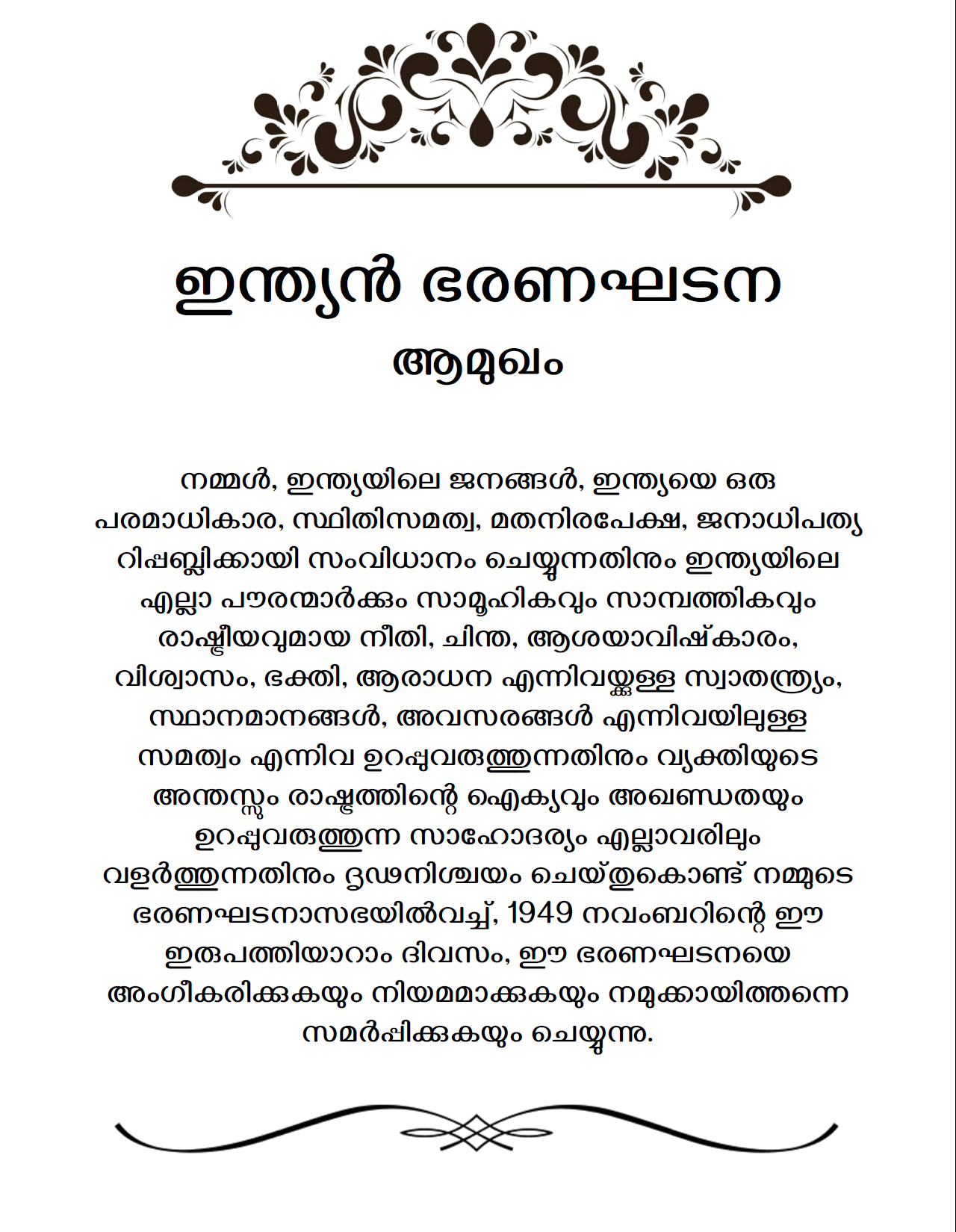
The Preamble declares India to be a sovereign socialist secular democratic republic and states the aims of justice, liberty, equality and fraternity. The words socialist and secular were not in the original text; they were added by the Forty second Amendment in 1976, during the Emergency. Article 1 describes India as a Union of States rather than a federation, wording chosen deliberately to signal that the states did not form the union by agreement and have no right to leave it.
Who exercises power
The system is parliamentary rather than presidential. The President is head of state, elected for five years by an electoral college of members of Parliament and of the state legislative assemblies, with votes weighted by population so that a legislator from Uttar Pradesh carries more weight than one from Sikkim. The President acts on the advice of the Council of Ministers headed by the Prime Minister, who must command a majority in the Lok Sabha, the directly elected lower house of Parliament. The Lok Sabha currently has five hundred and forty three members returned from single member constituencies by first past the post. The Rajya Sabha, the upper house, represents the states and is elected indirectly by state legislators, with a small number of members nominated for distinction in the arts and sciences. Money bills can originate only in the Lok Sabha, and the government is answerable to it alone.
Power is divided between the Union and the states by three lists in the Seventh Schedule. The Union List covers defence, foreign affairs, currency, railways and banking. The State List covers police, public health, agriculture and land. The Concurrent List, on which both may legislate with union law prevailing in conflict, covers education, criminal law, forests and marriage. Residuary powers belong to the Union, the opposite of the American arrangement, reflecting the drafters' anxiety about fragmentation after Partition. Each state has a Governor appointed by the President on the advice of the union government, which generates friction whenever the party in Delhi differs from the party in the state capital. Article 356 allows the union to dismiss a state government and rule directly, a power used well over a hundred times, often for nakedly partisan reasons, until the Supreme Court in 1994 held that its use is subject to judicial review and that a government's majority must be tested on the floor of the assembly rather than judged by the Governor.
Rights, amendment and the limits of Parliament
Part Three sets out fundamental rights: equality before the law and prohibition of discrimination, freedom of speech, assembly, association, movement and profession subject to reasonable restrictions, freedom of religion, cultural and educational rights of minorities, protection against arbitrary arrest, and the abolition of untouchability. Crucially, Article 32 gives any person the right to move the Supreme Court directly for enforcement of these rights, and the court may issue writs; the High Courts have a wider equivalent power under Article 226. Ambedkar called Article 32 the heart and soul of the Constitution, because a right without a remedy is a slogan. From the late 1970s the Supreme Court expanded this dramatically through public interest litigation, relaxing the requirement that a petitioner be personally affected, and reading rights to livelihood, education, a clean environment and privacy into the guarantee of life and personal liberty in Article 21.
Part Four contains the Directive Principles of State Policy, which are explicitly not enforceable in court: a living wage, equal pay, free education for children, public health, village panchayats, and a uniform civil code. They were meant as instructions to future legislatures rather than promises to citizens, and several have since become enforceable rights by amendment or judicial interpretation.
The amendment procedure in Article 368 is deliberately not very difficult. Most provisions can be amended by a majority of the total membership of each house and two thirds of those present and voting. Provisions touching the federal structure additionally require ratification by the legislatures of half the states. There is no referendum. This flexibility produced the central constitutional conflict of independent India: if Parliament can amend anything, can it amend away the rights the Constitution guarantees?
The answer came in 1973 in a case brought by the head of a monastery in Kerala challenging land reform laws. A bench of thirteen judges of the Supreme Court, the largest ever assembled, held by seven votes to six that Parliament may amend any part of the Constitution but may not damage or destroy its basic structure. The judges produced no exhaustive list of what that structure contains, but it is generally understood to include the supremacy of the Constitution, the democratic form of government, secularism, separation of powers, federalism, judicial review and free and fair elections. The doctrine has no textual basis and has been criticised as judicial invention. It was also the instrument that struck down an amendment placing the Prime Minister's election beyond challenge in 1975.
The Emergency of 1975 to 1977 remains the constitutional system's worst failure and the source of its most useful repairs. Declared on the ground of internal disturbance, it permitted mass detention without trial and suspended enforcement of fundamental rights. The Forty fourth Amendment of 1978 replaced internal disturbance with armed rebellion as a ground, required written cabinet advice before a proclamation, imposed parliamentary approval requirements, and made the rights to life and personal liberty non suspendable even in emergency. Other significant changes have devolved power to elected village and municipal bodies, made education a fundamental right for children, and created a national goods and services tax with a joint union and state council. The document remains under active argument, over the meaning of secularism, the case for a uniform civil code, the role of Governors and the balance of the federation, which is roughly what its drafters expected.
References
- Legislative Department, Government of IndiaThe Constitution of India
- Supreme Court of IndiaSupreme Court of India
- Parliament of IndiaLok Sabha
- Election Commission of IndiaElection Commission of India
- Encyclopaedia BritannicaIndia: Constitutional framework
This is a reference article, written from the sources above. It is background, not news reporting.