Indian Britain: A Century of Settlement
Reference library · 988 words

People from the subcontinent have been living in Britain for far longer than the standard story of post war migration allows. East India Company ships were crewed in large part by South Asian sailors, known as lascars, who were paid less than European seamen and frequently stranded in London and Liverpool between voyages, sufficiently often that a charitable home for destitute lascars operated in the East End in the nineteenth century. Indian nursemaids, called ayahs, travelled with returning British families and were sometimes abandoned on arrival; an Ayahs Home in Hackney existed to house them. These were not settlers in the modern sense, but they establish that the presence is two centuries deep rather than seventy years.
Individual figures cut through earlier still. Sake Dean Mahomed, born in Patna in 1759, published the first book in English written by an Indian, opened the Hindoostane Coffee House in London in 1810 (an early Indian restaurant that failed commercially), and then made a successful career in Brighton offering therapeutic vapour baths and massage, a practice he called shampooing, eventually serving as a bath attendant to George IV. Political representation came later. Dadabhai Naoroji, the Parsi economist whose drain of wealth argument shaped Indian nationalist economics, was elected Liberal member for Finsbury Central in 1892, becoming the first Indian in the House of Commons. Mancherjee Bhownagree followed for the Conservatives in 1895, and Shapurji Saklatvala, a communist, was elected for Battersea North in 1922.
The post war settlement
Mass migration was pulled by labour shortage and enabled by law. The British Nationality Act of 1948 confirmed that citizens of the Commonwealth and colonies were British subjects with the right to enter and settle, and Britain rebuilding after the war needed workers for foundries, textile mills, public transport and the newly created National Health Service. Recruitment was often informal, running through networks of village and kin: one man arrived, found work, and wrote home. The result was a strikingly concentrated geography. Punjabi Sikhs settled around Southall in west London and in Wolverhampton and Coventry, close to foundry and vehicle work. Gujaratis went to north west London and Leicester. Mill towns in Yorkshire and Lancashire drew workers from Punjab, from Mirpur in Pakistan administered Kashmir and from Sylhet in what became Bangladesh.
The most significant single arrival was not from India at all. Indian communities in East Africa, themselves descended from indentured and free migrants who had built the Uganda Railway and then established themselves in trade and administration, were expelled by Idi Amin from Uganda in 1972, given ninety days to leave. Around twenty seven thousand came to Britain, most holding British passports, and many settled in Leicester despite that city council having placed advertisements in Ugandan newspapers discouraging them. Within a generation these twice migrants, arriving with commercial experience and often with capital destroyed but skills intact, had transformed the retail economy of several English cities. Belgrave Road in Leicester and Ealing Road in Wembley are the visible result.
Restriction and resistance
The open door closed steadily. The Commonwealth Immigrants Act of 1962 introduced employment vouchers, the 1968 Act was rushed through specifically to restrict the entry of East African Asians holding British passports, and the Immigration Act of 1971 replaced the remaining rights with a system of work permits and the concept of patriality, which in practice favoured those with British born grandparents. Enoch Powell delivered his Rivers of Blood speech in Birmingham in April 1968; the political climate it expressed shaped the following decades.
Racist violence was a routine condition of life in the 1970s, and the response shaped a distinct British Asian politics. Asian Youth Movements formed in Southall, Bradford and elsewhere. The Grunwick dispute of 1976 to 1978, a strike at a film processing plant in Willesden over union recognition and working conditions, was led largely by East African Asian women and became a national trade union cause, with mass pickets and, ultimately, defeat for the strikers. In April 1979 an Anti Nazi League counter demonstration against a National Front meeting in Southall ended with the death of the teacher Blair Peach, and an inquiry conducted at the time concluded he was most likely killed by a police officer, though nobody was ever charged.
The shape of the community now
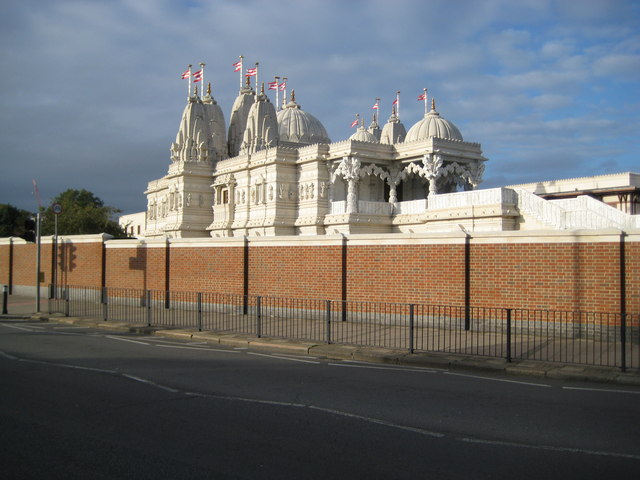
The Indian origin population of England and Wales is, by the 2021 Census, the largest single ethnic minority group in the country, and it is not one community but many, divided by religion, region and class in ways that outsiders regularly miss. Gujarati Hindus, Punjabi Sikhs, Goan Catholics, Tamils, Malayali nurses recruited to the NHS from the 1990s, and more recently highly qualified professionals arriving on skilled work visas from Hyderabad and Bengaluru have quite different histories. Places of worship register the difference: the BAPS Shri Swaminarayan Mandir in Neasden, opened in 1995 and built from Bulgarian limestone and Italian marble carved in India and assembled in London, sits a few miles from gurdwaras that grew out of converted terraced houses in the 1960s.
Two persistent misconceptions are worth correcting. The British curry house, often taken as the emblem of Indian Britain, is predominantly a Bangladeshi and specifically Sylheti enterprise, a fact with its own long migration history. And the community is not economically uniform: aggregate figures showing Indian origin households with above average incomes and strong educational outcomes conceal considerable variation, including among older textile workers whose industries disappeared in the 1980s.
Politically, the trajectory has been rapid. From three Indian members of Parliament before 1930 and none for decades afterwards, the Commons now contains a substantial cohort of members of Indian heritage across parties, and in October 2022 Rishi Sunak, a Hindu of East African Indian descent, became Prime Minister. Whether that represents arrival or merely the visibility of one segment is exactly the sort of question the community argues about among itself, and the argument, like the community, is more interesting than the headline.
References
- Office for National Statistics, United KingdomEthnic group, England and Wales: Census 2021
- The National Archives, United KingdomImmigration and citizenship records guidance
- British LibraryAsians in Britain collection
- BBCHistory of South Asian migration to Britain
- Museum of LondonLondon and South Asian communities
This is a reference article, written from the sources above. It is background, not news reporting.