Indian Railways as National Institution
Reference library · 982 words

Few organisations anywhere carry as much weight, literal and symbolic, as Indian Railways. It moves a number of passengers each day that exceeds the total population of many countries. It employs well over a million people, which places it among the largest employers on earth under a single management. It runs its own hospitals, schools, housing colonies, police force, recruitment examinations and sports teams. And it is, uniquely among Indian institutions, something almost every citizen has personally used. To understand modern India, it helps to understand the railway, not merely as transport but as a machine that has been rearranging the country continuously since the middle of the nineteenth century.
The first passenger train in India ran in April 1853 between Bori Bunder in Bombay and Thane, a distance of about thirty four kilometres. The network that followed was built by private British companies under a guarantee system in which the colonial government promised investors a minimum return, an arrangement that transferred risk to Indian revenues and was criticised at the time and since. The routes were not chosen to knit India together for its own sake. They ran from inland producing regions to the three great ports of Bombay, Calcutta and Madras, because the purpose was to move cotton, jute, coal and grain out and manufactured goods in, and to move troops quickly, a priority that became explicit after the rebellion of 1857.
An imperial tool that produced unintended nations
What the builders did not intend was the social effect. A railway carriage is a public space in which people of different castes, regions and religions are placed in proximity and charged by distance rather than by status. Reformers noticed this immediately and so did the orthodox, and nineteenth century Indian writing contains a good deal of anxious commentary about it. More importantly, cheap long distance travel made national politics possible. Delegates could attend a congress in a distant city. A leader could tour. Mohandas Gandhi, on returning from South Africa in 1915, was advised by his mentor Gopal Krishna Gokhale to spend a year travelling India by third class rail before speaking on public affairs, and he did so. The nationalist movement was organised along the same lines the empire had laid down for its own purposes.
The railway also inherited the empire's worst moment. During Partition in 1947 trains carried refugees in both directions across the new border, and some arrived carrying only the dead. The image of the Partition train is one of the most enduring in South Asian memory, and it is worth stating plainly that the railway was both the means of escape for enormous numbers of people and the site of massacres. After independence the network was nationalised and reorganised into zones, and the railway budget was for decades presented to Parliament separately from the general budget, a practice discontinued in 2017. That separate budget was a reliable indicator of the institution's political weight: ministers announced new lines and new trains for their constituencies, and the announcements were reported like election results.
How the system actually works
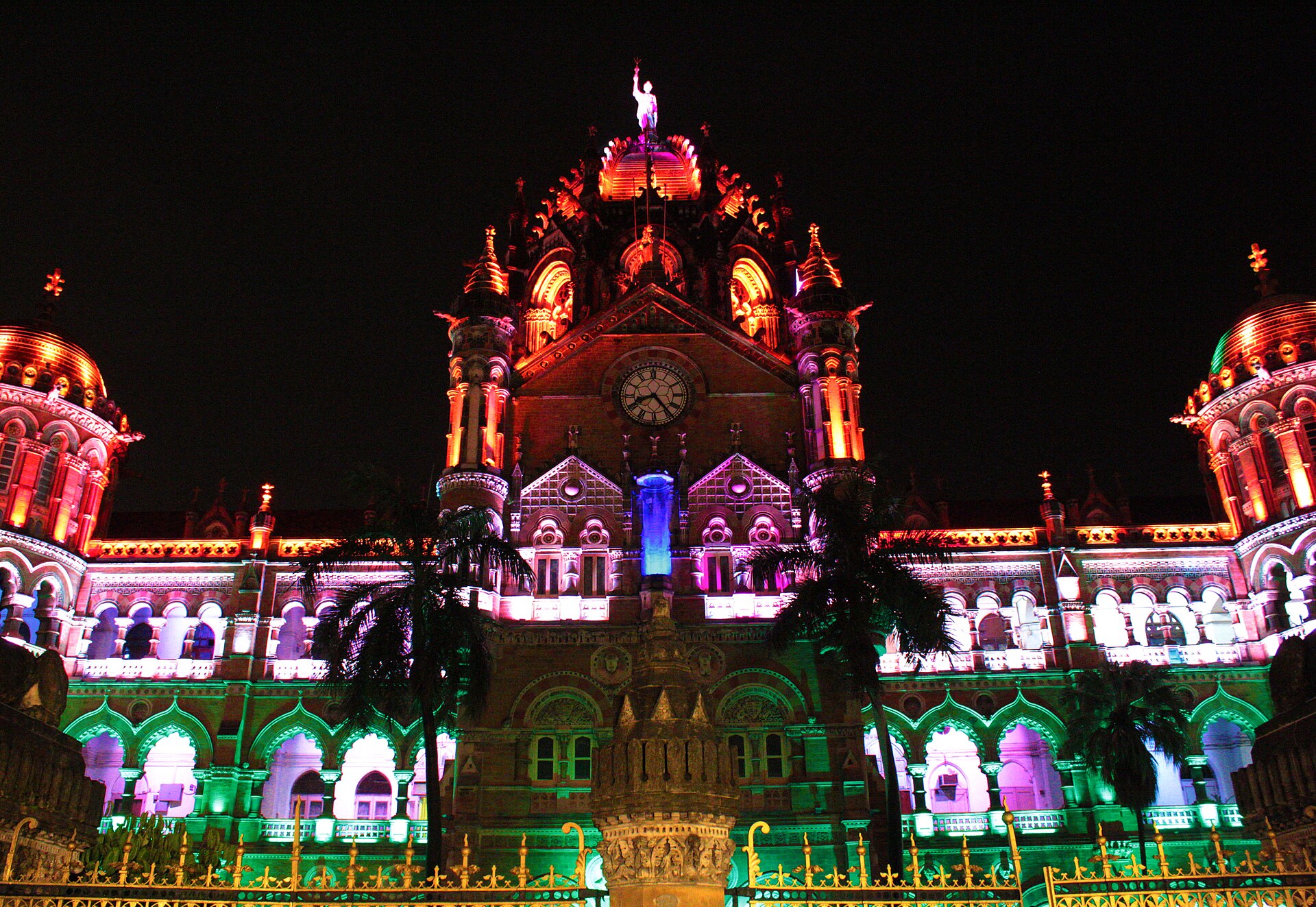
Operationally the railway is a study in scale and in compromise. India inherited multiple track gauges, and a long programme known as Project Unigauge converted most of the metre gauge and narrow gauge network to broad gauge, roughly 1.676 metres between the rails, simplifying operations enormously. A few narrow gauge mountain lines were deliberately preserved, including the Darjeeling Himalayan Railway, the Nilgiri Mountain Railway to Ooty and the Kalka Shimla line, which are together recognised by UNESCO as the Mountain Railways of India. The Chhatrapati Shivaji Maharaj Terminus in Mumbai, completed in the late nineteenth century in an exuberant Gothic and Indian style, is separately a World Heritage site and remains a working suburban station handling extraordinary crowds.
The reservation system deserves its own note, because it is one of the earliest and largest civilian computing operations in India. Before computerisation, booking a berth on a long distance train involved clerks, ledgers and considerable uncertainty. Computerised passenger reservation was introduced from the mid 1980s and networked nationally in the following decade, and online booking through the railway's ticketing arm later became one of the highest volume transaction websites in the world. The waiting list and the confirmation chart, with their own vocabulary understood by every Indian traveller, are artefacts of that system: demand routinely exceeds capacity on popular routes, and the algorithm that promotes waitlisted passengers as cancellations arrive is a familiar source of hope and anguish.
The institution's problems are as large as its achievements and are argued about seriously. Safety has improved substantially over decades, with the introduction of stronger coach designs and automated protection systems, but serious accidents still occur and each prompts renewed scrutiny of maintenance spending and staffing levels. Passenger fares have long been held below cost for political reasons and cross subsidised by freight tariffs, which pushes freight customers toward road transport and leaves the railway with less revenue than its capital needs require. Investment has surged in recent years into new high speed corridors, dedicated freight lines and station redevelopment, and there is genuine disagreement about whether that money is best spent on flagship projects or on capacity and safety across the existing network.
What is not disputed is the institution's place in Indian life. The railway carries the migrant labourer, the pilgrim, the student going to an examination centre, the family travelling for a wedding and the soldier reporting to a unit, often in the same carriage. It provides one of the few genuinely national reference points in a country of enormous linguistic and cultural variety: the announcements, the vendors, the tea in a paper cup, the shared meal offered to a stranger. It is common in India to hear the railway described as the lifeline of the nation, a phrase worn smooth by repetition but difficult to improve on.
References
- Indian Railways, Government of IndiaIndian Railways Official Portal
- UNESCO World Heritage CentreMountain Railways of India
- UNESCO World Heritage CentreChhatrapati Shivaji Terminus
- Encyclopaedia BritannicaIndian Railways
This is a reference article, written from the sources above. It is background, not news reporting.