

Nalanda and Takshashila: Ancient Seats of Learning
Reference library · 1097 words
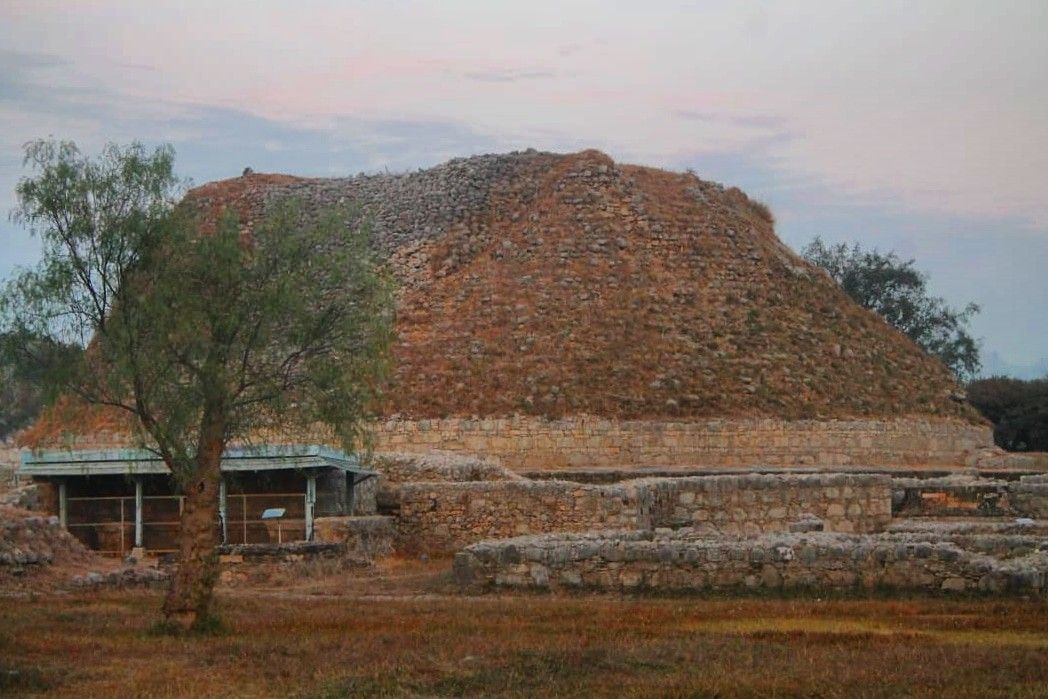

Two names dominate any account of higher learning in ancient South Asia, and they belong to very different things. Takshashila, known in English through its Greek derived form Taxila, lay in the north west of the subcontinent, in what is now Punjab province in Pakistan, roughly thirty kilometres from Islamabad. Nalanda lay in the eastern Gangetic plain, in what is now the state of Bihar, near the old Magadhan capital of Rajgir. They are separated by more than a thousand kilometres and by close to a millennium in their periods of greatest activity. Both are now archaeological sites inscribed on the UNESCO World Heritage List, Taxila in 1980 and the Nalanda Mahavihara in 2016. Beyond that they have less in common than the standard pairing suggests.
Takshashila was a city, and a very well placed one. It sat where the routes from Central Asia through the passes met the road system of the Indian plains, which made it a trading centre and also made it a repeated prize. Its archaeological remains, excavated over roughly two decades from 1913 under John Marshall of the Archaeological Survey of India, are not one settlement but several successive ones: the earliest layers at Bhir Mound, the grid planned Indo Greek city at Sirkap, and the later Kushan city at Sirsukh, together with major Buddhist monastic complexes including the Dharmarajika stupa and the monasteries at Jaulian and Mohra Muradu. The city passed through Achaemenid Persian, Mauryan, Indo Greek, Scythian, Parthian and Kushan control, and the sculpture of the surrounding region of Gandhara, blending Hellenistic form with Buddhist subject matter, is among the most distinctive art of the ancient world.
What kind of institution was it?
The learning associated with Takshashila is real but was not organised as a university, and calling it the world's first university, as popular accounts often do, imports a European institutional idea that did not exist there. The picture in the Buddhist Jataka literature and in Brahmanical sources is of individual teachers of high reputation who accepted students, sometimes from great distances, in their own households: teaching medicine, archery, grammar, law, astronomy and the Vedas, charging fees or accepting service in lieu, with no common syllabus, no degrees, no examinations and no governing body. Tradition associates the city with the grammarian Panini, whose analysis of Sanskrit remains one of the most sophisticated pieces of linguistic description ever produced; with Chanakya, also known as Kautilya, the political adviser linked to the founding of the Mauryan empire; and with the physician Jivaka. These traditions are late, and historians treat the specific attributions cautiously while accepting the general reputation.
Nalanda was the opposite: an institution in the full sense, endowed, resident, corporate and continuous. A mahavihara, or great monastery, it was established under the patronage of the Gupta emperor Kumaragupta in the fifth century of the common era and expanded by later rulers, including the emperor Harsha and the Pala dynasty that dominated eastern India from the eighth century. The excavated core, a series of large brick monasteries facing a line of shrines across a central avenue, shows exactly what a residential college looked like: cells for monks around open courtyards, wells, drains, kitchens, lecture spaces and a raised stupa complex. Entry was by examination administered by a gatekeeper scholar, teaching ran to a fixed daily schedule, and the institution was supported by the revenues of villages granted to it by rulers, which is what allowed hundreds of teachers and thousands of students to live without other work.
Most of what is known about daily life there comes from two Chinese Buddhist pilgrims. Xuanzang travelled overland to India in the seventh century, stayed at Nalanda for years and studied under the elderly abbot Shilabhadra, and his account describes the debates, the curriculum and the size of the community. Yijing, who came by sea a generation later, wrote a detailed description of monastic rules, medicine and daily observance. Their testimony matters because it is external and contemporaneous. The curriculum they describe was dominated by Mahayana Buddhist philosophy, especially the logical traditions associated with Dignaga and Dharmakirti, but it also covered grammar, medicine, mathematics, astronomy and the doctrines of rival schools, which students had to understand well enough to argue against. Students came from Tibet, China, Korea, Java and Sumatra, and the texts they carried home shaped Buddhism across Asia.
Decline, destruction and revival
Nalanda's end is usually given as a single dramatic event: a raid around the last decade of the twelfth century led by Bakhtiyar Khalji, described in the Persian chronicle of Minhaj i Siraj, in which a fortified Buddhist establishment in Bihar was stormed and its inhabitants killed. The chronicle is a genuine source and the destruction of monastic centres in Bihar in that period is not in doubt. What is more doubtful is the elaborated version, popular in modern retellings, in which a library of nine million manuscripts burned for six months. That detail appears in much later Tibetan accounts, not in the contemporary record, and historians treat it as embellishment. The more sober explanation of the decline is cumulative: Buddhism had been losing lay support and royal patronage across much of India for centuries, the Pala dynasty that endowed the eastern mahaviharas fell, the land grants that paid for everything lapsed, and the raids removed what was left of a system already weakened. Nalanda was not alone; the related foundations at Vikramashila and Odantapuri in Bihar and at Somapura in what is now Bangladesh disappeared in the same broad period.
Both sites carry heavy modern political freight. Taxila sits in Pakistan, where its Buddhist and Hellenistic heritage has an uneasy relationship with national narrative, and where the site faces pressure from quarrying and urban growth. Nalanda has been enlisted in an Indian argument about civilisational precedence, and the revival project reflects that. The Indian Parliament passed legislation in 2010 creating a new Nalanda University, backed by several East Asian governments through the East Asia Summit process; it admitted its first students in 2014 with the economist Amartya Sen as its first chancellor, and later moved to a purpose built campus at Rajgir near the ruins. The venture has had a difficult institutional history, including public disputes over governance and academic independence. Whether a new university near an archaeological site can meaningfully continue a tradition broken eight hundred years ago is an open question. What the ruins themselves demonstrate, without any need for continuity claims, is that organised, endowed, residential higher education with an international student body existed in the Gangetic plain for something like seven hundred years.
References
- UNESCO World Heritage CentreArchaeological Site of Nalanda Mahavihara at Nalanda, Bihar
- UNESCO World Heritage CentreTaxila
- Archaeological Survey of IndiaExcavated Remains at Nalanda
- Nalanda UniversityNalanda University, Rajgir
This is a reference article, written from the sources above. It is background, not news reporting.