
Non-Alignment and the Cold War Years
Reference library · 1099 words

India became independent in August 1947 into a world that was already dividing into two armed camps. Within three years the Berlin blockade had happened, NATO had been founded and the Korean War had begun, and small and newly decolonised states were being pressed to choose a side. India declined. The policy that followed, non alignment, was the most distinctive contribution of independent India to international politics, and arguing about whether it worked has occupied Indian strategists ever since.
What the policy actually claimed
Jawaharlal Nehru, who served as his own foreign minister for the whole of his premiership, set out the logic early. Non alignment was not neutrality in the Swiss sense, and Nehru was explicit about that. A neutral state stays silent; India intended to take positions on individual questions, sometimes with Washington and sometimes with Moscow, but to do so on the merits rather than by prior commitment to a bloc. A country that had just emerged from colonial rule, was desperately poor and had to build an industrial base needed capital and technology from wherever they could be obtained. Joining a bloc would have closed off half the world.
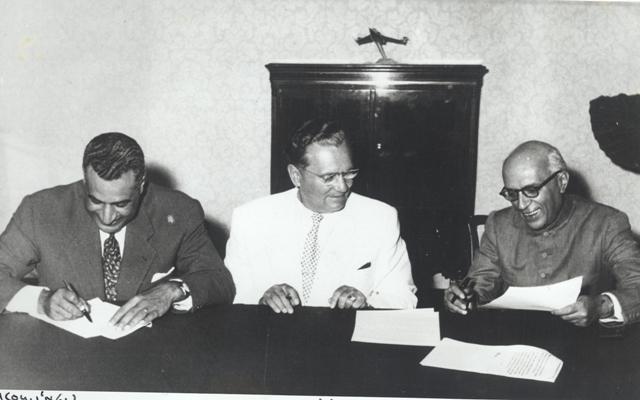
The doctrine acquired a formal vocabulary in 1954, when India and China signed an agreement over trade with Tibet whose preamble set out the Five Principles of Peaceful Coexistence, known in India as Panchsheel: mutual respect for sovereignty and territorial integrity, non aggression, non interference in internal affairs, equality and mutual benefit, and peaceful coexistence. At the Asian African Conference held at Bandung in Indonesia in April 1955, with twenty nine states attending, these principles were absorbed into a broader anti colonial declaration, and Nehru appeared alongside Zhou Enlai, Sukarno and Gamal Abdel Nasser as one of the leaders of a new grouping. The Non Aligned Movement itself was formally founded at Belgrade in September 1961, with Nehru, Josip Broz Tito of Yugoslavia, Nasser of Egypt, Sukarno of Indonesia and Kwame Nkrumah of Ghana as its principal architects.
India put the doctrine to work in practice. It played mediating roles in Cold War disputes, most notably chairing the Neutral Nations Repatriation Commission that handled the difficult question of prisoners of war after the Korean armistice in 1953. It also earned early criticism for inconsistency. In 1956 India condemned the British, French and Israeli attack on Egypt over Suez in strong terms, while responding to the Soviet suppression of the Hungarian uprising in the same weeks with conspicuous reticence, a contrast cited by critics of the policy ever since.
Where the doctrine met reality
The decisive shock came in October 1962, when China attacked across the disputed Himalayan frontier and Indian forces were routed in the North East Frontier Agency and in Ladakh. The war destroyed a set of assumptions at once: that Asian solidarity would restrain conflict, that Panchsheel bound the country it had been signed with, and that a state could be morally influential without being militarily capable. India appealed for and received American and British military assistance during the fighting, and rearmed sharply afterwards.
The pattern of the following decade was one of pragmatic tilting. After the 1965 war with Pakistan it was the Soviet Union that brokered the settlement, with Prime Minister Lal Bahadur Shastri and President Ayub Khan meeting at Tashkent in January 1966 under Soviet auspices. In August 1971, with the crisis in East Pakistan escalating toward war and the United States moving toward its opening to China, India signed a Treaty of Peace, Friendship and Cooperation with the Soviet Union containing a mutual consultation clause that functioned as insurance against Chinese or American intervention. When the war came in December, the Nixon administration ordered a naval task force led by the aircraft carrier Enterprise into the Bay of Bengal, an episode remembered in India as proof of American hostility. Critics reasonably ask whether a relationship of that depth can be described as non aligned at all.
Nuclear policy followed the same logic of autonomy. India refused to sign the Nuclear Non Proliferation Treaty opened in 1968, arguing that a treaty permitting five states to keep weapons while forbidding everyone else was discriminatory rather than disarmament. It conducted a nuclear test at Pokhran in Rajasthan in May 1974, described at the time as a peaceful nuclear explosion, and absorbed the technology sanctions that followed.
The credibility of the movement suffered its worst self inflicted wound in 1979, when the Soviet Union invaded Afghanistan and India's response was muted to the point of appearing to accept the Soviet account, disappointing states that had taken the principle of non interference literally. Indira Gandhi nonetheless chaired the movement from the New Delhi summit of 1983, by which time much of its energy had shifted from Cold War questions to economic demands: the call for a New International Economic Order, better terms of trade, and debt relief, pursued in parallel through the Group of 77 at the United Nations.
After the Cold War
The policy's original premise disappeared in 1991. The Soviet Union collapsed, taking with it a trading relationship conducted partly in rupees and roubles, and India simultaneously faced a balance of payments crisis that forced it to liberalise its economy and seek Western capital. Within months India had opened full diplomatic relations with Israel, launched what became the Look East policy toward Southeast Asia, and begun the long repair of relations with Washington.
What survived was not the movement but the instinct. Indian officials now speak of strategic autonomy or multi alignment rather than non alignment, and the practical expression is a set of relationships that would once have been considered contradictory. India participates in the Quad alongside the United States, Japan and Australia while remaining a member of BRICS and the Shanghai Cooperation Organisation alongside Russia and China. It buys advanced American and French military equipment while operating a largely Russian origin arsenal, and after the invasion of Ukraine in 2022 it abstained on United Nations resolutions and sharply increased purchases of discounted Russian oil, drawing Western criticism and a consistent reply from New Delhi that it will act in its own interest.
The verdict on non alignment remains genuinely contested. Critics argue it substituted moral commentary for capability and left India isolated in 1962. Defenders answer that a poor, newly independent state preserved its freedom of action, avoided becoming a client, obtained steel mills and technical institutes from both blocs, and never fought a war on someone else's behalf. What is clear is that the underlying preference, keeping options open and refusing permanent alignment, outlived the Cold War that produced it.
References
- Encyclopaedia BritannicaNon-Aligned Movement
- Government of India, Ministry of External AffairsMinistry of External Affairs, India
- United NationsTreaty on the Non-Proliferation of Nuclear Weapons
- Office of the Historian, United States Department of StateForeign Relations of the United States, South Asia volumes
- BBCIndia country profile and timeline
This is a reference article, written from the sources above. It is background, not news reporting.