
Non-Alignment: India's Middle Path in the World
Reference library · 1001 words

When India became independent in August 1947, the world was dividing into two armed camps. Within two years the North Atlantic Treaty Organisation existed, within eight the Warsaw Pact did, and the intervening period brought the Berlin blockade, the Chinese revolution and the Korean War. Almost every newly independent state was invited, pressed or bribed to choose a side. India declined. The doctrine it built to justify that refusal, non alignment, became the organising idea of Indian foreign policy for four decades and remains the ancestor of what Indian diplomats today call strategic autonomy or multi alignment.
What non alignment actually meant
Non alignment was widely misunderstood, then and since, as neutrality. It was not. A neutral state abstains from judgement; India judged constantly and often loudly. Jawaharlal Nehru, who was his own foreign minister for the whole of his premiership from 1947 to 1964, described the policy as the freedom to decide each question on its merits rather than by bloc membership. India could therefore criticise the Soviet suppression of Hungary and Anglo French action at Suez in the same year, 1956, and did, though critics noted the criticism of Moscow was markedly softer than the criticism of London and Paris.
The policy rested on a hard reading of India's position. The country was poor, its army modest, its industrial base small, and its priority was development rather than power projection. Alliance membership would have imported the quarrels of others, invited bases on Indian soil barely a decade after the British left, and constrained the country's ability to buy weapons, food aid and machinery from whoever offered the best terms. Non alignment was in that sense an economic policy as much as a moral one: it kept both Washington and Moscow interested in courting Delhi.
It also had an ideological content that mattered enormously in Asia and Africa. Nehru framed the Cold War as a distraction from the real business of the century, which was decolonisation, racial equality and the elimination of poverty. India led opposition to apartheid South Africa at the United Nations from the very first session of the General Assembly, and Indian troops served in early United Nations peacekeeping operations including in Korea, in the Congo and in Gaza, giving Delhi a standing in world forums out of all proportion to its material strength.
The Panchsheel principles and their collapse
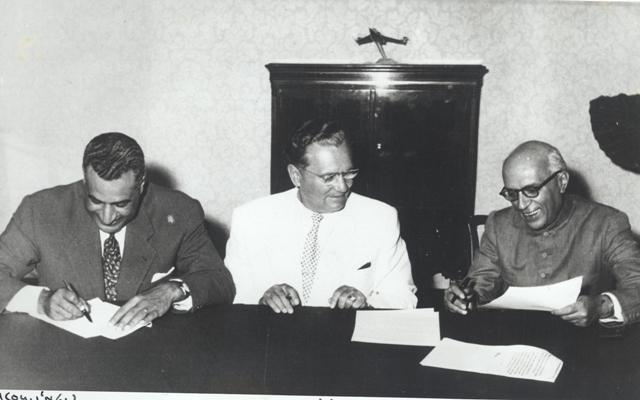
The doctrinal core was set out in the agreement India signed with the People's Republic of China in April 1954 on trade with the Tibet region. Its preamble contained the five principles, Panchsheel: mutual respect for territorial integrity and sovereignty, mutual non aggression, non interference in each other's internal affairs, equality and mutual benefit, and peaceful coexistence. They were restated at the Asian African Conference at Bandung in Indonesia in April 1955, where Nehru appeared alongside Sukarno of Indonesia, Gamal Abdel Nasser of Egypt, Zhou Enlai of China and others, and where the political constituency for non alignment was formed. The Non Aligned Movement itself was founded at Belgrade in September 1961, with Josip Broz Tito of Yugoslavia as a principal architect alongside Nehru and Nasser.
The doctrine's most painful test came from the partner it had been written with. The border dispute with China over Aksai Chin in the west and the territory below the McMahon Line in the east led to war in October and November 1962. The Indian army, poorly equipped and badly deployed at altitude, was defeated. Nehru's international standing never recovered, and India quietly sought and received emergency military assistance from the United States and Britain. Non alignment survived, but the illusion that goodwill substituted for capability did not. India began a serious military build up, and the Sino Indian boundary remains undelimited to this day, with periodic confrontations along the Line of Actual Control.
The second strain came in the 1970s. Facing a hostile Pakistan backed by Washington and a China aligned against her, Indira Gandhi signed the Treaty of Peace, Friendship and Cooperation with the Soviet Union in August 1971, months before the war that produced Bangladesh. The treaty contained a consultation clause in the event of attack. Whether this was compatible with non alignment was argued about at the time and is argued about still. Soviet weapons, oil and diplomatic cover became structural features of Indian policy, and a large share of the Indian military inventory remains of Russian origin as a result.
From non alignment to strategic autonomy
The Soviet collapse in 1991 removed one pole and, at the same moment, an Indian balance of payments crisis forced economic liberalisation. Non alignment as a slogan lost its object: there was no longer a bloc system to stand apart from. What survived was the underlying instinct. India today buys American, French, Israeli and Russian equipment, participates in the Quadrilateral Security Dialogue with the United States, Japan and Australia while also sitting in the BRICS grouping and the Shanghai Cooperation Organisation with China and Russia, and has declined to join Western sanctions regimes against Moscow while deepening defence ties with Washington. Officials describe this as multi alignment, engagement with everyone and commitment to no one.
Whether this is principle or opportunism is genuinely contested. Sympathetic analysts argue that a country of India's size, with an unsettled border with China and enduring dependence on imported energy, would be reckless to lock itself into a single camp, and that hedging maximises leverage. Critics respond that hedging works only while all sides believe you might come their way, that Russian dependence has become a liability rather than an asset, and that a policy of keeping options open can shade into having no policy at all. The Non Aligned Movement itself still meets, with well over one hundred member states, but its summits attract less attention and India's prime ministers have not always attended in person. The idea that gave it birth, however, that a large poor democracy should refuse to rent out its foreign policy, has proved considerably more durable than the institution.
References
- Ministry of External Affairs, Government of IndiaPanchsheel
- United NationsUnited Nations Peacekeeping: troop contributions and mission history
- Office of the Historian, US Department of StateThe Bandung Conference, 1955
- Ministry of External Affairs, Government of IndiaIndia and the Non-Aligned Movement
This is a reference article, written from the sources above. It is background, not news reporting.