
Odia: A Language of the Eastern Coast
Reference library · 1030 words
.jpg)
Odia is the language of Odisha, the state that runs along India's eastern coast between West Bengal and Andhra Pradesh, and it is spoken by something in the order of thirty five million people, with sizeable communities in neighbouring Jharkhand, Chhattisgarh, West Bengal and Andhra Pradesh. It belongs to the Indo Aryan family, and within it to the eastern group that also contains Bengali and Assamese, meaning all three descend from the same regional ancestor and share a great deal of grammar and vocabulary. Its position is nonetheless distinct, and the argument over exactly how distinct is not merely academic: it once determined whether Odisha would exist at all.
A script shaped by palm leaves
The Odia script belongs to the Brahmi lineage that produced almost every Indian writing system, arriving through the older Kalinga script used in the region. Its most immediately recognisable feature is that nearly every letter sits under a rounded umbrella like curve, giving a page of Odia a distinctive pebbled look quite unlike the straight top line of Devanagari or Bengali. The usual explanation is technological. For centuries manuscripts in this region were incised on dried palm leaf strips with a metal stylus, and a straight horizontal stroke drawn along the grain tends to split the leaf, whereas curves do not. Whether this fully accounts for the shape is debated among palaeographers, but the correlation between palm leaf cultures and rounded scripts across eastern and southern India is striking.
The manuscript tradition itself is remarkable. Odisha holds large collections of palm leaf texts covering literature, astronomy, medicine and religious commentary, some of them illustrated with fine engraved drawings that are inked afterwards so the lines show black against the pale leaf. Conservation of these collections is an ongoing and underfunded task, since palm leaf is vulnerable to humidity, insects and simple handling.
Literature, temple and the Panchasakha
Odia's literary history is old enough to have earned it official recognition as a classical language of India in 2014, a designation that carries research funding and academic status. It was the sixth language to receive it and the first Indo Aryan language other than Sanskrit to do so, a decision resting on evidence of a distinct literary tradition stretching back well over a thousand years. Some linguists elsewhere in India questioned aspects of the classical language criteria in general, which have been applied to a growing list of languages, but the antiquity of Odia writing is not seriously disputed.
The towering early figure is Sarala Das, a fifteenth century poet usually called the Adikabi, or first poet, who composed a vast Odia Mahabharata that is a free retelling rather than a translation, packed with local geography, local deities and characters absent from the Sanskrit epic. He was, by his own account, not a Sanskrit scholar, and writing a version of the great epic in the spoken language of ordinary people was itself a democratising act. The sixteenth century produced the Panchasakha, the five friends, a group of devotional poets including Balarama Das and Jagannatha Das whose Odia Bhagabata became something close to a household scripture. Villages across Odisha built a bhagabata tungi, a small structure where the text was read aloud in the evenings, which meant that literary Odia was heard even by those who could not read it.
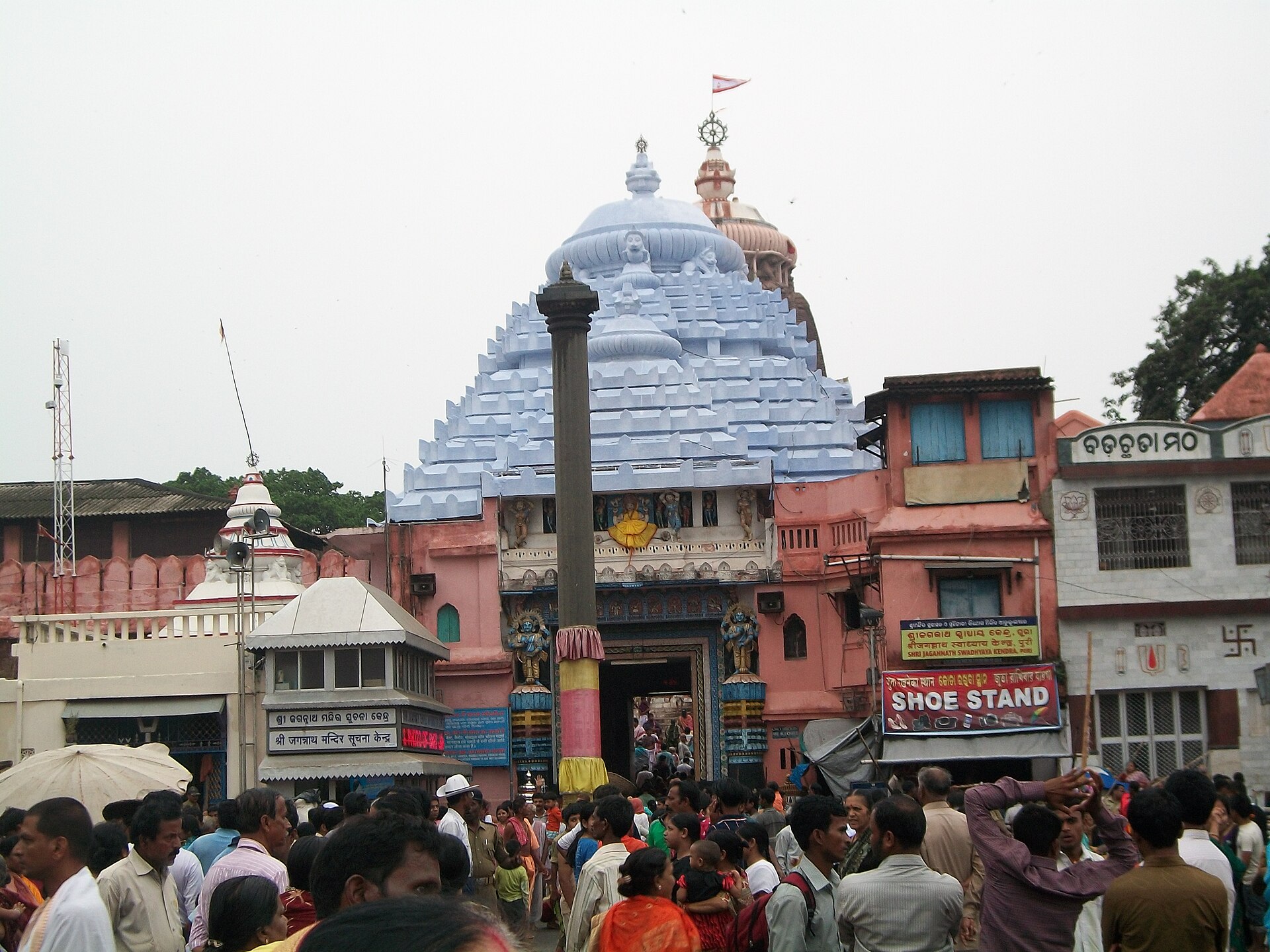
All of this is bound tightly to the temple of Jagannath at Puri. The deity, worshipped in an unusual wooden form alongside his siblings Balabhadra and Subhadra, is the presiding figure of Odia religious and cultural life, and the annual Rath Jatra, when the three are pulled through the streets on enormous timber chariots rebuilt each year, draws crowds in the hundreds of thousands. Temple ritual, temple music, the Odissi dance tradition and Odia devotional literature developed in constant contact with one another.
The language that had to prove it existed
The nineteenth century brought a crisis that still shapes Odia identity. Under British administration, the Odia speaking population was divided between three separate provinces: Bengal, Bihar and the Madras Presidency. In none of them was Odia the language of government, and administrative and teaching posts were commonly filled by Bengali or Telugu speakers. In 1870 a pamphlet appeared arguing that Odia was not a language in its own right but a dialect, and that schooling in the region should therefore be conducted in Bengali. The proposal galvanised an Odia language movement, led by writers and reformers who set about demonstrating the language's independent literary pedigree.
Out of this came both a body of modern literature and a political programme. Fakir Mohan Senapati, often called the father of modern Odia prose, wrote the novel Chha Mana Atha Guntha, translated as Six Acres and a Third, at the end of the nineteenth century. It is a sharp, ironic account of a landlord dispossessing a peasant couple of their small plot, and it is now recognised as one of the earliest Indian novels to take rural exploitation as its direct subject rather than as background. On the political side, the Utkal Sammilani, founded in 1903 with Madhusudan Das among its leading figures, campaigned for the unification of Odia speaking territories. It succeeded: on 1 April 1936 Odisha became the first province in British India created on a linguistic basis, a precedent that would be invoked repeatedly after independence when Indian states were reorganised along language lines. The date is still observed as Utkala Dibasa.
The contemporary picture is mixed. Odia is the official language of the state and is taught in government schools, its Unicode support is stable and its digital presence has grown. At the same time, aspirational parents increasingly choose English medium schooling, urban young people mix heavily in English and Hindi, and large numbers of Odia speaking labourers migrate seasonally to Gujarat, Kerala and Tamil Nadu, where their children may grow up with limited written command of the language. None of this threatens a language with tens of millions of speakers in the short term. It does raise the question of which registers, literary, administrative, technical, remain genuinely alive in it, which is the question that matters most for any regional language in India today.
References
- Encyclopaedia BritannicaOdia language
- Government of India, Ministry of EducationClassical Languages of India
- Government of OdishaOdisha State Portal, language and culture
- UNESCOMemory of the World and manuscript heritage programmes
This is a reference article, written from the sources above. It is background, not news reporting.