Onam: A Harvest Festival of the South
Reference library · 1009 words

Onam is the great annual festival of Kerala, the narrow coastal state on India's south western edge, and it is unusual among Indian festivals in belonging to a place rather than to a religion. It falls in Chingam, the first month of the Malayalam calendar, which corresponds to late August and September in the Gregorian calendar, at the point when the south west monsoon has passed its peak and the first rice harvest is in. Malayali Christians and Muslims keep it alongside Hindus, government offices close, and the state government has for decades treated it as Kerala's official festival and the anchor of its tourism calendar.
The story attached to it is one of the more sympathetic in Indian mythology. Mahabali, usually called Maveli, was an asura king whose reign over the land was so just that there was no poverty, no deceit and no distinction of high and low birth. His virtue made him powerful enough to disturb the gods, so Vishnu took the form of Vamana, a dwarf brahmin, and asked the king for as much ground as he could cover in three strides. Mahabali agreed. Vamana grew until two strides covered earth and sky, and the king, having nothing left to give, offered his own head for the third. He was pressed into the netherworld but granted one boon: to return once each year to see his people. Onam is that visit. Households are cleaned and decorated because a king is coming, and the standard Onam greeting wishes prosperity in his name.
Ten days, and what happens in them
The festival runs for ten days, from the asterism Atham to Thiruvonam, the day of the main feast. It opens in the town of Tripunithura near Kochi with the Athachamayam procession, a survivance of the ceremonial march of the rulers of Kochi, now a public parade of caparisoned elephants, folk dance troupes, percussion ensembles and floats that effectively announces the season to the state.
From that first day, households lay a pookalam, a circular carpet of flower petals, on the swept ground at the entrance. It begins small, often a single ring, and grows in rings and colours each day until Thiruvonam. Traditionally the flowers were gathered locally, thumba, chethi, mukkutti and others; today much of the volume is bought at market, and a large share of the marigolds and chrysanthemums arrives by truck from Tamil Nadu and Karnataka, a small illustration of how a domestic ritual has become a commercial supply chain. Competitive pookalam contests are held in schools, offices and residents' associations, and diaspora associations abroad run them too.
The centre of Thiruvonam is the Onasadya, a vegetarian banquet served on a banana leaf. The number of dishes varies by household and ambition, commonly around two dozen and sometimes many more, and the placement on the leaf is conventional: pickles and the salted preparations at the narrow left, thoran and other vegetable dishes above, rice in the centre, with sambar, parippu, avial, olan, kalan, erissery, pachadi and kichadi served in sequence, and one or more payasams, milk or jaggery based sweet puddings, to close. Papadam is broken over the rice. The meal is eaten with the right hand and the leaf is folded towards the diner at the end as a sign of satisfaction.
Around the feast sit the games and performances collectively called Onakalikal: swings hung from mango trees, tug of war, the women's circle dances Thiruvathirakali and Kaikottikali, and in Thrissur the Pulikali, in which men paint their bodies as tigers in ochre, black and red and dance through the town to drums on the fourth day of the festival. New clothes, the Onakkodi, are given within families, and the traditional Kerala set mundu, cream cotton with a gold border, is worn very widely during the season.
Boat races, money and argument
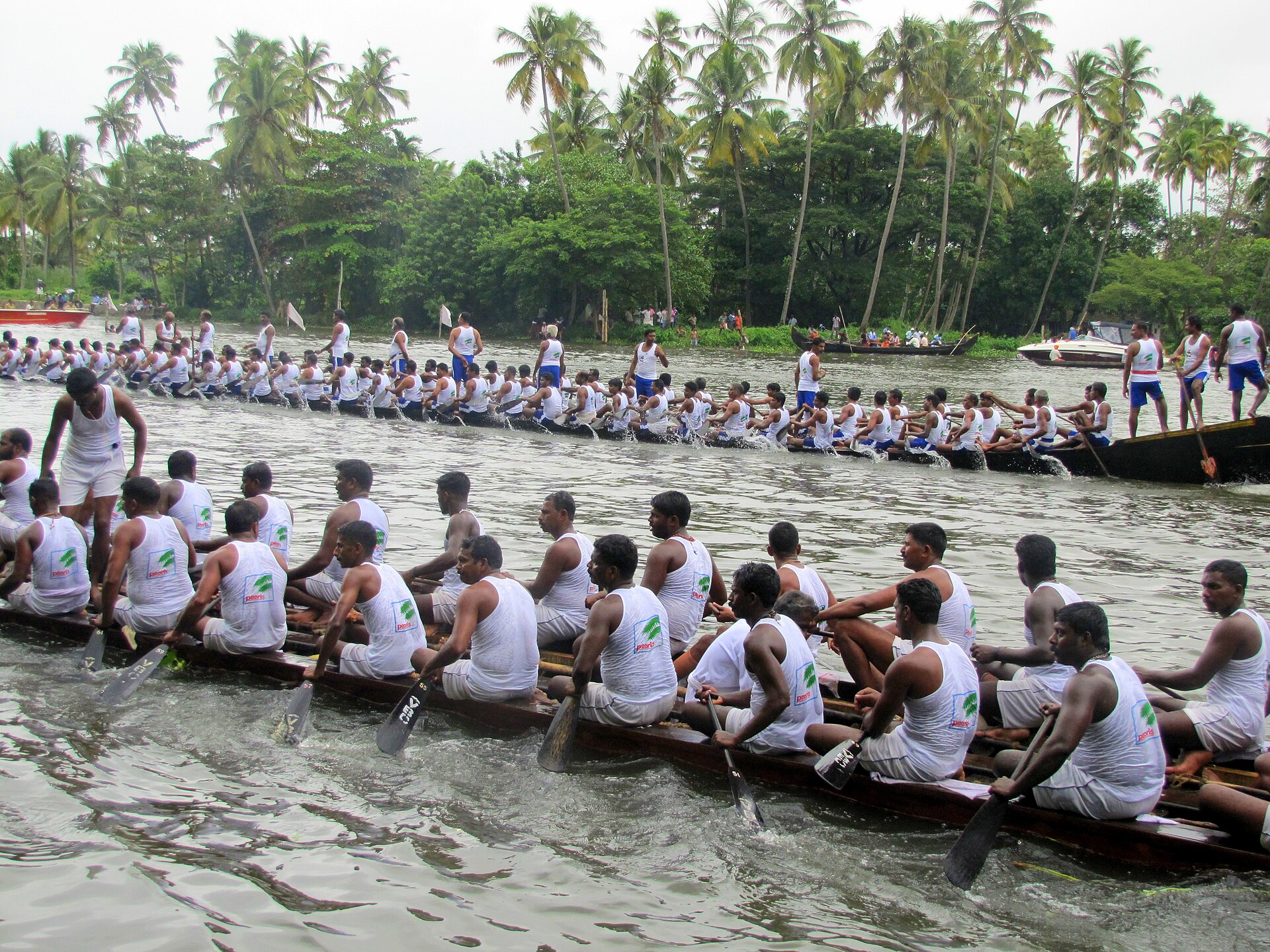
The most photographed element of the season is Vallam Kali, the snake boat races of the backwater districts. The chundan vallam is an enormous rowing canoe, well over thirty metres long, with a raised stern, crewed by around a hundred rowers who row to the rhythm of the vanchipattu boat songs. Villages own the boats and maintain them collectively, and the rivalries between them are old and serious. The best known regatta is the Nehru Trophy Boat Race on Punnamada Lake at Alappuzha, which takes its name from Jawaharlal Nehru's visit to the backwaters in 1952, when he watched a race and later donated a trophy. Others are held at Aranmula on the Pamba, where the boats are associated with a temple and the event is treated as a ritual offering rather than a competition, and at Champakulam and Payippad.
Onam is also, plainly, an economic event. The state's consumer purchasing peaks in this period, government employees receive festival advances, the state run Kerala State Civil Supplies Corporation runs subsidised Onam markets to hold down prices of rice, pulses and oil, and the textile and gold trades count on it. Kerala Tourism built a state wide Onam Week around the festival, with cultural programmes in Thiruvananthapuram. The very large Malayali populations in the Gulf states, and the newer communities in Australia, Singapore, Britain and North America, hold their own Onam programmes, typically a hall, a mass sadya, a pookalam contest and a stage show, with the date shifted to the nearest weekend.
The festival's meaning is not uncontested. Some Hindu organisations emphasise the Vamana side of the story and mark the period as Vamana Jayanti, honouring the avatar rather than the defeated king. Others, including writers from Dalit and rationalist traditions, read the Mahabali legend as the memory of an indigenous and egalitarian order overthrown by a brahmanical one, and hold that the popular sympathy for the king is the point. There is no settling this from the texts alone, since the Vamana episode appears in Sanskrit puranic literature while the Kerala harvest observance has its own regional lineage, and the two were joined over a long period. What is not in doubt is which figure Kerala waits for each Chingam.
References
- Kerala TourismOnam Festival
- Government of KeralaOfficial Portal of the Government of Kerala
- Encyclopaedia BritannicaOnam
- Nehru Trophy Boat RaceNehru Trophy Boat Race, Alappuzha
This is a reference article, written from the sources above. It is background, not news reporting.