

Pilgrimage Traditions Across the Subcontinent
Reference library · 964 words
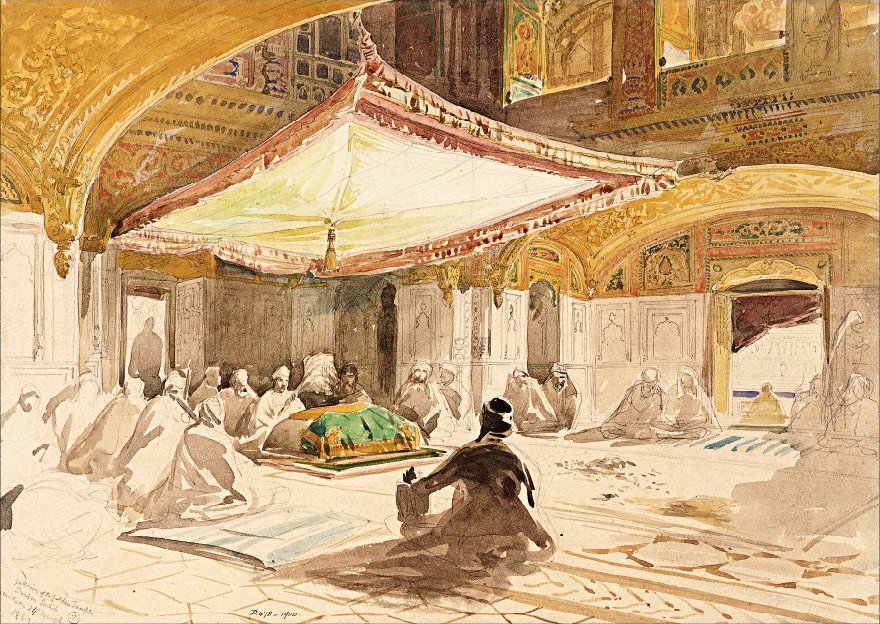
_in_Amritsar_by_William_Simpson,_ca.1860.jpg)
Pilgrimage is among the oldest continuous social practices of the Indian subcontinent, and among the largest in sheer scale anywhere on earth. The Kumbh Mela, held in rotation at Prayagraj, Haridwar, Ujjain and Nashik, gathers crowds counted in the tens of millions over a period of weeks, and is generally described as the largest peaceful assembly of human beings in the world. But the Kumbh is an extreme instance of something that happens constantly and quietly: the movement of ordinary people to particular places believed to be charged with sanctity, along routes that have been walked for centuries and that shaped the roads, markets and towns of the region long before any modern state existed.
The Sanskrit term commonly used for a pilgrimage site is tirtha, which literally means a ford or crossing place. The word is revealing. A tirtha is understood as a point where the ordinary world and something beyond it are unusually close, a place where crossing over is easier. That is why so many major sites sit at rivers, confluences, coastlines and mountain passes. Varanasi on the Ganga, Prayagraj at the meeting of the Ganga and the Yamuna, Rameswaram at the southern tip facing Sri Lanka, and the Himalayan shrines of Badrinath, Kedarnath, Gangotri and Yamunotri, collectively the Char Dham of Uttarakhand, all occupy thresholds of one kind or another. The philosopher and reformer Adi Shankara, traditionally placed in the eighth century, is credited with establishing monastic centres at the four compass points of the subcontinent, an act that helped knit distant regions into a single religious geography.
A landscape of many faiths
It would be a serious error to treat pilgrimage in the subcontinent as a Hindu practice with minority additions. The Sikh tradition centres on the Harmandir Sahib in Amritsar, the Golden Temple, completed in its early form in the sixteenth century and rebuilt after destruction, where visitors of any background are fed at the community kitchen. Muslim devotional practice in South Asia is organised substantially around the shrines of Sufi saints, above all the dargah of Moinuddin Chishti at Ajmer in Rajasthan, whose annual Urs draws enormous crowds including many non Muslims, a fact that complicates any simple account of communal separation. Buddhist pilgrims travel to Bodh Gaya in Bihar, where the Mahabodhi Temple marks the site of the Buddha's awakening, and to Sarnath, Kushinagar and Lumbini across the border in Nepal. Jain pilgrims climb Shatrunjaya in Gujarat and Shravanabelagola in Karnataka, where the monolithic statue of Bahubali is ritually anointed at intervals of roughly twelve years. Christians travel to Velankanni in Tamil Nadu and to the Basilica of Bom Jesus in Goa, where the remains of Francis Xavier are displayed at long intervals.
The mechanics of these journeys are as interesting as their theology. Pilgrimage moves money and people through places that would otherwise have little economic reason to exist at their scale. A shrine town supports priests, guides, lodging keepers, flower sellers, sweet makers, barbers, porters, photographers and transport operators, in a seasonal economy tuned to a festival calendar. Hereditary priestly families at many sites maintain genealogical registers recording the visits of particular families across generations, so that a pilgrim can be shown the entry made when a great grandfather came. Roads, rest houses and water tanks along historic routes were often endowed by rulers and merchants as acts of merit, which means that a good deal of pre modern public infrastructure in South Asia was built as religious donation rather than state provision.
Modern transport, modern crowds, modern risks
Railways changed pilgrimage more than any doctrinal development. From the middle of the nineteenth century a journey that had taken weeks on foot could be made in days, and later in hours, which vastly increased both the number of pilgrims and the distance they were willing to travel. Special trains for major festivals remain a standard feature of Indian Railways operations. Motor roads pushed further, opening Himalayan shrines that had been reachable only by long treks, and helicopter services now carry those who can afford them to Kedarnath and Vaishno Devi. Each improvement multiplies the crowd, and the crowd creates its own problems.
Those problems are serious and should be stated without euphemism. Crush incidents at crowded shrines and festival gatherings have killed people on multiple occasions across different states and different faiths, and they typically involve narrow approaches, sudden surges and inadequate crowd management rather than any single failure. Environmental strain is equally real: the Himalayan pilgrimage routes pass through geologically unstable terrain, and the catastrophic floods that struck Uttarakhand in June 2013 killed thousands, many of them pilgrims caught at the height of the Char Dham season, and prompted a lasting argument about whether road widening and construction in fragile valleys had made the disaster worse. River sites face the pollution load of mass bathing alongside industrial and municipal discharge, and successive government programmes to clean the Ganga have produced improvements that most independent assessments consider partial.
None of this has reduced the practice, and there is little sign that it will. If anything, rising incomes, better roads and organised tour operators have made pilgrimage more accessible to more people than at any point in history, including to diaspora families who fly in specifically to complete a journey their parents made on foot. The persistence is worth pausing on. In a region that has industrialised, urbanised and digitised at speed, tens of millions of people still choose to travel long distances, endure discomfort and stand in enormous queues for an experience that produces no material return. That choice is the clearest available evidence that the sacred geography mapped out over two thousand years has not been displaced by the modern one laid on top of it, but is being carried along inside it.
References
- UNESCOKumbh Mela, Intangible Cultural Heritage
- UNESCO World Heritage CentreMahabodhi Temple Complex at Bodh Gaya
- Encyclopaedia BritannicaTirtha
- UNESCO World Heritage CentreChurches and Convents of Goa
This is a reference article, written from the sources above. It is background, not news reporting.