
Pongal and Makar Sankranti: Harvest Across Regions
Reference library · 1008 words

In the middle of January, on roughly the same two days every year, a very large part of India celebrates at once. In Tamil Nadu it is Pongal. Across most of the north and west it is Makar Sankranti. In Punjab it is Lohri and Maghi, in Assam Magh Bihu, in Gujarat Uttarayan, in Andhra Pradesh and Telangana Sankranti. The names, foods and rituals differ, sometimes drastically, but the timing does not, and the reason is astronomical rather than cultural.
Most Indian festivals follow the moon and therefore wander through the Gregorian calendar. This one follows the sun. It marks Makara Sankranti, the sun's entry into the sidereal sign of Makara, conventionally translated as Capricorn. Because Indian astronomy measures positions against the fixed stars rather than against the equinox, and because the Earth's axis precesses, that entry point drifts slowly forward through the solar year at a rate of roughly one day every seventy years or so. This is why the festival now falls on 14 or 15 January although it is popularly described as marking the winter solstice, which occurs in late December. Around fifteen hundred to two thousand years ago the two events did nearly coincide. The festival has kept the astronomical definition and let the meaning drift with it.
What survives everywhere is the underlying idea: the sun turns north, the days lengthen, and the main winter crop is in. In much of the country this is the point at which the year's food security is settled, and the rituals are accordingly about grain, cattle, fire and debt. The uttarayana or northward phase is also considered auspicious in Hindu tradition, which is why it is associated with beginnings, and why the season is popular for weddings and for ritual bathing at river confluences.
Four days in the Tamil country
Tamil Pongal is the most elaborately structured version. It opens the Tamil month of Thai, and the proverb that the month of Thai will make a way is one of the most quoted lines in Tamil. It runs over four days. Bhogi, the first, is for discarding: old mats, brooms and household junk go on a bonfire before dawn, and houses are cleaned and whitewashed. The second and central day is Thai Pongal itself. Newly harvested rice is boiled with milk and jaggery in a clay pot, usually outdoors, often on a hearth of three bricks, and the pot is watched until the mixture boils over the rim. The overflow is the point. When it happens the household calls out that the rice has boiled over, and the abundance is treated as an omen for the year. The dish and the festival share a name, from a Tamil verb meaning to boil or to swell. The first offering goes to the sun.
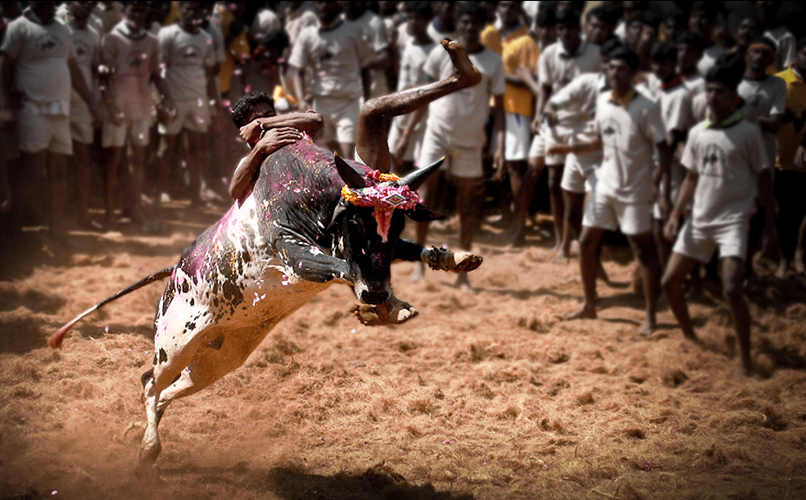
The third day, Mattu Pongal, is for cattle. Bulls and cows are washed, their horns painted and tipped with brass, garlands and bells hung on them, and they are fed the sweet pongal before anyone else eats. In parts of southern Tamil Nadu this is also the season for jallikattu, the bull taming contest in which young men attempt to hold the hump of a released bull. The best known events are at Alanganallur, Palamedu and Avaniyapuram near Madurai. The sport was restricted and then effectively banned following animal welfare litigation, culminating in a Supreme Court decision in 2014. In January 2017 sustained public protests, the largest of them occupying Marina Beach in Chennai for days, pushed the state government to legislate to permit the sport under regulation. The dispute is not settled in principle: animal welfare groups continue to argue that regulation does not remove cruelty, while defenders argue that the events sustain indigenous cattle breeds that would otherwise disappear. The fourth day, Kaanum Pongal, is for visiting, outings and family.
The same sun, many rituals
North and west of the Vindhyas the emphasis shifts. In Punjab the celebration begins the previous evening with Lohri, a bonfire around which sesame, popcorn, peanuts and jaggery are thrown, accompanied by songs about Dulla Bhatti, a sixteenth century Punjabi figure remembered for rescuing girls from being sold. The following day, Maghi, brings ritual bathing and a major fair at Muktsar. In Assam, Magh Bihu or Bhogali Bihu is the feasting Bihu, marked by the construction of temporary huts and tall conical structures of bamboo, thatch and leaves, which are burned at dawn after a night of communal eating.
In Gujarat the day belongs to the sky. Uttarayan turns Ahmedabad and Vadodara into kite battlegrounds, with abrasive coated string used to cut opponents' lines and rooftops occupied from before sunrise. The city has hosted an international kite festival since the late 1980s. The practice has a documented cost: glass coated and synthetic strings injure birds and, in some cases, people on motorcycles, and several states restrict specific string types. In Maharashtra the day is marked by exchanging sesame and jaggery sweets with the phrase asking the recipient to take the tilgul and speak sweetly, a formula for repairing relationships. In Andhra Pradesh and Telangana the festival runs several days, with elaborate rice flour muggu drawn at doorsteps, itinerant singers, and cockfighting in coastal districts that is illegal but persistent.
Along the Ganga the day is one of the great bathing occasions. Ritual bathing at Prayagraj during the Magh Mela, and the enormous gathering at Sagar Island in West Bengal where the Ganga meets the sea, both centre on Sankranti. Sesame, again, is the ritual substance, along with the giving of blankets and food to the poor, which fits the season's logic of clearing accounts before a new cycle begins.
The festival travels well because it needs little institutional infrastructure: a pot, a fire, some grain and a date fixed by the sun. Thai Pongal is a public holiday in Sri Lanka and is observed in Mauritius, Malaysia and Singapore, and Tamil and Telugu associations across Australia, Britain, Canada and the Gulf hold community Pongal events each January, often on the nearest weekend rather than the astronomical day.
References
- Encyclopaedia BritannicaMakar Sankranti
- Government of Tamil NaduTamil Nadu: Art and Culture
- BBC NewsJallikattu: India's bull-taming protests
- Encyclopaedia BritannicaLohri
This is a reference article, written from the sources above. It is background, not news reporting.