
Post-Independence Migration Waves
Reference library · 1088 words

India has one of the largest populations living outside its borders of any country in the world, spread across every inhabited continent, and the shape of that dispersal is not random. It was produced by a series of distinct waves, each triggered by a specific change in the law of a receiving country rather than by any single push from India. Understanding the waves separately is the only way to make sense of why the Indian community in Britain is largely Punjabi and Gujarati, why the community in the United States is disproportionately professional, why the Gulf population is overwhelmingly male and temporary, and why Australia and Canada acquired large Indian populations only recently.
The first movement after 1947 was internal and enormous. Partition displaced something in the order of fifteen million people between India and the new state of Pakistan, in both directions, accompanied by killings on a scale that historians still estimate within a wide range. This was not emigration, since it moved people between successor states of the same former territory, but it matters here because it uprooted communities, particularly Punjabis and Sindhis, who then proved unusually willing to move again, and because it created refugee networks in Delhi, Bombay and Calcutta from which later international migration was launched.
Britain, then North America
The first true wave abroad went to Britain, enabled by the British Nationality Act of 1948, which confirmed the right of Commonwealth citizens to enter and settle, and pulled by acute post war labour shortages in foundries, textile mills, transport and the National Health Service. It was chain migration in the technical sense: a small number of pioneers, often ex servicemen who had seen Britain during the war, established themselves and drew in relatives and neighbours from the same villages. That is why the outflow came overwhelmingly from a few districts of Punjab and Gujarat rather than evenly from India. The door narrowed with the Commonwealth Immigrants Acts of 1962 and 1968 and closed substantially with the Immigration Act of 1971.
The second wave went to North America, and its cause was a single statute. The United States Immigration and Nationality Act of 1965, often called the Hart Celler Act, abolished the national origins quota system that had effectively excluded Asians since the 1920s and replaced it with preferences based on family reunification and occupational skills. Because the occupational route favoured the highly qualified, the Indians who arrived were doctors, engineers, scientists and academics, a selection effect that shaped the character of Indian America for a generation and gave rise to the Indian debate about brain drain: whether a poor country subsidising medical and engineering education should be training professionals for wealthy ones. Canada made a parallel change, replacing racially framed criteria with a points based system in 1967, and drew both professionals and, in British Columbia especially, a large Punjabi Sikh settlement that built on a much older presence dating to the early twentieth century.
Australia moved on a similar timetable but from further behind. The dismantling of the White Australia policy was completed by the Whitlam government in 1973, and non discriminatory selection was formalised thereafter. Indian migration to Australia nevertheless remained modest until the 1990s and then accelerated sharply, driven first by skilled migration in information technology, engineering, accounting and health, and then by the expansion of international education and the pathways from student visas to permanent residence.
The Gulf, and the twice migrants
The third wave, from 1973 onwards, went west to the Arab Gulf states after the oil price rises created construction booms and vast public spending in countries with tiny populations. This wave differed from all the others in a fundamental way: it was designed to be temporary. Visas were tied to employers under sponsorship systems, there was and is essentially no route to citizenship, and families frequently remained in India. It drew first from Kerala and later from Uttar Pradesh, Bihar, Rajasthan, Tamil Nadu and Andhra Pradesh, and it made the Gulf the largest single destination region for Indian nationals abroad.
Running across all of these is the movement of people the scholar Parminder Bhachu called twice migrants: communities descended from earlier Indian migration who were displaced again. Indians in East Africa, many descended from workers brought to build the Uganda Railway from 1896 and from Gujarati traders, faced Africanisation policies after independence and, in the case of Uganda, mass expulsion by Idi Amin in 1972; most went to Britain, some to Canada and India. Indo Fijians, descendants of indentured labourers, emigrated in large numbers to Australia, New Zealand and Canada after the coups of 1987 and 2000 and the political marginalisation that followed. In each case a community arrived at its new destination with commercial experience, English, and no possibility of return.
Skills, students and the state
The most recent wave began in the 1990s and has not ended. The United States created the H-1B specialty occupation visa in the Immigration Act of 1990, and Indian software engineers became its largest users by a wide margin, a flow amplified by the Year 2000 remediation boom and by the growth of Indian technology firms with American clients. Simultaneously, students became a migration category in their own right rather than a temporary presence, particularly to the United States, Australia, Canada and Britain, where post study work rights turned education into a settlement pathway and made international education a major export industry for the receiving countries. This wave is drawn much more widely across India, with Andhra Pradesh, Telangana, Maharashtra, Gujarat and Punjab all heavily represented.
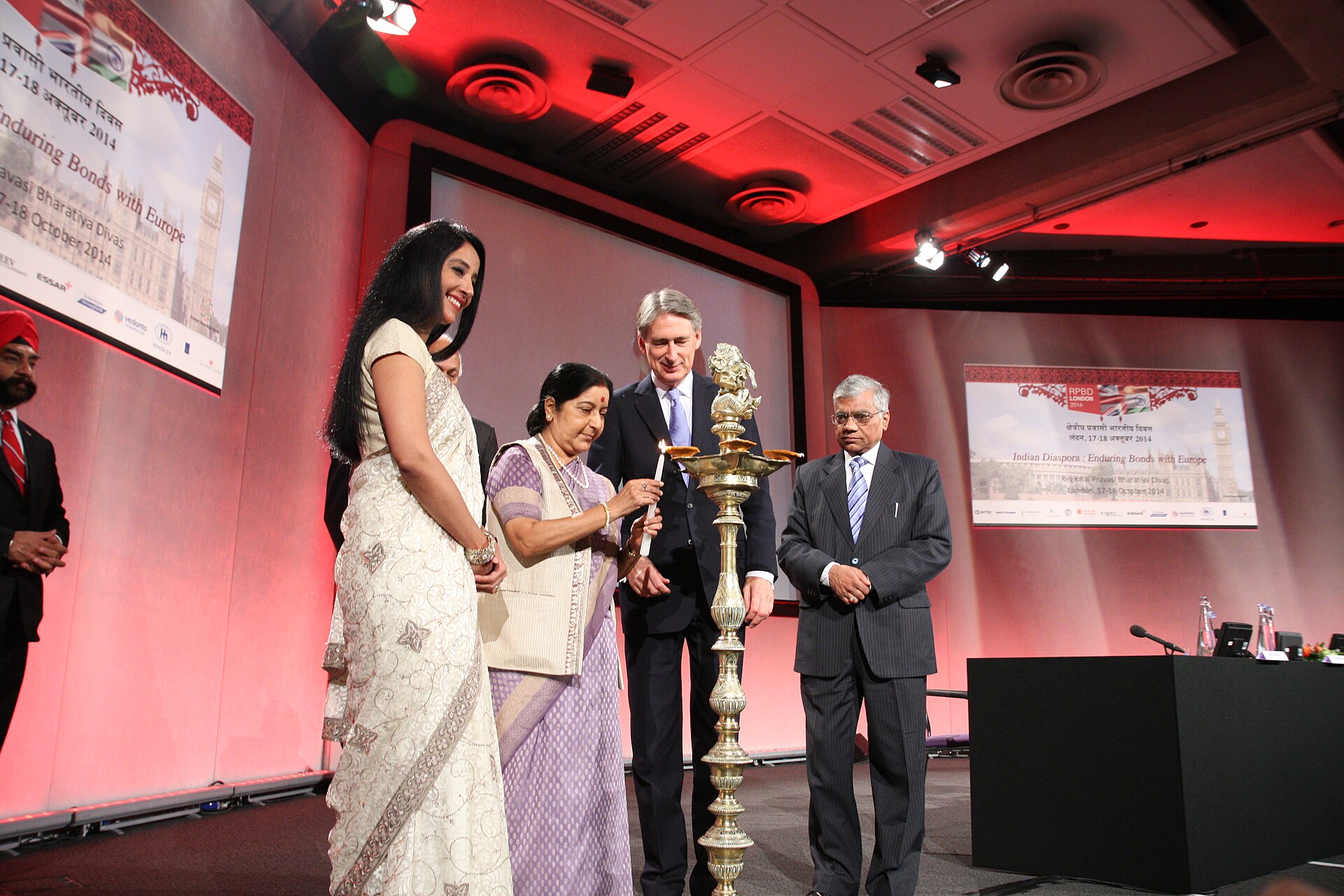
India government position shifted correspondingly. For decades after independence the official attitude to emigrants was cool: Jawaharlal Nehru advised Indians abroad to be loyal citizens of their adopted countries and expect nothing from India. That changed at the end of the 1990s. A Person of Indian Origin card was introduced in 1999, a High Level Committee on the Indian Diaspora chaired by L. M. Singhvi reported in 2001 and 2002, and Pravasi Bharatiya Divas has been observed since 2003 on 9 January, the date Gandhi returned from South Africa in 1915. The Overseas Citizen of India scheme, launched in 2005, provides a lifelong visa and most economic rights but not voting rights or public office, because the Constitution does not permit dual citizenship. India also receives more remittances than any other country, which is the plainest measure of why the state changed its mind. What began as departure the government preferred not to discuss has become a relationship it actively manages.
References
- Ministry of External Affairs, Government of IndiaIndian diaspora and overseas citizenship
- Migration Policy InstituteIndian immigrants in the United States
- World BankMigration and Development Brief series
- Department of Home Affairs, AustraliaHistorical migration statistics
- Encyclopaedia BritannicaPartition of India
This is a reference article, written from the sources above. It is background, not news reporting.