
Punjabi: Language of Poetry, Farming and the Diaspora
Reference library · 1100 words
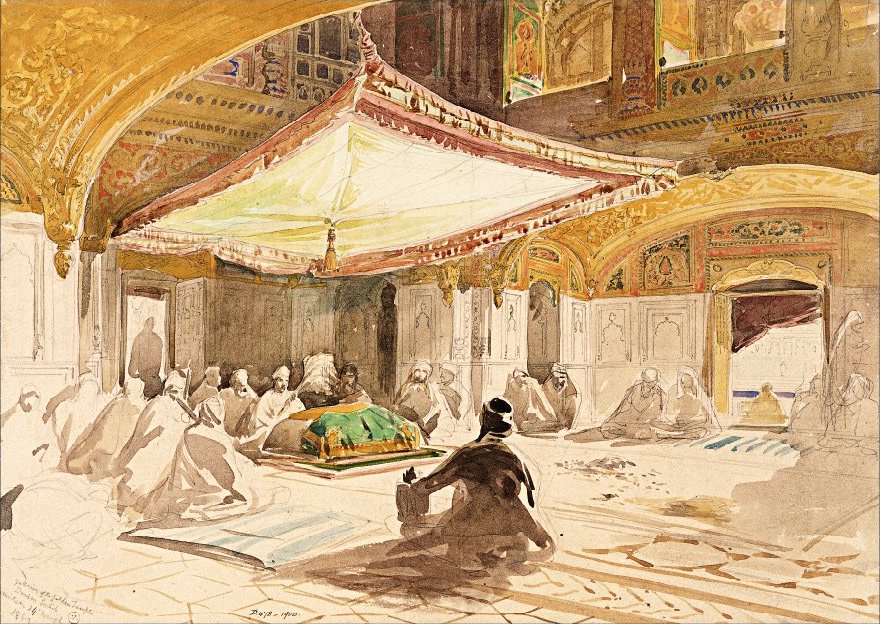
_in_Amritsar_by_William_Simpson,_ca.1860.jpg)
Punjabi is an Indo-Aryan language spoken across a region that was cut in two in 1947 and has never been reassembled. It is the majority language of Pakistan by number of speakers, although Urdu holds the national language position there, and it is the official language of the Indian state of Punjab. Counting both sides of the border and the communities abroad, it ranks among the ten or so most widely spoken languages in the world. What makes it unusual is not its size but the way it has been carried: by a scripture, by a body of Sufi love poetry, by an agricultural economy that reshaped India, and by one of the most mobile populations on earth.
Linguistically it has a feature rare in its family. Punjabi is tonal. Where older Indo-Aryan had voiced aspirated consonants, Punjabi lost the aspiration and converted the distinction into pitch, so that words otherwise identical are separated by a rising or falling tone on the vowel. Learners from Hindi or Urdu backgrounds, who can otherwise follow much of the vocabulary, find this the hardest thing to acquire. The grammar is close enough to Hindi and Urdu that basic conversation across the three is possible, which leads outsiders to underestimate how far apart the literary traditions are.
Two scripts, one language
The deepest division in Punjabi is not spoken but written. In Indian Punjab the language is written in Gurmukhi, a script whose standardisation is attributed to Guru Angad, the second Sikh Guru, in the sixteenth century, and which is used for the Guru Granth Sahib, the Sikh scripture compiled by Guru Arjan in 1604 and installed at the Harmandir Sahib in Amritsar. In Pakistani Punjab the language is written in Shahmukhi, a Perso-Arabic script closely related to the one used for Urdu. The consequence is severe: a literate Punjabi speaker in Lahore generally cannot read a book printed in Ludhiana, and the reverse is true, even though the two would understand each other perfectly in speech. Transliteration projects and digital tools have chipped away at this, but a single reading public has not re-formed.
The literary inheritance is older than the border and belongs to both sides. Baba Farid, a Sufi of the twelfth and thirteenth centuries whose shrine is at Pakpattan in present day Pakistan, has verses included in the Sikh scripture. Shah Hussain of Lahore, Sultan Bahu, and above all Bulleh Shah of Kasur in the eighteenth century produced a devotional poetry that dissolves religious boundaries and is still sung today by qawwals, folk singers and pop artists alike. The great romance is Heer Ranjha, given its definitive form by Waris Shah in 1766, a work so embedded that its verses are common reference in ordinary speech. When the poet Amrita Pritam wrote her famous lament on the violence of Partition, she addressed it to Waris Shah and asked him to speak from his grave, which every Punjabi reader understood instantly.
Punjabi's official position in India was itself won by agitation. The Punjabi Suba movement pressed through the 1950s and early 1960s for a state organised around the language, and in 1966 the old Indian Punjab was divided into a smaller Punjabi speaking Punjab, a Hindi speaking Haryana, and additions to Himachal Pradesh. The campaign was complicated by census returns in which many Punjabi speaking Hindus recorded Hindi as their mother tongue, a political act as much as a linguistic one, and the episode is still cited in arguments about what census language data actually measures.
The language of a farming revolution
From the mid 1960s, Punjab on the Indian side became the laboratory of the Green Revolution. High yielding dwarf wheat varieties, developed from work associated with Norman Borlaug and adapted in India under M. S. Swaminathan, were introduced alongside assured irrigation from canal and tubewell, subsidised fertiliser, and guaranteed state purchase at a minimum support price through the regulated market yards known as mandis. Punjab Agricultural University at Ludhiana, established in 1962, supplied the science and the extension network. Within about a decade India moved from importing grain under emergency arrangements to holding buffer stocks, and Punjab, a small state by area, supplied a disproportionate share of the wheat and rice in the central pool.
The costs arrived later and are now the central subject of Punjabi public debate. Growing paddy in a semi arid state has drawn groundwater down to depths that make pumping expensive and, in many blocks, unsustainable. Burning rice stubble in the short window before wheat sowing contributes to the autumn air pollution that settles over Delhi. Land holdings have fragmented across generations, input costs have risen faster than procurement prices, and rural indebtedness and farmer suicides have become a recognised crisis. When three farm laws were passed in 2020 to loosen the regulated market system, Punjabi farmers formed the core of the protest camps on the approaches to Delhi that lasted more than a year, until the laws were repealed in November 2021. The Punjabi language was the medium of those protests: their songs, their stage speeches and their slogans.
A language that travels
Punjabis have migrated in large numbers since the late nineteenth century, first as soldiers and labourers within the British empire, then to the Pacific coast of North America, where the Komagata Maru, carrying mostly Punjabi passengers, was turned away from Vancouver in 1914 in an episode Canada later apologised for. Later waves went to Britain after the Second World War, filling foundries and textile mills in the West Midlands and settling in areas such as Southall in west London. Punjabi is now among the most spoken languages in Canada and has been used in the Canadian Parliament. In Australia it has been recorded in successive censuses as one of the fastest growing languages spoken at home, driven by student and skilled migration from Punjab since the 2000s.
The diaspora has become a producer of Punjabi culture rather than merely a consumer of it. Bhangra, originally a harvest dance, was rebuilt in British Punjabi clubs in the 1980s with drum machines and reggae influences and then exported back to India. Punjabi language popular music now routinely reaches global streaming charts and is recorded as often in Toronto or Birmingham as in Chandigarh. Whether this secures the language is disputed. Broad audibility is not the same as intergenerational transmission, and some observers argue that children in diaspora households increasingly understand Punjabi without speaking it, while others point to the growth of weekend schools, community radio and formal examinations abroad as evidence that the language is being deliberately maintained rather than passively lost.
References
- Encyclopaedia BritannicaPunjabi language
- Government of Punjab, IndiaGovernment of Punjab
- Punjab Agricultural UniversityPunjab Agricultural University, Ludhiana
- Australian Bureau of StatisticsCultural diversity of Australia
This is a reference article, written from the sources above. It is background, not news reporting.