
Puppetry and Folk Theatre Traditions
Reference library · 1127 words
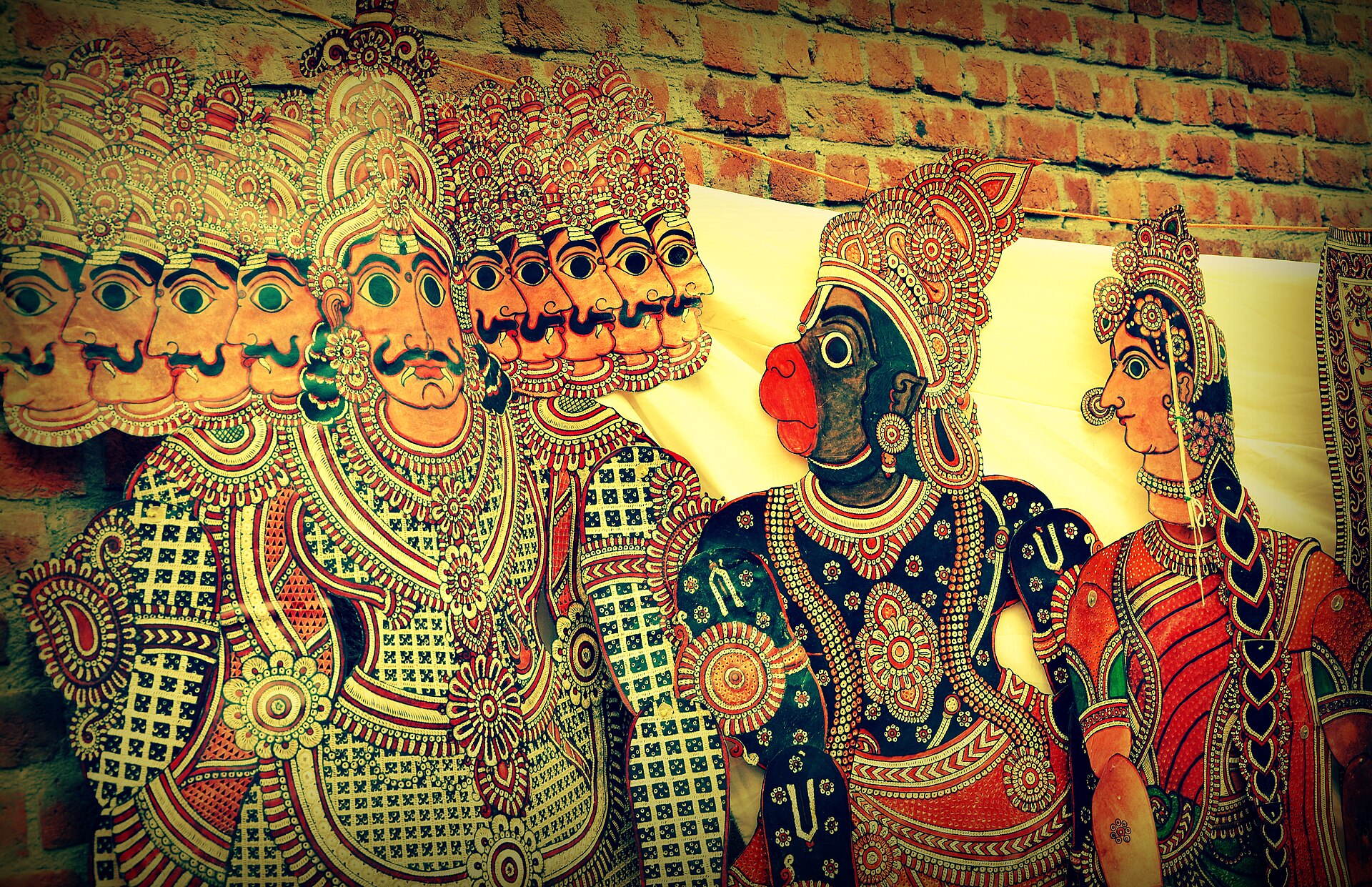

Before cinema, before radio, and long before television, the way most Indians encountered the Ramayana and the Mahabharata was not by reading them. It was by sitting on the ground in a village square or a temple courtyard, often through the night, watching performers in painted masks and enormous headdresses, or watching leather figures move behind a lit cotton screen. These forms are usually filed under the vague heading of folk art, which understates them. They are complete theatrical systems with their own conventions of music, verse, improvisation and audience address.
The four puppet families
Indian puppetry divides conventionally into four families, distributed unevenly across the country. String puppetry is best known through the Kathputli of Rajasthan, wooden figures in long skirts manipulated by a small number of strings tied to the puppeteer's fingers, traditionally performed by families of the Bhat community whose repertoire centres on the legend of Amar Singh Rathore, a seventeenth century Rajput noble. Karnataka has its own string tradition, Gombeyatta, whose puppets are jointed at neck, shoulders, elbows, hips and knees and whose stories draw on the Yakshagana repertoire. In Tamil Nadu, Bommalattam uses some of the largest and heaviest puppets anywhere, controlled by strings from an iron ring worn on the puppeteer's head together with rods held in the hands.
Shadow puppetry is southern and eastern. Tholu Bommalata of Andhra Pradesh and Telangana uses large, brilliantly coloured translucent figures of treated goat or deer hide, sometimes taller than a person, thrown onto a white screen by an oil lamp or now an electric bulb. Karnataka's Togalu Gombeyatta scales the puppet's size to the character's rank. Ravanachhaya of Odisha is the most austere of them: its figures, made of deer skin, are not coloured and have no jointed limbs, so the entire effect depends on silhouette and movement. Tholpavakoothu in Kerala is not really a village entertainment at all but a temple ritual, performed in a dedicated structure called a koothumadam in Bhagavathy temples of the Palakkad and Thrissur region during the festival season, narrating the Ramayana in a version derived from the Tamil Kamba Ramayanam over many consecutive nights, whether or not anyone is watching.
Rod puppetry survives principally in eastern India, in the Putul Nautch of West Bengal, where near life sized figures are supported on rods strapped to the performer's waist, and in the Yampuri of Bihar, carved from a single piece of wood without joints. Glove puppetry is the smallest family, and includes the remarkable Pavakathakali of Kerala, in which hand puppets perform the repertoire, costume and gestural language of full scale Kathakali dance drama in miniature.
Folk theatre and its occasions
Live folk theatre is even more varied because almost every linguistic region developed its own. In the Hindi belt, Ramlila stages the Ramayana across days or weeks, culminating in the burning of effigies of Ravana at Dussehra. The most elaborate version, at Ramnagar across the river from Varanasi, has been staged under the patronage of the Maharaja of Banaras since the nineteenth century, runs for about a month, and uses the whole town as its set, with the audience walking from location to location as the story moves. Ramlila was inscribed on the UNESCO Representative List of the Intangible Cultural Heritage of Humanity in 2008. Nautanki of Uttar Pradesh, developed around the towns of Hathras and Kanpur, is a secular, often bawdy operatic form built on sung verse metres and driven by the nagara drum. Bhavai in Gujarat, Tamasha in Maharashtra, Swang in Haryana, Jatra in Bengal and Odisha, and Therukoothu, literally street theatre, in Tamil Nadu each occupy a comparable place.
Some forms sit at the boundary between folk and classical. Yakshagana of coastal Karnataka combines elaborate headgear and painted faces with a sung narrative delivered by a bhagavata who also conducts the performance. Kutiyattam, the Sanskrit theatre of Kerala performed in temple theatres by Chakyar families, was among the first traditions anywhere to be recognised by UNESCO, in 2001. Chhau, the masked and unmasked dance theatre of the Seraikella, Purulia and Mayurbhanj traditions on the borders of Jharkhand, West Bengal and Odisha, was added in 2010. In Assam, the Ankiya Nat plays composed in the sixteenth century by the reformer Sankardev are performed as Bhaona in the namghar prayer halls and in the monastic satras of Majuli, making them one of the few Indian theatre traditions with a named single author and a surviving script tradition.
Three features recur across almost all of these. The audience is on three or four sides rather than in front, so staging is presentational rather than illusionistic. There is a narrator figure, the sutradhara or bhagavata or equivalent, who introduces characters, comments on the action and manages the transition between scenes. And there is a licensed comic who breaks the frame to make jokes about local officials, prices and current events, which is how a script fixed for centuries stays current.
Patronage, loss and revival
The economic base of these forms has been eroding for a century, and the mechanism is not mysterious. Court and landlord patronage ended with the abolition of princely states and zamindari. All night performances compete against television and now against a phone. Performing families depended on a circuit of village engagements at harvest and festival times; as agricultural labour migrated to cities, the circuit thinned. Puppeteers from Nagaur in Rajasthan who settled a district near Shadipur in Delhi known as the Kathputli Colony found themselves, decades later, at the centre of a redevelopment scheme that dispersed many families to transit accommodation, which shows how precarious their material footing is.
Institutional support exists but is thin. The Sangeet Natak Akademi, established in the early 1950s, documents and awards folk artists. The Song and Drama Division of the central government, set up in 1954, has employed folk troupes for decades to carry public messages on immunisation, literacy, family planning and elections, which provides income and simultaneously bends the repertoire towards state messaging. Museums and festivals, including the Bharatiya Lok Kala Mandal founded at Udaipur in the early 1950s, keep skills alive, and UNESCO listing has brought grant funding.
Whether this amounts to revival is genuinely disputed. A form transferred to a proscenium stage at an urban festival, compressed from eight hours to ninety minutes, performed to an audience that shares neither the language nor the ritual calendar, is preserved in one sense and hollowed out in another. The counter argument is that survival on any terms beats extinction, and that traditions have always adapted to their patrons. What is not disputed is that the number of families able to live by these skills continues to fall, and that transmission within families, which is how the repertoire has always passed on, is the link most at risk.
References
- UNESCORamlila, the traditional performance of the Ramayana
- UNESCOKutiyattam, Sanskrit theatre
- UNESCOChhau dance
- Sangeet Natak AkademiTraditional Theatre and Puppetry Programmes
- Indira Gandhi National Centre for the ArtsFolk and Traditional Performing Arts of India
This is a reference article, written from the sources above. It is background, not news reporting.