
Raksha Bandhan: A Thread Between Siblings
Reference library · 968 words
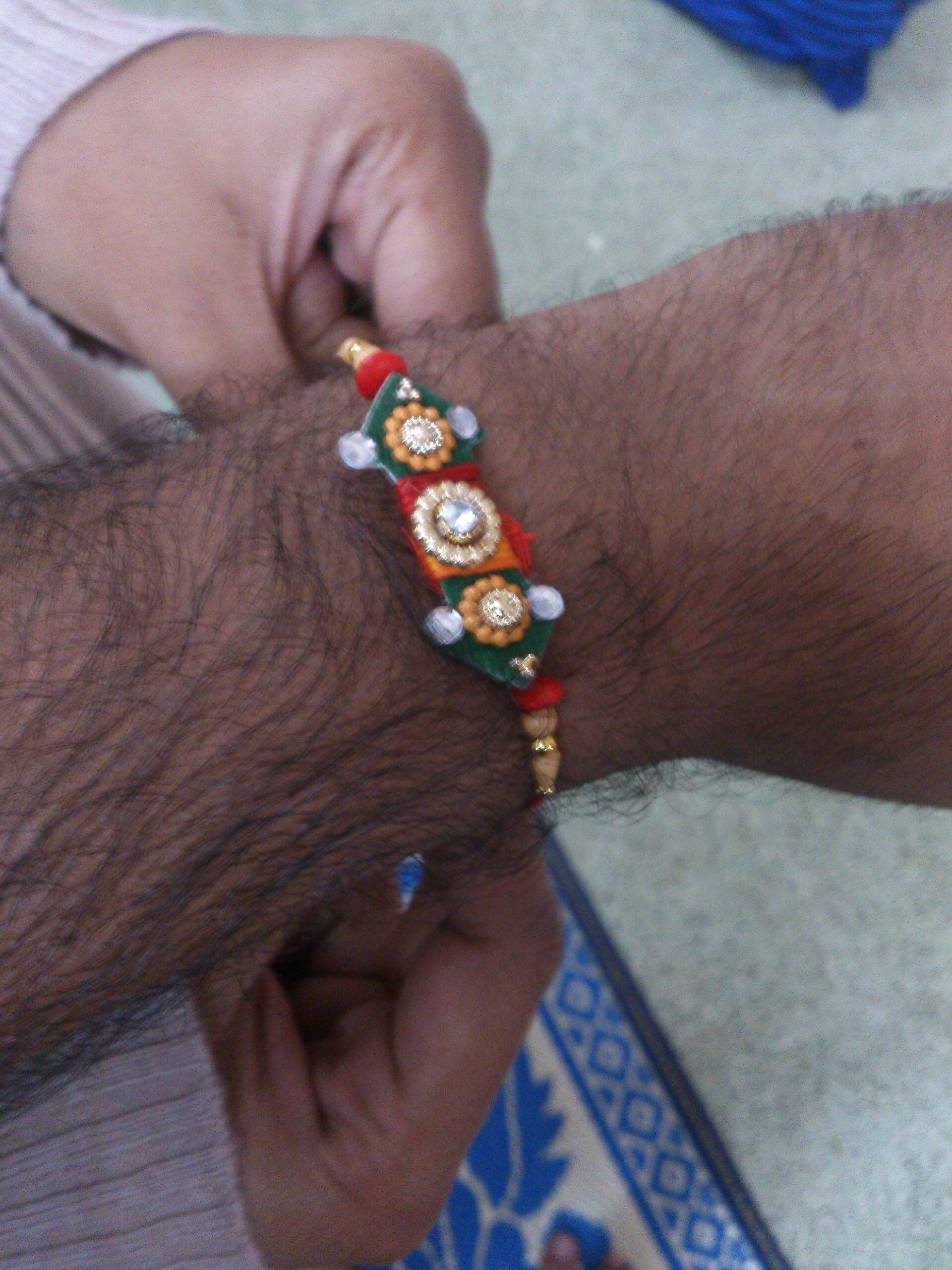

On the full moon day of the month of Shravana, which falls in late July or August, millions of Indian households perform a small domestic ritual. A sister ties a decorated thread, the rakhi, around her brother's right wrist, marks his forehead with a tilak of vermilion and rice, offers him a sweet and receives a gift and, more importantly, an implied undertaking of protection. The Sanskrit name says it plainly: raksha means protection, bandhan means bond or tying.
The ritual is short, but the festival is not one thing. Raksha Bandhan as most Indians now perform it, with the brother and sister at its centre, is largely a north and west Indian practice that spread nationally through the twentieth century, helped by cinema, by the postal system and by the migration of northern families into the metros. On the same lunar date, other communities do something quite different. Along the Konkan and Maharashtra coast the day is Nariyal Purnima, coconut full moon, when fishermen offer coconuts to the sea to mark the calming of the monsoon and the resumption of the fishing season. Among Brahmin communities in south and west India the day is Upakarma, also called Avani Avittam in the Tamil country, when the sacred thread worn across the shoulder is ceremonially replaced and Vedic study formally recommenced. In parts of Uttar Pradesh, Bihar and Madhya Pradesh the day carries the name Kajari Purnima and is associated with the sowing of barley and with songs about the rainy season. In Gujarat the day is observed as Pavitropana with rituals in Shiva temples. It is more accurate to say that a single auspicious full moon carries several unrelated observances than that one festival has regional variants.
What is history and what is not
Popular accounts attach the festival to a series of stories, and it is worth separating them carefully. The most repeated is that Rani Karnavati of Chittor sent a rakhi to the Mughal emperor Humayun asking for help against Bahadur Shah of Gujarat in 1535. The story circulates widely, but it does not appear in contemporary sources and historians generally treat it as a later legend rather than a documented event. Other tales involving figures from the Mahabharata, such as Draupadi tearing cloth to bind Krishna's bleeding hand, are drawn from epic and devotional literature rather than from any historical record of the ritual.
One episode is genuinely documented. In 1905 the British administration partitioned Bengal, and Rabindranath Tagore urged Hindus and Muslims to tie threads on one another's wrists as a public demonstration that the province should not be divided along religious lines. Processions of people exchanging rakhis moved through Calcutta. That use of the thread as a political and civic symbol rather than a family one has been repeated many times since, when rakhis are sent to soldiers on the border, tied on police officers or presented to politicians.
Why a sibling ritual matters so much
The festival's persistence is easier to understand once the social structure around it is described. Across much of northern India, marriage is patrilocal and village exogamous: a woman marries out of her natal village and joins her husband's household, often at some distance. Her brother becomes the institutional link back to where she came from. He is expected to visit, to send gifts at festivals and childbirth, and in a crisis to intervene. Raksha Bandhan formalises and refreshes that claim once a year, and the gift given in return is not incidental. In a system where daughters historically received a dowry at marriage rather than a share of land, the brother's continuing obligation was in practice the substitute for an inheritance.
That legal background has changed, which is one reason the festival now attracts argument. The Hindu Succession (Amendment) Act of 2005 gave daughters equal rights by birth in ancestral property, and in the Vineeta Sharma judgment of 2020 the Supreme Court confirmed that a daughter's coparcenary right applies regardless of whether her father was alive when the amendment came into force. If a sister is a legal equal in the family estate, a ritual whose logic rests on a brother's protection reads differently. Some critics regard the rakhi as an annual re-enactment of female dependence. Others, including many women who perform it, describe it as a mutual and affectionate bond that is not primarily about vulnerability at all, and a growing number of families now tie threads between sisters, or between siblings in both directions. The disagreement is real and unlikely to be settled.
The festival has a second life as a social device. A rakhi tied on a man who is not a relative defines the relationship as fraternal and therefore not romantic, a signal that is understood immediately across north India and is used, sometimes gently and sometimes pointedly, by young women. The phrase rakhi brother has entered general Indian English.
Threads, post offices and freight
Commercially, Raksha Bandhan is among the larger retail moments of the Indian year. Rakhi manufacture is concentrated in workshops in Ahmedabad, Delhi, Kolkata and Indore, and ranges from a few rupees of coloured thread to gold and silver items sold by jewellers. India Post issues special waterproof rakhi envelopes in the weeks before the festival, courier companies advertise cut off dates, and sweet shops run at capacity. For the diaspora the logistics are part of the ritual: families in Melbourne, Auckland, Toronto, Nairobi or Dubai post rakhis to India weeks in advance, or receive them, and the video call while the thread is tied by proxy on a photograph or by a cousin standing in has become an ordinary part of the day. That adaptation is not a dilution so much as evidence of what the festival was always doing, which is keeping a claim alive across distance.
References
- Encyclopaedia BritannicaRaksha Bandhan
- BBCReligions: Hinduism
- Supreme Court of IndiaJudgments and case information
- Government of India, Ministry of Law and JusticeHindu Succession (Amendment) Act, 2005
- Victoria and Albert MuseumSouth Asian collections
This is a reference article, written from the sources above. It is background, not news reporting.