
Religious Pluralism in Everyday Indian Life
Reference library · 1098 words

India is the birthplace of four religions that spread beyond it, Hinduism, Buddhism, Jainism and Sikhism, and it is also home to some of the oldest continuously settled communities of two religions that arrived from outside, Christianity and Islam, along with Zoroastrians, Jews and Baha'is. According to the 2011 census, close to eighty per cent of the population identified as Hindu, a little over fourteen per cent as Muslim, and roughly two per cent as Christian, with Sikhs, Buddhists and Jains accounting for most of the remainder. Those percentages conceal enormous absolute numbers. India's Muslim population is among the largest of any country in the world, and its Christian population is larger than the total population of many European states.
Pluralism in India, though, is not primarily a matter of statistics. It is a matter of how days are organised. The public holiday calendar of any Indian state includes Hindu, Muslim and Christian festivals, and often Sikh, Jain, Buddhist and Parsi ones too. Offices in Mumbai close for Ganesh Chaturthi and for Eid. Schools in Kerala mark Onam, Christmas and Eid alike. Restaurants advertise pure vegetarian food because Jain and many Hindu customers require it, and separately advertise halal meat, frequently on the same street. Most Indians navigate this without any theory about it.
Shared shrines and borrowed practice
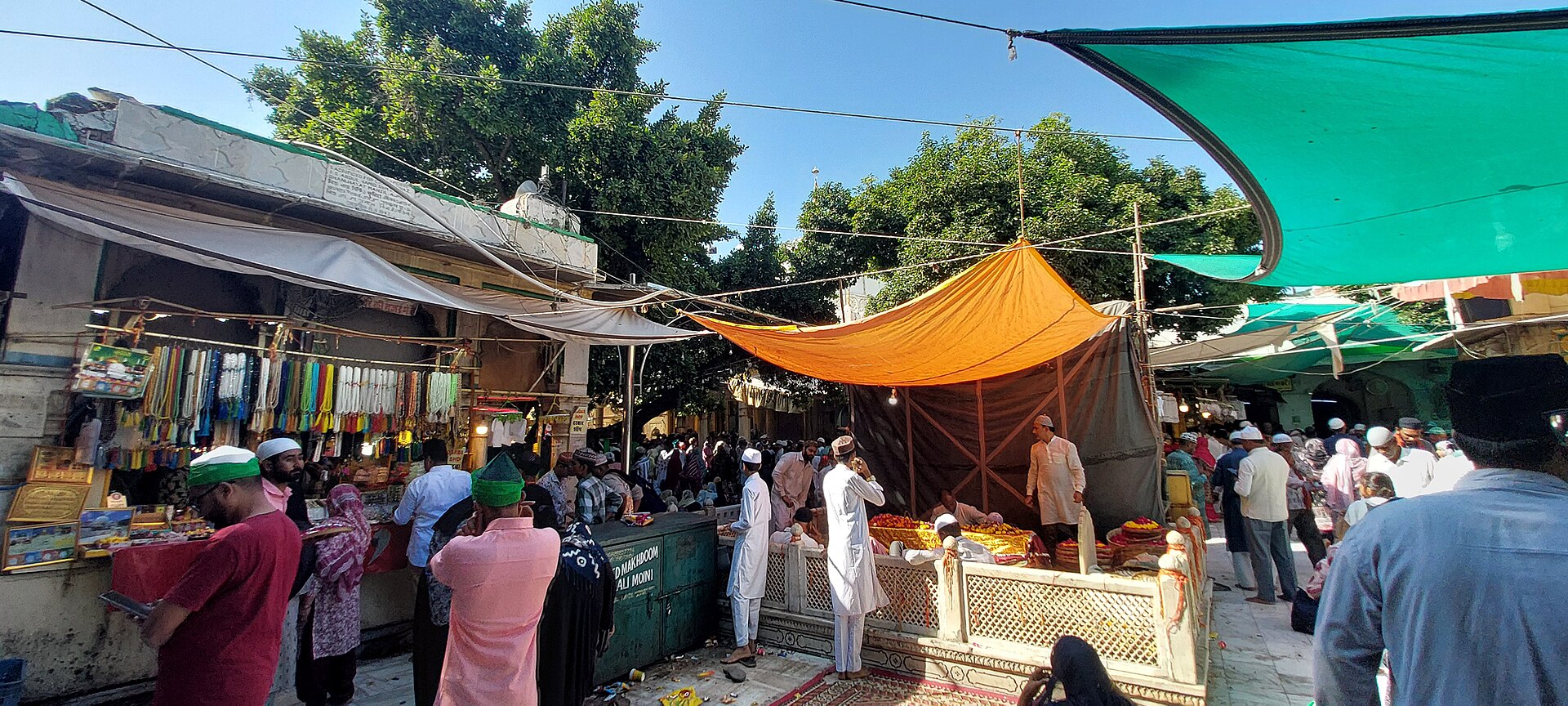
The more striking evidence is at shrines that draw worshippers across religious lines. The dargah of Moinuddin Chishti at Ajmer in Rajasthan, the tomb of a thirteenth century Sufi saint, receives very large numbers of pilgrims annually, of whom a substantial share are Hindu. The same pattern holds at the shrine of Nizamuddin Auliya in Delhi and at Haji Ali off the Mumbai shoreline. In the other direction, the basilica of Our Lady of Health at Velankanni on the Tamil Nadu coast attracts Hindu devotees in large numbers, who make vows and offerings there in forms recognisable from Hindu practice. Pilgrims travelling to the hill shrine of Sabarimala in Kerala traditionally stop at the mosque of Vavar at Erumely, a figure remembered in local legend as a companion of the deity Ayyappan.
Some of this reflects deep historical entanglement. The Christians of Kerala trace their community to the apostle Thomas and were established on the Malabar coast many centuries before European missionaries arrived, using Syriac liturgy and organised along lines that mirrored surrounding caste society. The Bhakti and Sufi movements from roughly the twelfth century onward produced poets and teachers whose devotional language crossed boundaries; Kabir, a weaver from Varanasi, is claimed by Hindus, Muslims and Sikhs alike and his verses are included in the Sikh scripture. Guru Nanak, the founder of Sikhism, taught in a vocabulary drawing on both traditions. Musical forms carry the same mixture: qawwali is Sufi devotional music with Indian classical structure, and classical music lineages routinely cross religious lines.
The legal architecture, and the strain on it
The Constitution frames all this in a particular way. Articles 25 to 28 guarantee freedom of conscience and the right to profess, practise and propagate religion, subject to public order, morality and health, and grant religious denominations the right to manage their own affairs and institutions. Indian secularism, as the courts have described it, does not mean the state ignores religion; it means the state is meant to treat religions equally, which in practice has included regulating Hindu temple administration in several states, funding pilgrimages, and maintaining separate systems of family law.
That last point is the sharpest live issue. India has no single family law. Hindus, which for statutory purposes includes Sikhs, Buddhists and Jains, are governed by codified legislation on marriage, succession, adoption and maintenance passed in the mid 1950s. Muslims are governed largely by Muslim personal law as applied through a 1937 statute, Christians and Parsis by their own nineteenth and twentieth century acts, and anyone may instead marry under the Special Marriage Act of 1954, a civil route that requires public notice and a waiting period. Article 44 of the Constitution directs the state to endeavour to secure a uniform civil code, and this has been argued about for the entire life of the Republic. Supporters present it as a matter of equality, especially for women; opponents see it as majoritarian pressure on minority identity, and note that Hindu law itself was reformed only against strong internal resistance. Goa retains a common civil code inherited from Portuguese rule, and Uttarakhand has legislated its own, so the question is no longer purely hypothetical.
It would be dishonest to describe Indian pluralism as untroubled. Communal violence has recurred across the independence era, including in Bombay in 1992 and 1993, in Gujarat in 2002, and in north east Delhi in 2020, each with substantial loss of life and each the subject of continuing legal and political dispute over responsibility. The demolition of the Babri Masjid at Ayodhya on 6 December 1992 by a mobilised crowd set off nationwide rioting; the Supreme Court's judgment of 9 November 2019 awarded the disputed site for the construction of a temple, which was consecrated in January 2024, while directing that alternative land be allotted for a mosque. Several states have enacted laws restricting religious conversion, framed as prohibiting conversion by force, fraud or inducement, which critics argue are applied in practice to obstruct legitimate conversion and interfaith marriage. Whether these developments represent a durable narrowing of Indian pluralism or a turbulent phase within a system that has absorbed such shocks before is genuinely and heatedly contested, and any confident answer should be treated with suspicion.
What is observable is that everyday accommodation continues alongside the political conflict, and the two are not the same thing. Interreligious neighbourhoods, workplaces, business partnerships and friendships remain the ordinary texture of Indian urban life, and rural life in most places has its own long standing arrangements of mutual participation in festivals and life cycle events. The Sikh institution of langar, the free community kitchen attached to every gurdwara that serves anyone who comes regardless of religion or status, is a formalised version of the same principle, and it has become one of the most visible Indian contributions to civic life abroad, including in Australian, British and Canadian cities during floods, fires and the pandemic. For Indian communities overseas, pluralism often becomes more deliberate than it was at home: a Hindu temple, a mosque, a gurdwara and a church built by migrants from the same district may share a suburb, a car park and a council planning fight, and the habit of coexistence that was unexamined in India becomes something people notice themselves practising.
References
- Office of the Registrar General and Census Commissioner, IndiaCensus of India 2011: Religion
- Government of India, Ministry of Law and JusticeThe Constitution of India, Articles 25 to 28
- Pew Research CenterReligion in India: Tolerance and Segregation
- Supreme Court of IndiaM Siddiq v Mahant Suresh Das (Ayodhya judgment, 2019)
This is a reference article, written from the sources above. It is background, not news reporting.