
Sanskrit's Enduring Heritage
Reference library · 1024 words
.jpg)
Sanskrit occupies an odd position among the world's languages. Almost nobody speaks it as a first language, yet it is a scheduled language of the Indian Constitution, taught in universities on every continent, chanted daily in temples and homes across South Asia and its diaspora, and quarried constantly for new vocabulary by modern Indian languages in the way European languages quarry Latin and Greek. It is not quite dead and not quite alive, and the reasons for that in-between condition are the most interesting thing about it.
Linguistically, Sanskrit belongs to the Indo-Iranian branch of the Indo-European family, which makes it a relative of Persian, Greek, Latin, Armenian and the Germanic, Slavic and Celtic languages. That relationship was not obvious to Europeans until Sir William Jones, a judge in Calcutta and a founder of the Asiatic Society, argued in an address in 1786 that Sanskrit bore a resemblance to Greek and Latin stronger than could possibly have been produced by accident, and suggested all three sprang from a common source no longer existing. The claim was not entirely new, but Jones made it stick, and it launched comparative philology as a discipline. Nineteenth century European linguistics, and with it the reconstruction of Proto-Indo-European, was built substantially on Sanskrit evidence, because the language preserved archaic features that Greek and Latin had lost.
Panini and the rule system
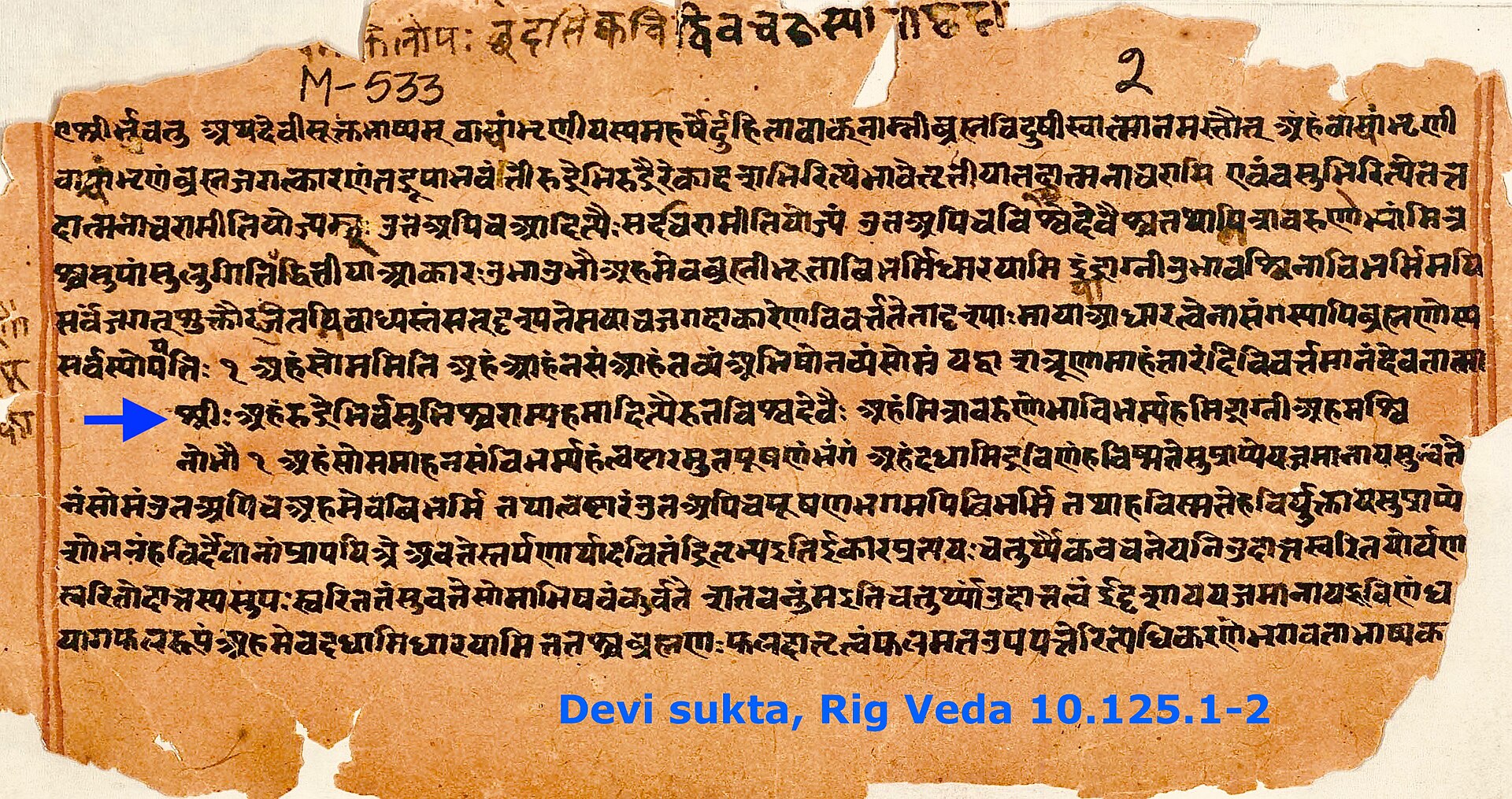
The oldest form of the language, Vedic Sanskrit, is the language of the Rigveda and the other Vedic collections, composed over centuries in the second millennium before the common era and transmitted orally for a very long time before being written down. The transmission methods were themselves remarkable: reciters memorised the text not only in ordinary sequence but in permuted forms, word by word, in overlapping pairs, and in elaborate interlocking patterns, so that any corruption in one recitation would fail to match the others. This redundancy is why the Vedic text is unusually stable across manuscript traditions, and UNESCO has recognised the tradition of Vedic chanting on its intangible heritage list.
The pivotal moment for the language, though, was grammatical. Around the fifth or fourth century before the common era, Panini composed the Ashtadhyayi, a description of Sanskrit in roughly four thousand extremely compressed rules. It is not a schoolbook. It is a generative system: a set of ordered rules with meta-rules governing how they apply and which takes precedence in conflict, together with a technical shorthand of abbreviated sound classes that allows enormous economy of statement. Given a root and a set of grammatical conditions, the system derives the correct form. Linguists in the twentieth century recognised it as a formal grammar of a sophistication not matched in the West until modern times, and it was later commented on and refined by Katyayana and by Patanjali in the Mahabhashya. The practical effect of Panini's work was to freeze the language. Classical Sanskrit is, essentially, the language as Panini described it, and correctness thereafter meant conformity to that description.
This is why Sanskrit stopped changing while the spoken languages around it kept moving. The Prakrits, and later the modern Indo-Aryan languages including Hindi, Bengali, Marathi, Gujarati and Punjabi, descend from ordinary speech, not from the codified literary standard. Sanskrit became a learned second language, acquired through education rather than at home, used across an enormous region by people whose everyday speech differed completely. That is exactly the position Latin occupied in medieval Europe, and it produced the same result: a shared high register enabling communication across political and vernacular boundaries.
What was written in it
The literature is vast and far more varied than its devotional reputation suggests. The two great epics, the Mahabharata and the Ramayana, sit alongside a sophisticated courtly tradition: Kalidasa's play Abhijnanashakuntalam and his lyric Meghaduta, Shudraka's urban comedy Mrichchhakatika, Bana's prose romances, Jayadeva's twelfth century Gita Govinda. There is systematic philosophy across several competing schools, including materialist and sceptical positions, and a body of political and economic writing of which the Arthashastra is the best known. There is also serious science. Aryabhata's Aryabhatiya of 499 gives a place-value based computational system and a startlingly good approximation of pi; Brahmagupta's work of 628 sets out rules for operating with zero and with negative quantities; Bhaskara II wrote in the twelfth century; the Kerala school associated with Madhava of Sangamagrama developed infinite series expansions for trigonometric functions centuries before comparable European work. Medicine has the Charaka and Sushruta compendia. Grammar, poetics, metrics, law and astronomy all have technical literatures.
Sanskrit also travelled. Between roughly the fourth and thirteenth centuries it functioned as a prestige language across mainland and island Southeast Asia, with royal inscriptions in Sanskrit in Cambodia, Champa, Java and elsewhere, and with local elites adopting Sanskrit names, titles and literary forms. The scholar Sheldon Pollock has called this zone the Sanskrit cosmopolis, and its traces survive today in the Sanskrit-derived vocabulary of Thai, Khmer, Javanese, Malay and Burmese, and in place and personal names throughout the region.
The modern situation is contested in ways worth stating directly. Indian censuses record only a very small number of people claiming Sanskrit as a mother tongue, though a much larger number study it, and there are villages and institutions where conversational Sanskrit is deliberately cultivated. The Indian state supports the language through a central Sanskrit university system and through funding for traditional pathashalas, and this support is politically charged: critics argue that resources go to a language of historically restricted access, since formal Vedic learning was long confined by caste and largely closed to women, while advocates argue that the corpus is a national scholarly inheritance that would otherwise be lost, and that access today is open to anyone. A separate and persistent claim, that a space agency identified Sanskrit as the ideal language for computing, is a misreading of a 1985 research article that discussed how Sanskrit grammarians' analysis of sentences resembles the knowledge-representation structures used in artificial intelligence. It was an interesting observation about grammatical theory, not an endorsement of Sanskrit as a programming language, and it is worth setting aside so that the genuinely remarkable achievement, Panini's grammar, gets the attention instead.
References
- Encyclopaedia BritannicaSanskrit language
- UNESCOIntangible Cultural Heritage: Tradition of Vedic chanting
- University of CologneCologne Digital Sanskrit Dictionaries, including Monier-Williams
- Sahitya AkademiIndian literature in the scheduled languages
This is a reference article, written from the sources above. It is background, not news reporting.