
Script Diversity: How India Writes
Reference library · 1056 words

Take an Indian banknote and turn it over. Along one side runs a panel giving the denomination in fifteen languages, in addition to the Hindi and English on the front. It is one of the few places where the ordinary citizen encounters, in a single glance, the fact that India does not write in one script or two but in more than a dozen in current official use, with several more in active community use and a number of newly created ones in the process of establishing themselves. This is not the same thing as linguistic diversity. Several languages share a script, and at least one language is written in two scripts by different communities. Script is a separate dimension, and it carries its own politics.
One ancestor, many descendants
Almost all of the scripts of India, and a great many outside it, descend from a single system. Brahmi is securely attested in the rock and pillar edicts issued by the emperor Ashoka in the third century BCE, distributed from Afghanistan to Karnataka. Its northwestern contemporary, Kharoshthi, written right to left and clearly derived from Aramaic, was used in Gandhara and along the Central Asian routes for several centuries before dying out entirely. Brahmi did not die out. It diverged. Regional hands drifted apart over a thousand years of manuscript copying, and by the medieval period the northern and southern branches had become mutually unreadable.
The knowledge of how to read Brahmi was itself lost, and its recovery is a good story. James Prinsep, working in Calcutta in the 1830s with the Asiatic Society, deciphered the script by comparing short donative inscriptions of predictable form, and the result unlocked the Ashokan edicts and with them a large part of early Indian chronology. Until that decipherment in 1837, the identity of the emperor named in those inscriptions was not known.
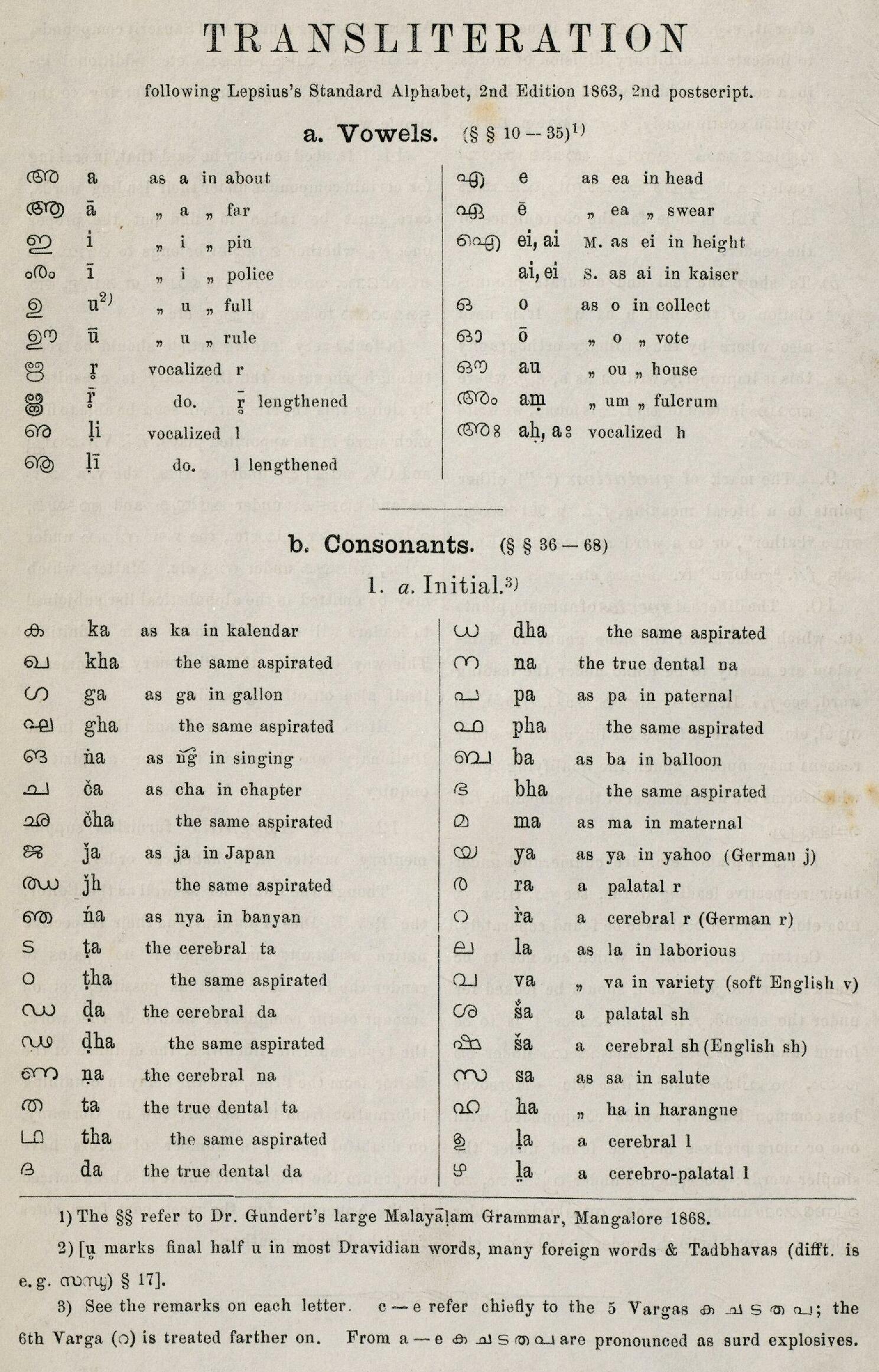
What all the descendants share is a structural principle that distinguishes them from both alphabets and syllabaries. Linguists call the type an abugida or alphasyllabary. The basic written unit is a consonant that already carries an inherent vowel, conventionally a short a. To write a different vowel you attach a diacritic mark, which may sit above, below, before or after the consonant, and may in some scripts wrap around it. To write a consonant with no vowel at all you either add a suppressing mark, the virama or halant, or you fuse the consonants into a conjunct ligature, which is why Devanagari and Bengali have hundreds of conjunct forms that must be learned as shapes. This is an elegant and phonetically precise system, and it is also the reason Indian scripts were difficult for early computing to handle.
The visible differences between descendants often come from writing materials. The rounded, almost circular letterforms of Odia, Kannada, Telugu, Malayalam and Sinhala are commonly attributed to writing with a stylus on palm leaf, where a straight incision along the grain would split the leaf, so scribes curved everything. The northern scripts, written with reed pen and ink on birch bark and paper, kept angular strokes and developed the shirorekha, the horizontal headline from which Devanagari and Bengali letters hang. Gujarati is essentially Devanagari with the headline dropped, a change that suited rapid commercial writing.
Scripts as identity, and scripts as politics
Because a script is visible in a way that grammar is not, it becomes a marker of community, and communities fight about it. Gurmukhi was standardised in the sixteenth century and is associated with the Sikh scriptural tradition; Punjabi written in the Perso-Arabic Shahmukhi script by Muslim Punjabis in Pakistan is the same language in a different garment, and speakers on either side of the border frequently cannot read one another. Hindi and Urdu present the mirror case: substantially the same spoken language at the colloquial level, written in Devanagari and in the Perso-Arabic nastaliq style respectively, with divergent formal vocabularies drawn from Sanskrit and from Persian and Arabic. The nineteenth-century controversy over which script would be used in the courts and administration of the North-Western Provinces was one of the formative episodes of communal politics in colonial India, and it was fought over letterforms.
Elsewhere script change has been an assertion of distinct identity. Manipur has progressively restored Meitei Mayek, the older script of the Meitei language, in place of the Bengali script that had been used for centuries, introducing it through the school system from the early 2000s. Santali, a major Austroasiatic language of eastern India, is written in Ol Chiki, a script devised in the twentieth century by Raghunath Murmu specifically so that Santali would not have to be written in the Bengali, Odia or Devanagari scripts of neighbouring dominant languages; the language's inclusion in the Eighth Schedule gave the script official standing. Several other Adivasi languages have similar purpose-built scripts. In the north-east, by contrast, missionary activity in the nineteenth and twentieth centuries established the Roman alphabet as the standard script for Mizo, Khasi and most Naga languages, and it has remained so. Sindhi in India is written in both an Arabic-based script and Devanagari, which is a live and unresolved matter within that community. And Marathi's older administrative script, Modi, fell out of official use in the twentieth century, leaving vast archives of land and revenue records that few people can now read.
The technological problem has been substantial and is now largely, though not entirely, solved. Early computing assumed a small character set and left-to-right sequences of independent letters, neither of which describes an Indic script with its reordering vowel signs and its conjunct ligatures. India adopted a national standard, ISCII, in the early 1990s, and the InScript keyboard layout was devised so that a single phonetically organised layout could serve all Brahmic scripts, since they share a common underlying inventory of sounds. Unicode subsequently encoded the major Indian scripts, and modern text rendering engines handle the required reordering and ligature substitution. What remains harder is the long tail: fonts of decent quality for minority scripts, optical character recognition for historical manuscripts, spell checking, speech systems and search that behaves sensibly across scripts. Government programmes have released free fonts and language tools for the scheduled languages, and the gap now falls most heavily on exactly those communities whose scripts carry the most identity weight and the least commercial value.
References
- Reserve Bank of IndiaBanknote features and language panel
- Unicode ConsortiumThe Unicode Standard, South and Central Asia scripts
- The British MuseumAshokan pillar and rock edicts
- Ministry of Electronics and Information Technology, Government of IndiaTechnology Development for Indian Languages
This is a reference article, written from the sources above. It is background, not news reporting.