Silk Road Connections to the Subcontinent
Reference library · 1028 words

The Silk Road was never a road, and the name is modern. The German geographer Ferdinand von Richthofen coined the term in the 1870s to describe the network of overland routes linking China with Central Asia and the Mediterranean, and it stuck so firmly that it now shapes how the whole of pre-modern Eurasian exchange is imagined. What actually existed was a shifting web of caravan routes, mountain passes, river valleys, oasis towns and sea lanes, along which almost nobody travelled the full distance. Goods moved in relays, passing through many hands and many markups. India sat in the middle of this web rather than at its edge, connected to it by land through the northwest passes and by sea through the ports of Gujarat, the Konkan and Malabar, and it was as much a source of what moved as a conduit for it.
The land routes and the Gandhara junction
The overland connection ran through what Indian texts call the Uttarapatha, the northern route, a corridor across the Gangetic plain and Punjab to Taxila, and from there through the passes of the Hindu Kush into Bactria and the Central Asian oasis cities. The mountain tracks of the upper Indus, through what is now Gilgit-Baltistan, carried a startling amount of traffic, and the evidence is written on the rocks. At Chilas, Shatial and along the Karakoram corridor there are many thousands of petroglyphs and inscriptions carved by travellers over centuries, in Kharoshthi, Brahmi, Sogdian, Bactrian and other scripts, depicting stupas, hunting scenes and animals, left by merchants and pilgrims recording their passage.
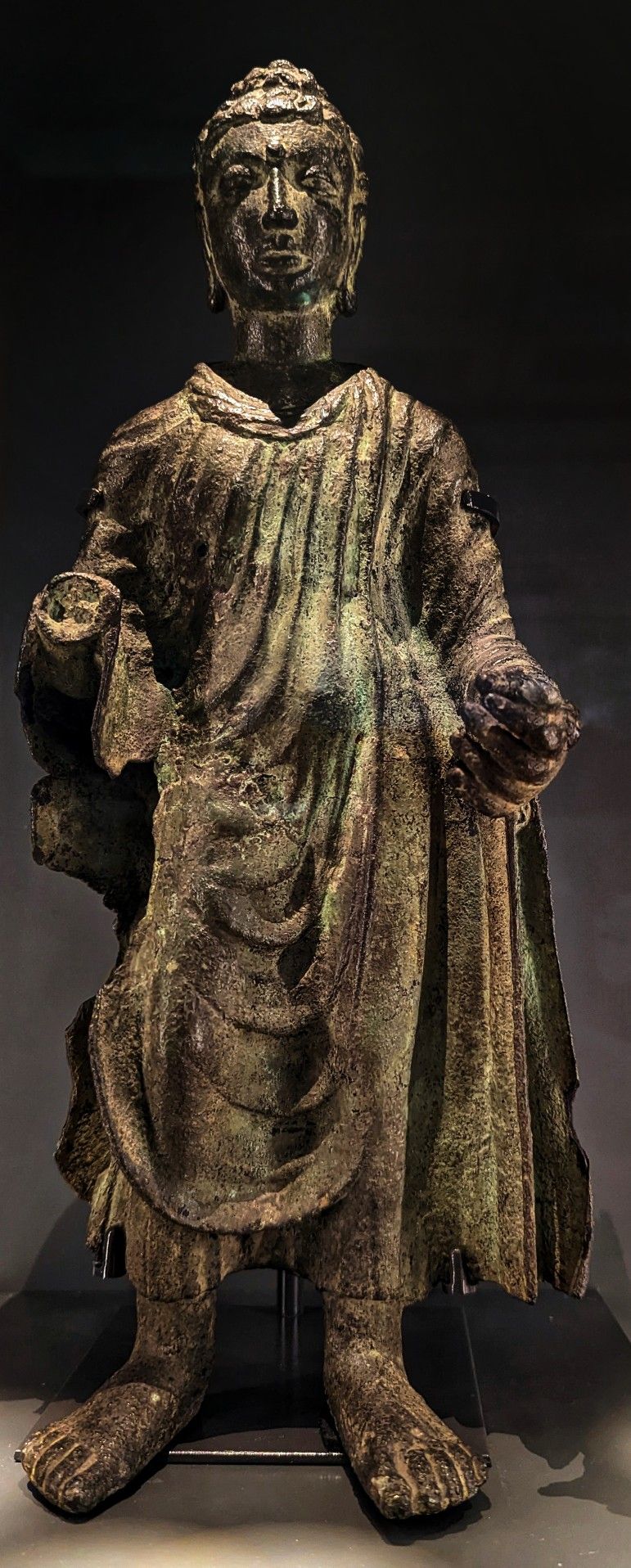
The pivot of this system in the early centuries of the common era was the Kushan empire, which at its height controlled territory from Central Asia across the northwest of the subcontinent to the Gangetic plain. The Kushans sat astride the junction where Chinese, Iranian, Indian and Hellenistic worlds met, and their coinage shows it: issues bearing Greek script alongside Iranian and Indian deities, minted to weight standards that made them acceptable across multiple markets. Under Kushan rule the region of Gandhara produced the extraordinary Greco-Buddhist sculptural tradition, in which the Buddha is rendered with the drapery and facial conventions of Hellenistic art, an artistic language that then travelled north and east along the same routes.
What travelled with it was Buddhism itself, and this is arguably India's largest single export in the whole story. Monks, texts and relics moved from the northwest into the Tarim Basin oasis towns of Khotan, Kucha and Turfan, and on to the Chinese capitals. The cave complexes along the route, above all the Mogao caves at Dunhuang, preserve the layered evidence of that transmission in paint and in manuscripts. The traffic ran in both directions. Chinese pilgrims travelled to India specifically to obtain accurate texts and to study at its monastic universities: Faxian made the journey in the early fifth century, Xuanzang travelled overland in the seventh and spent years in India, much of it at Nalanda, before returning with hundreds of manuscripts, and Yijing went and returned by sea via the Srivijaya kingdom in Sumatra. Their travel accounts are among the most valuable sources historians have for Indian society of the period, precisely because Indian writers of the time were less interested in recording the mundane.
What India sold, and what it bought
India's exports were not silk. They were pepper and other spices, fine cotton textiles, ivory, precious and semi-precious stones including diamonds from the Deccan, indigo, sandalwood, sugar and steel. Chinese silk came in, and Sanskrit texts including the Arthashastra refer to silk cloth from China by name, indicating that the trade was established early enough to have a standard commercial term. India also imported horses in very large numbers throughout its history, because the subcontinent's climate is poor for breeding cavalry mounts, and the horse trade through Afghanistan and by sea from Arabia and Persia was one of the most valuable and politically consequential imports for centuries.
The maritime branch mattered as much as the land branch and is often underplayed. The Periplus of the Erythraean Sea, a first-century Greek merchant's handbook, describes in practical detail the sailing routes, the ports of Barygaza in Gujarat and the pepper ports of the Malabar coast, and what to bring and what to buy at each. Once Mediterranean sailors learned to use the monsoon winds to cross the Arabian Sea directly rather than coasting, the volume rose sharply. Roman gold and silver coin hoards have been excavated in substantial numbers in Tamil Nadu and Kerala, and excavations at Pattanam in Kerala have produced Mediterranean amphorae and other imported material consistent with the ancient port of Muziris. Roman writers complained about the outflow of bullion to India in exchange for luxuries, a complaint that is itself evidence of the trade balance.
Ideas moved with all of this, and the most consequential of them may have been mathematical. The decimal place-value system with a symbol for zero, developed in India and set out in works such as Brahmagupta's seventh-century treatise, passed into the Islamic world through translation in Baghdad and from there into Europe, which is why the digits are still called Arabic numerals in English and Indian numerals in Arabic. Astronomy, medicine, chess and, later, the technology of paper moved along the same channels. So did less welcome cargo: epidemic disease travelled the trade routes as reliably as silk did.
The routes declined for a combination of reasons rather than one: the fragmentation of the Central Asian polities that had guaranteed caravan security, the growing cost advantage of bulk sea transport, and finally the Portuguese arrival in the Indian Ocean at the end of the fifteenth century, which reorganised maritime trade around European armed shipping. The physical remnants are still contested territory in the present. The Bamiyan Buddhas, carved in a Silk Road valley in Afghanistan, were destroyed in 2001. And the name itself has been revived politically, most prominently in China's Belt and Road Initiative announced in 2013, which India has declined to join, in part because its flagship corridor runs through territory India claims. The Silk Road, in other words, remains an argument as well as a history.
References
- UNESCOSilk Roads Programme
- The British MuseumGandhara and Kushan collections
- UNESCO World Heritage CentreTaxila
- The British LibraryInternational Dunhuang Project
This is a reference article, written from the sources above. It is background, not news reporting.