Singapore's Layered Indian Community
Reference library · 934 words
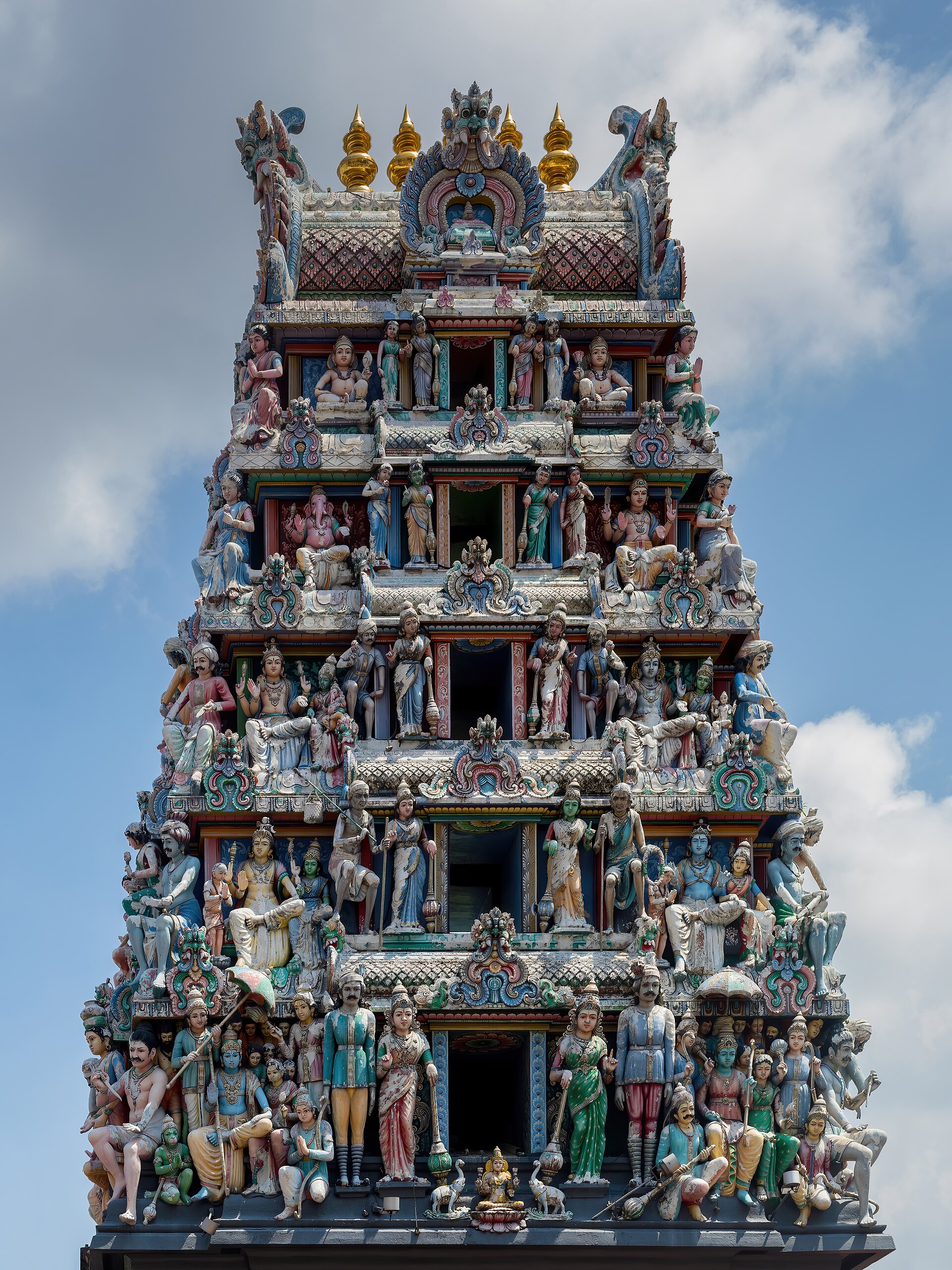

Indians make up roughly nine per cent of Singapore's resident population, the smallest of the three groups named in the republic's official racial framework of Chinese, Malay, Indian and Others. That single figure conceals a community assembled in at least four distinct waves across two centuries, speaking different languages, arriving under very different terms and, at times, regarding one another with some suspicion. Understanding Singapore's Indians means understanding those layers rather than the category.
Traders, convicts and sepoys
Indians were present from the beginning of the modern port. When Stamford Raffles established a British trading post in 1819 he arrived from Penang with Indian assistants, among them Naraina Pillai, a Tamil clerk who set up as a builder and merchant and who founded the Sri Mariamman Temple, the oldest Hindu temple in Singapore, on South Bridge Road in 1827. Tamil Muslim traders from the Coromandel coast, often called Chulias, were already active in the Straits ports and gave their name to Chulia Street in the financial district.
A second stream arrived in chains. From the 1820s the British transported convicts from India to Singapore, where they were used as construction labour. Convict work built roads, cleared land and contributed to St Andrew's Cathedral, and the practice continued until the transportation system was wound down in the 1870s. A third stream was military. Sepoy regiments of the Indian Army garrisoned the island, leaving place names such as Sepoy Lines, and in February 1915 part of the 5th Light Infantry mutinied in Singapore, an episode suppressed with executions and long remembered by the colonial authorities as a warning.
The largest stream, however, was labour. Tamil workers came in the late nineteenth and early twentieth centuries under kangani recruitment and indenture-like arrangements to work on rubber estates in Malaya, on the docks, on the railways and in the municipality. Many circulated between Singapore and Malaya rather than settling permanently. Alongside them came specialised commercial castes, most famously the Nattukottai Chettiars, bankers from the Chettinad region of Tamil Nadu who financed rubber and rice across South East Asia from shophouse offices on Market Street and who built the Sri Thendayuthapani temple, the destination of the annual Thaipusam procession. Sikh migrants, largely from Punjab, came as policemen and watchmen and established gurdwaras that still function.
The area now called Little India, around Serangoon Road, was not originally a residential quarter. It grew from cattle pens, brick kilns and lime pits worked substantially by Indian labour in the nineteenth century, and only later became the commercial and social centre it is today, crowded at Deepavali when the street lights go up.
From colony to republic
Politics gave the community an early national profile. Singapore was the headquarters of Subhas Chandra Bose's Indian National Army in 1943, and it was in Singapore that he proclaimed the Provisional Government of Free India; a memorial marker stands at Esplanade Park where the INA monument once was. Indian workers were prominent in the labour movement of the 1950s, and Indians were disproportionately represented in the leadership of early Singapore politics relative to their numbers.
After separation from Malaysia in 1965 the new state adopted four official languages: Malay, Mandarin, Tamil and English. Tamil is the only Indian language with that status, even though Singapore's Indians also speak Malayalam, Telugu, Punjabi, Hindi, Gujarati, Bengali and more. Non-Tamil Indian languages were later admitted as examinable mother tongues in schools, but Tamil remains the emblematic one, sustained by the newspaper Tamil Murasu and by state broadcasting. Three of Singapore's heads of state have been of Indian descent, including C. V. Devan Nair and S. R. Nathan, and Halimah Yacob, president from 2017 to 2023, is of Indian and Malay parentage. In 1991 the government supported the establishment of SINDA, a self-help body funded largely by community contributions, to address educational underperformance among Indian students, mirroring similar bodies for other communities.
The new arrivals and the friction
The most recent layer began in the 1990s, when Singapore set out to recruit professionals for finance, information technology, biomedical science and academia. These migrants came from across India rather than mainly from the Tamil south, arrived with degrees and employment passes rather than as labourers, and clustered in condominium districts rather than in Little India. At the same time a large population of construction and shipyard workers from Tamil Nadu, Andhra Pradesh, West Bengal and Bihar arrived on work permits that do not lead to settlement, housed in purpose built dormitories on the island's edges. The two groups have almost nothing in common except nationality.
This has produced real social friction. Long settled Singaporean Indians sometimes find themselves mistaken for new arrivals, and the political debate about foreign professionals became sharply audible after the 2020 general election, when the India Singapore Comprehensive Economic Cooperation Agreement, signed in 2005, was blamed in some quarters for immigration levels. The Singapore government responded in Parliament that the agreement contains no automatic immigration entitlement and that entry remains governed by ordinary work pass criteria, but the perception persisted. A separate flashpoint came in December 2013, when a fatal traffic accident in Little India triggered a riot involving migrant workers, the first serious public disorder in Singapore in decades, and prompted a commission of inquiry and tighter rules on alcohol sales in the district.
What holds across the layers is public visibility rather than uniformity. Deepavali is a national public holiday, Thaipusam draws a large kavadi procession through the streets, and Tamil appears on currency notes and station signs. The community is small, internally plural and, on questions of class and recent migration, genuinely divided.
References
- National Library Board, SingaporeNational Library Board, Singapore
- Department of Statistics SingaporePopulation and Population Structure
- National Heritage Board, SingaporeRoots: Singapore heritage
- Encyclopaedia BritannicaSingapore
- Singapore Indian Development AssociationAbout SINDA
This is a reference article, written from the sources above. It is background, not news reporting.