Spice, Trade and the Making of a Coastline
Reference library · 969 words

The narrow strip of land between the Western Ghats and the Arabian Sea, running roughly from Goa down to the southern tip of Kerala, is one of the few places on earth whose entire social history can be explained by botany. Black pepper, Piper nigrum, is a climbing vine native to the wet evergreen forests of these hills. Cardamom grows in the higher elevations of the same range. Ginger, turmeric and cinnamon relatives thrive in the same monsoon-fed humidity. For roughly two thousand years, everyone who wanted these things in quantity had to come to this coastline to get them, and the coastline was reshaped by the coming.
The trade is older than most written records of it. The Periplus of the Erythraean Sea, a Greek merchant's handbook from the first century of the common era, describes ports on the Malabar coast including Muziris, and lists pepper and malabathrum among the cargoes taken on. Roman coin hoards turn up inland in Tamil Nadu and Kerala, and excavations at Pattanam, near the mouth of the Periyar in Kerala, have produced Mediterranean amphora fragments and other imported material that many archaeologists associate with Muziris, though the identification is argued over rather than settled. What made the route practical was the monsoon. Mariners learned that the southwest monsoon would carry a ship from the Red Sea across open ocean to the Indian coast in weeks, and the northeast monsoon would carry it home, which turned an arduous coast-hugging voyage into a predictable annual cycle.
Communities made by cargo
Because the trade was seasonal, traders had to wait months for the return wind, and waiting produced settlement. Arab and Persian merchants established communities along Malabar and married locally, and their descendants form the Mappila Muslim community of northern Kerala, whose presence long predates any conquest. Jewish traders settled at Kodungallur and later at Kochi, where the Paradesi Synagogue, built in the sixteenth century in what is still called Jew Town, remains standing. The Saint Thomas Christians, whose liturgical tradition connects them to the Church of the East in Persia, formed another commercial community with deep roots. Kerala's unusual religious composition, far more plural than the Indian average, is not an accident of tolerance in the abstract. It is the residue of a port economy that needed resident foreign partners and made room for them.
The political geography followed the same logic. Power on this coast clustered around harbours rather than agrarian heartlands. The Zamorin of Calicut, ruler of Kozhikode, grew wealthy chiefly by guaranteeing security and fair dealing to visiting merchants, which is why the port attracted them. When Vasco da Gama's ships reached Kappad near Calicut in May 1498, having rounded the Cape of Good Hope and crossed from East Africa with the help of a local pilot, they arrived not as discoverers of a trade but as latecomers to a crowded one. The Portuguese difference was strategy. Rather than buy pepper alongside everyone else, they attempted to control the sea itself, issuing passes, taxing shipping and building fortified factories. Fort Kochi was established in the first years of the sixteenth century, and Saint Francis Church there is among the oldest European-built churches in India.
Monopoly, and its limits
The Portuguese attempt at monopoly never fully worked, partly because pepper grows on thousands of smallholdings across a wide hill region and cannot be controlled at source the way a mine can. It was nonetheless disruptive enough to invite competitors. The Dutch East India Company took Kochi from the Portuguese in 1663 and rebuilt the palace at Mattancherry that still carries their name, while the English established themselves further along the coast, notably at Anchuthengu and later at Thalassery, from which the pepper trade of northern Malabar was worked. Each successive European power tried the same thing: contract with local rulers for exclusive supply, exclude rivals by force at sea, and discover that inland producers and coastal middlemen would sell to whoever paid. By the later eighteenth century the region's politics had been thoroughly militarised, drawing in Mysore under Haidar Ali and Tipu Sultan and eventually bringing Malabar under Company administration.
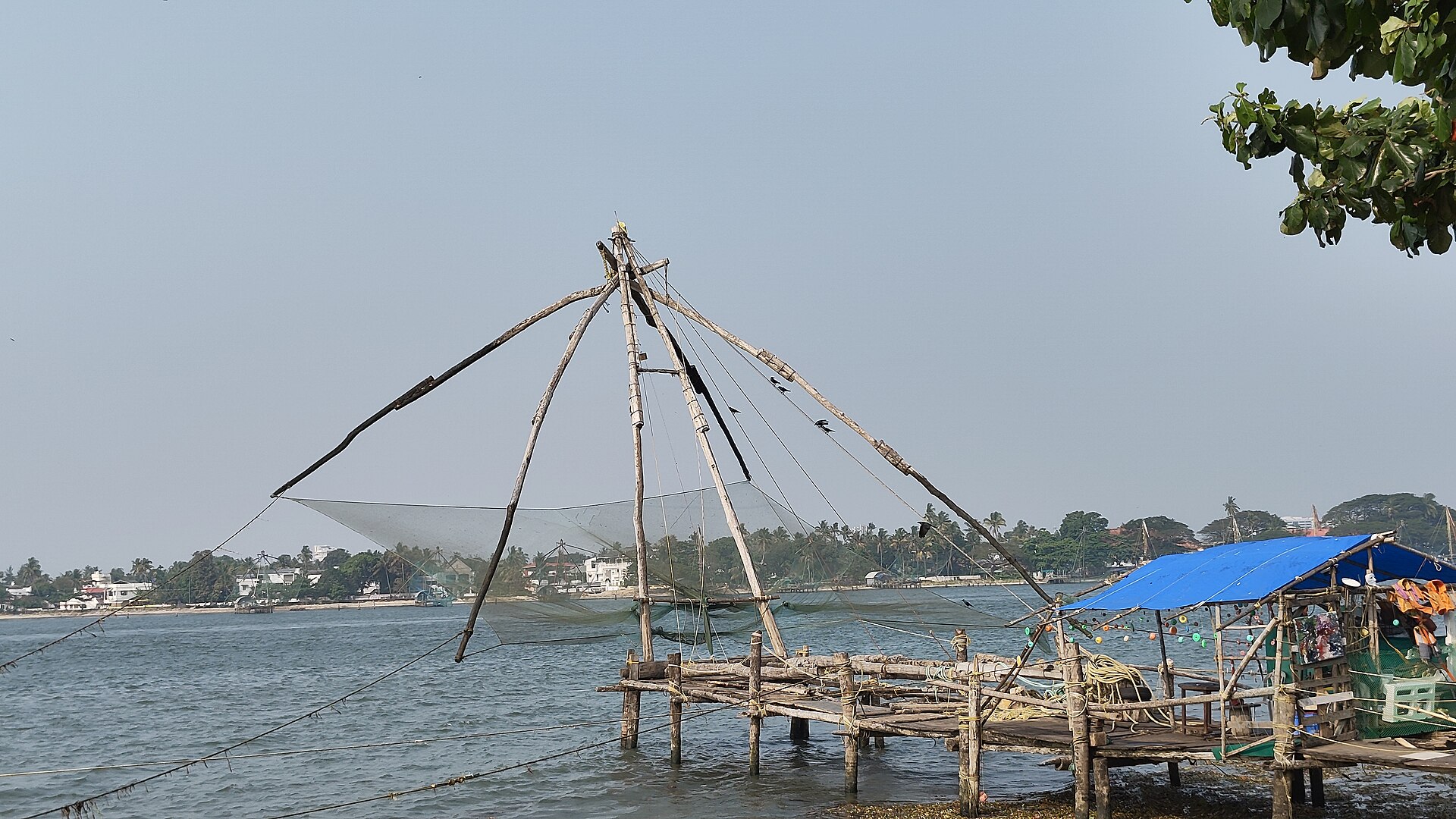
The physical coastline still records all of this. Kochi's harbour, Fort Kochi's cemeteries and warehouses, the godowns of Mattancherry where pepper and ginger are still graded and bagged, the Chinese-style shore-operated lift nets along the estuary, the Portuguese and Dutch street plans, the spice auction rooms: these are working infrastructure, not a museum. Kochi remains the administrative centre of the modern trade, and the Spices Board of India, the statutory body under the Union Ministry of Commerce and Industry responsible for promotion, quality control and export certification of Indian spices, is headquartered there. Cardamom is still sold through licensed auctions in the hill towns of Idukki district.
What has changed is India's relative position. India remains a major spice producer and by far the largest consumer of its own output, and its exports now lean heavily on chilli, cumin, turmeric and value-added products such as oleoresins and extracts rather than on raw pepper alone. In pepper specifically, Vietnam entered the market in force from the 1990s and became the dominant exporter, with Indonesia and Brazil also significant, and Indian pepper is now sold more on quality and origin than on volume. Kerala's growers face ageing vines, fungal disease, fragmented plots and price volatility set on international exchanges rather than in Kochi. The response has been the same one every specialised producer reaches for: geographical indication tags, organic certification and traceability, marketing Malabar and Wayanad and Idukki as places rather than commodities. It is an old strategy in a new register. The value of this coastline was always that the thing grown here could not easily be grown elsewhere, and the interesting question of the present century is how long that remains true.
References
- Spices Board of India, Ministry of Commerce and IndustrySpices Board India
- Encyclopaedia BritannicaMalabar Coast
- Encyclopaedia BritannicaVasco da Gama
- Archaeological Survey of IndiaArchaeological Survey of India
- Royal Botanic Gardens, KewPlants of the World Online
This is a reference article, written from the sources above. It is background, not news reporting.