
Storytelling Traditions Old and New
Reference library · 970 words

India has an unusually deep and unusually continuous relationship with narrative. The same handful of stories, told first in Sanskrit epics well over two thousand years ago, are still being retold this year in television serials, comic books, dance dramas, village performances and animated films, and audiences follow them not despite knowing the ending but because they do. This is a fundamentally different relationship with story than the one that dominates modern Western entertainment, where surprise is prized and spoilers are a grievance. In much of Indian performance the plot is common property and the artistry lies entirely in the telling.
The oldest theoretical account of this comes from the Natyashastra, a treatise on dramaturgy, dance and music attributed to Bharata and generally assigned to the early centuries around the beginning of the common era. Its central concept is rasa, usually translated as flavour or essence, meaning the aesthetic emotion that a performance is designed to produce in a prepared audience. The text enumerates a set of these, including the erotic, the comic, the compassionate, the furious, the heroic, the fearful, the disgusting and the marvellous, and describes the gestures, glances, rhythms and situations that evoke each. That framework still underlies classical Indian dance forms and, in diluted form, popular cinema, which is why a Hindi film may move from comedy to grief to a fight scene to a song without any sense of tonal violation. It is not incoherence. It is a different theory of what a performance is for.
The forms that carried the stories
Before print or broadcast, stories travelled through named performance traditions, most of which still exist. Harikatha in the south and kathavachan in the north combine narration, song and commentary, with a single performer moving between voices and pausing to explain a moral point. Kathakali in Kerala presents episodes from the epics through elaborately painted characters, codified hand gestures and eye movements trained over years, in performances that traditionally ran through the night. Yakshagana in coastal Karnataka does something similar with brighter colour and greater improvisation. Kutiyattam, also from Kerala and recognised by UNESCO as an intangible heritage tradition, may devote several nights to a single act. Bhavai in Gujarat, Tamasha in Maharashtra, Nautanki in the Hindi belt and Jatra in Bengal supply the comic, satirical and topical end of the spectrum, often with a licence to mock local authority that more respectable forms lack.
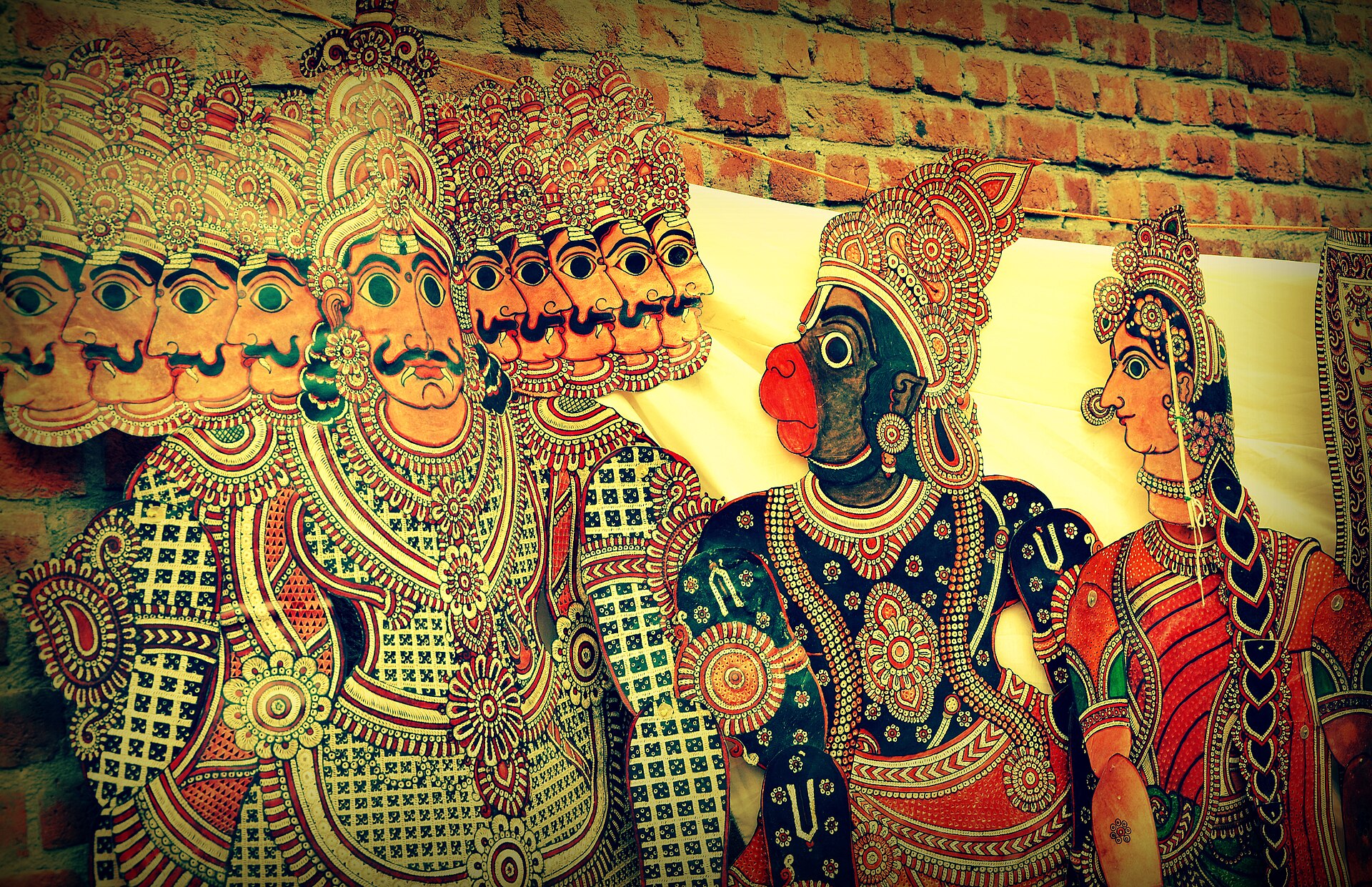
Visual narrative traditions ran alongside performance. Scroll painters carried painted cloth or paper from village to village, unrolling panels while singing the accompanying story, a practice preserved in the Patua tradition of Bengal and the phad paintings of Rajasthan, which illustrate the deeds of local heroes on long horizontal cloths displayed at night by lamplight. Shadow puppet theatre, using perforated leather figures, survives in Andhra Pradesh, Karnataka, Kerala and Odisha, and closely related forms exist across Southeast Asia, a reminder that these narrative traditions travelled by sea long before any European arrived. In each case the performer was also a teacher, a news carrier and often a genealogist, since the story could be extended to include the patron's ancestors.
Print, film and the screen in the pocket
Modern media did not replace these forms so much as absorb their grammar. Indian cinema, from the silent era onward, drew directly on mythological subjects and on the conventions of stage performance; the first full length Indian feature, Raja Harishchandra, made by Dadasaheb Phalke and released in 1913, was a mythological. Song sequences in Indian films are not decoration bolted on for commercial reasons but a continuation of a performance tradition in which narration and music were never separate. Amar Chitra Katha comics, launched in 1967, put the same epic and historical material into cheap illustrated form and became for millions of urban and diaspora children the primary means of learning stories their grandparents had heard performed.
Television produced the most striking single demonstration of the tradition's continuing hold. When a serialised Ramayan was broadcast on the state network Doordarshan from 1987, and a Mahabharat followed from 1988, viewership was so extensive that streets were reported empty during transmission and some households treated the broadcast as a devotional occasion, garlanding the television set. That is not a story about television. It is a story about what happens when an ancient narrative meets a technology that can deliver it simultaneously to an entire country.
The current phase is more fragmented and harder to assess. Streaming platforms have funded Indian series in many languages and have made regional cinema available far beyond its home state, so that a Malayalam thriller or a Tamil drama can find an audience in Delhi or Dubai with subtitles. Short video applications have created a generation of performers working in formats measured in seconds, some of whom are doing recognisable versions of the old comic and satirical traditions in a new container. Audio storytelling and podcasting in Indian languages have grown quickly, which suits a narrative culture that was oral to begin with. Whether any of this constitutes continuity or replacement is genuinely arguable, and the argument is worth having rather than settling.
What can be said with confidence is that the traditional performance forms are under real economic pressure. They depended on patronage, whether from temples, courts, landholders or village collectives, and those structures have weakened. Training in forms such as Kutiyattam or Kathakali takes many years and offers uncertain income, and the practitioner communities are small. Government academies, UNESCO recognition and festival circuits provide some support, and some troupes have found new audiences abroad, particularly among diaspora communities who fund performances at cultural centres and temples. But the survival of a night long performance tradition in a world of short attention is not assured, and pretending otherwise would be a disservice to the artists still doing it.
References
- UNESCOKutiyattam, Sanskrit theatre
- UNESCORamman and traditional performance, Intangible Heritage lists for India
- Encyclopaedia BritannicaNatyashastra
- Encyclopaedia BritannicaDadasaheb Phalke
This is a reference article, written from the sources above. It is background, not news reporting.