

Tea Country: How the Hills Became Plantations
Reference library · 1040 words
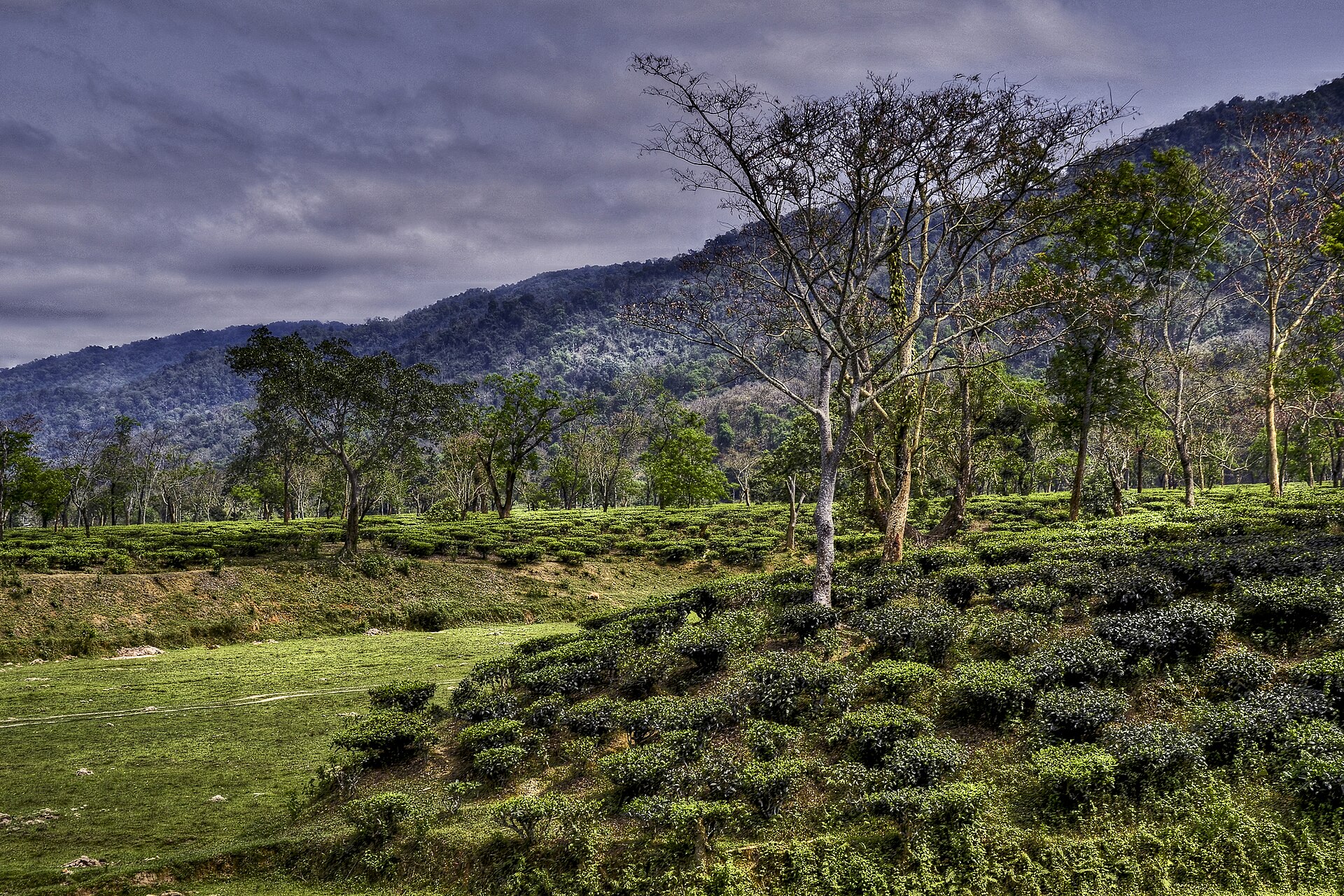

India's tea districts look timeless from a train window: clipped green bushes contoured across hillsides, shade trees at intervals, women moving through the rows with baskets on their backs. Almost nothing about that landscape is old. It was engineered in the nineteenth century by a company that wanted to break China's monopoly on a commodity it was buying with silver, and the social arrangements built to work it have proved considerably more durable than the empire that created them.
The commercial logic was straightforward. Britain's tea habit was supplied entirely from China, paid for partly through the opium trade, and the East India Company wanted a source inside its own territory. The breakthrough was botanical. In the 1820s, reports reached British officials that a tea-like plant grew wild in Assam and was used by the Singpho people there, and it was eventually accepted as a distinct variety of Camellia sinensis, the broad-leaved assamica, better suited to hot lowland conditions than the Chinese variety. Lord William Bentinck, as Governor General, appointed a Tea Committee in 1834 to pursue cultivation. The first Assam tea reached London for auction at the end of the 1830s, and the Assam Company was floated in 1839 as one of the earliest joint-stock enterprises operating in India. In parallel, the botanist Robert Fortune travelled in China between 1848 and 1851 on the Company's behalf, obtaining plants, seed and, critically, experienced Chinese tea makers, in what was effectively industrial espionage.
Land, labour and the making of a workforce
Growing tea required two things the Company arranged by policy. The first was land. Wasteland rules made large tracts in Assam available to European planters on generous terms, converting forest and shifting-cultivation country into surveyed estates. The second was labour, and this is where the modern social geography of Indian tea originates. Assam was thinly populated and local people had little reason to accept plantation work. Planters therefore recruited at long distance, principally from the Chhotanagpur plateau and adjoining tribal regions in what are now Jharkhand, Odisha, Chhattisgarh and West Bengal, drawing on Oraon, Munda, Santhal and other Adivasi communities. Recruitment ran through licensed contractors and village agents, workers were bound by penal contracts under which breaking an agreement was a criminal rather than a civil matter, mortality on the journey and in early years on the gardens was severe, and return was in practice impossible for most. Their descendants form the tea garden community of Assam today, numbering in the millions, speaking a distinct Sadri-based creole, and constituting a recognised and politically significant population in the state.
The plantation was designed as a closed system. Workers lived in lines on the estate, were paid partly in cash and partly in rations and housing, and depended on the employer for water, medical care, schooling and often for credit. After independence this arrangement was regulated rather than dismantled. The Plantations Labour Act of 1951 made the employer legally responsible for housing, drinking water, medical facilities, creches and educational arrangements for workers and their families, and set conditions on hours and leave. The result is that a tea worker's total remuneration is a bundle of cash wage plus in-kind entitlements, which makes wage comparison genuinely difficult and is the crux of a long-running dispute. Unions and campaigners argue that daily cash wages in Assam and West Bengal have remained far below the statutory minimum wages of other sectors and that the in-kind provisions are frequently underdelivered; the industry argues that the full cost of the in-kind bundle must be counted and that garden economics cannot bear more. Both claims can be partly true at once, which is why the dispute has outlasted many governments.
Districts, grades and the modern trade
Three regions dominate. Assam, in the Brahmaputra and Barak valleys, is lowland, hot and humid, and produces the bulk of India's output, most of it strong, malty and processed by the crush, tear, curl method that yields the granular tea used in mass-market blends and in Indian household chai. Darjeeling, in the eastern Himalaya of West Bengal, is a small-volume, high-value producer working at altitude with largely Chinese-variety bushes, making delicate orthodox whole-leaf teas sold by flush, the first flush of spring being the most prized. Darjeeling tea was the first product registered under India's geographical indications system in the mid 2000s, a defensive measure against the volume of tea sold worldwide under the name. The Nilgiris in Tamil Nadu and the high estates around Munnar in Kerala form the third region, growing year round at elevation.
The institutional architecture is largely statutory. The Tea Board of India, which traces its lineage to a cess-funded body established early in the twentieth century and was reconstituted under the Tea Act of 1953, regulates and promotes the industry under the Union Ministry of Commerce and Industry. Research has been conducted since 1911 at the Tocklai station near Jorhat in Assam, among the oldest tea research institutions anywhere. Most tea is sold through public auction centres, at Kolkata, Guwahati, Siliguri, Kochi, Coonoor, Coimbatore and elsewhere, with Guwahati handling very large volumes of granular Assam tea. Auctions moved to electronic platforms from the late 2000s, which improved transparency but did not change the underlying price problem.
That problem defines the present. India is one of the largest producers in the world and also one of the largest consumers, absorbing most of what it grows, which insulates growers from export shocks but exposes them to a domestic market that competes hard on price. Kenya's expansion made it the leading exporter of black tea globally, squeezing India in third markets. Meanwhile the structure of production has shifted: a growing share of Assam's green leaf now comes not from large estates but from small growers selling to bought-leaf factories, a change that spreads ownership but weakens quality control and leaves the smallest producers with little bargaining power. Estates in the Dooars and elsewhere have periodically been abandoned by owners, stranding resident workforces who have nowhere else to live. Add erratic monsoon behaviour, pest pressure and tightening residue limits in export markets, and the picture is of an industry with formidable heritage assets and thin margins, trying to sell origin and quality in a market that mostly buys on price.
References
- Tea Board of India, Ministry of Commerce and IndustryTea Board of India
- UNESCO World Heritage CentreMountain Railways of India, including the Darjeeling Himalayan Railway
- Encyclopaedia BritannicaTea
- International Labour OrganizationWorking conditions in the plantation sector
- Royal Botanic Gardens, KewCamellia sinensis
This is a reference article, written from the sources above. It is background, not news reporting.