
Temples and Gurdwaras: Building Community Abroad
Reference library · 1078 words

Wherever Indians have settled in numbers, the sequence has been much the same. First a rented hall or a suburban garage where a few dozen families gather on a Sunday. Then a converted church, warehouse or scout hut, bought with pooled savings and fitted out on weekends by volunteers. Then, if the community grows and prospers, a purpose built temple or gurdwara, often carved in India and shipped in pieces. This progression, repeated in Vancouver, Nairobi, Leicester, Dallas and Melbourne, is one of the clearest physical records of Indian migration that exists, and it can be read almost like a set of geological strata.
From back rooms to stone mandirs
The earliest institutions belong to the Sikh corridor, because Punjabi migration to the Pacific rim preceded most other movements. The Khalsa Diwan Society was formed in Vancouver in 1906 and opened a gurdwara on West Second Avenue soon after, serving mill workers in British Columbia. In Britain, the Khalsa Jatha of the British Isles was founded in 1908 and established a gurdwara in London a few years later. In the United States, the gurdwara built at Stockton, California, in 1912 by Punjabi farm labourers in the Central Valley is generally described as the first in the country and remains in use. These were institutions built by men who had come to work, often without families, under immigration regimes designed to keep them temporary.
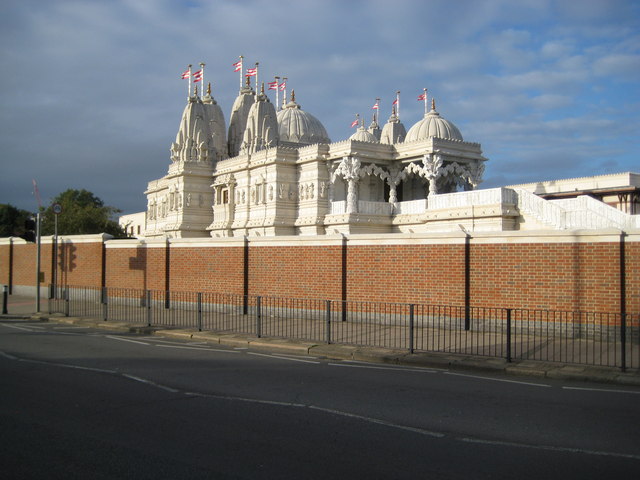
The Hindu building programme came later, largely because Hindu migration to the West was later. In the United States, the Hindu Temple Society of North America consecrated its Ganesha temple in Flushing, Queens, in 1977, and the Sri Venkateswara temple at Penn Hills near Pittsburgh was consecrated the year before, with technical and priestly help from Tirumala. In Australia, the Sri Venkateswara temple at Helensburgh, on the escarpment south of Sydney, opened in the 1980s, and the Shri Shiva Vishnu temple at Carrum Downs in Melbourne followed in the 1990s. In Britain, the Shri Swaminarayan Mandir at Neasden in north London, opened in 1995, changed what diaspora communities thought was possible: Bulgarian limestone and Italian marble were shipped to Rajasthan and Gujarat, carved by hundreds of craftsmen into thousands of numbered pieces, and reassembled in London without structural steel. The same organisation completed a larger complex at Robbinsville, New Jersey, in 2023.
Gurdwara building followed a similar arc. Sri Guru Singh Sabha Southall, opened in 2003 in west London, is among the largest outside India. The Guru Nanak Sikh Gurdwara in Surrey, British Columbia, anchors a Vaisakhi procession that regularly draws crowds in the hundreds of thousands, one of the largest Sikh gatherings anywhere outside Punjab. In Australia, Punjabi banana growers at Woolgoolga on the New South Wales north coast built a gurdwara in the late 1960s, decades before the more recent wave of Punjabi migration, and the town remains an unusual instance of a rural Australian settlement shaped by Sikh farming families.
What the buildings actually do
To understand why these places matter more abroad than their equivalents do at home, it helps to notice how much they carry beyond worship. In India, a temple is one institution among many; a migrant family has access to few others. The gurdwara langar, the free communal kitchen open to anyone regardless of faith or status, is a religious obligation, but in a diaspora setting it also feeds students, taxi drivers on night shifts and newly arrived families with no money. Sikh volunteer networks that grew out of gurdwaras have become visible in disaster response, distributing meals during Australian bushfires, British floods and North American storms.
Beyond the kitchen, these buildings host language classes so that children can read Gurmukhi or Gujarati or Tamil, dance and music instruction, senior citizens' day programmes for grandparents who arrived late in life and speak little English, matrimonial noticeboards, credit and legal referrals, and funeral logistics, which is a genuinely difficult problem for a first generation community with no burial society and no relatives nearby. They also function as the interface with the host society: the place a local council, police liaison officer or health department contacts when it needs to reach a community, and the place that organises submissions when a planning application or a school policy is at issue.
Getting them built is rarely simple. Planning applications for temples and gurdwaras routinely attract objections framed around traffic, parking and noise, and occasionally around less presentable concerns. Communities respond by buying industrial land, by capping congregation numbers in their applications, and by funding road improvements. The result is that many diaspora temples sit in light industrial estates near motorways rather than in residential centres, which shapes how they are used: people drive there for scheduled events rather than dropping in.
Strains, factions and the second generation
It would be misleading to present these institutions as uncomplicated successes. Gurdwara management committees are elected, control substantial assets, and have in several countries produced sustained factional conflict, occasional litigation over constitutions and elections, and disputes that spill into local politics. Temple trusts face similar issues over control of funds and appointment of priests. Caste has travelled with migration too: separate places of worship associated with particular communities exist in Britain, Canada and elsewhere, and the question of whether caste discrimination should be legally actionable has been litigated in British employment tribunals and debated in American state legislatures. Sectarian and regional divisions that would be unremarkable in India become sharper in a small settlement where one building must serve everyone.
The generational question is the one most trustees privately worry about. A congregation built by migrants who arrived as adults with an intact religious vocabulary is not automatically inherited by children raised in English, working long hours and living far from the suburb where the temple was built. Some institutions have adapted, adding English language discourses, youth camps, sports and wedding facilities, and services aimed at converts and mixed families. Others have not, and face ageing memberships and buildings whose maintenance costs exceed what the congregation can raise.
What seems clear is that the building itself outlasts the phase of migration that produced it. A gurdwara raised by farm workers in 1912 now serves software engineers; a temple built by doctors in the 1970s now serves their grandchildren and a fresh wave of arrivals on student visas who have nothing else in common with them. The continuity is architectural and institutional rather than social, and that is precisely what makes these places worth studying.
References
- Ministry of External Affairs, Government of IndiaPopulation of Overseas Indians
- Historic EnglandSikh Places of Worship in England
- Pluralism Project, Harvard UniversityHindu Temples in America
- Australian Bureau of StatisticsCultural diversity: Census 2021
This is a reference article, written from the sources above. It is background, not news reporting.