
The Craft of Saree Draping Across Regions
Reference library · 1085 words
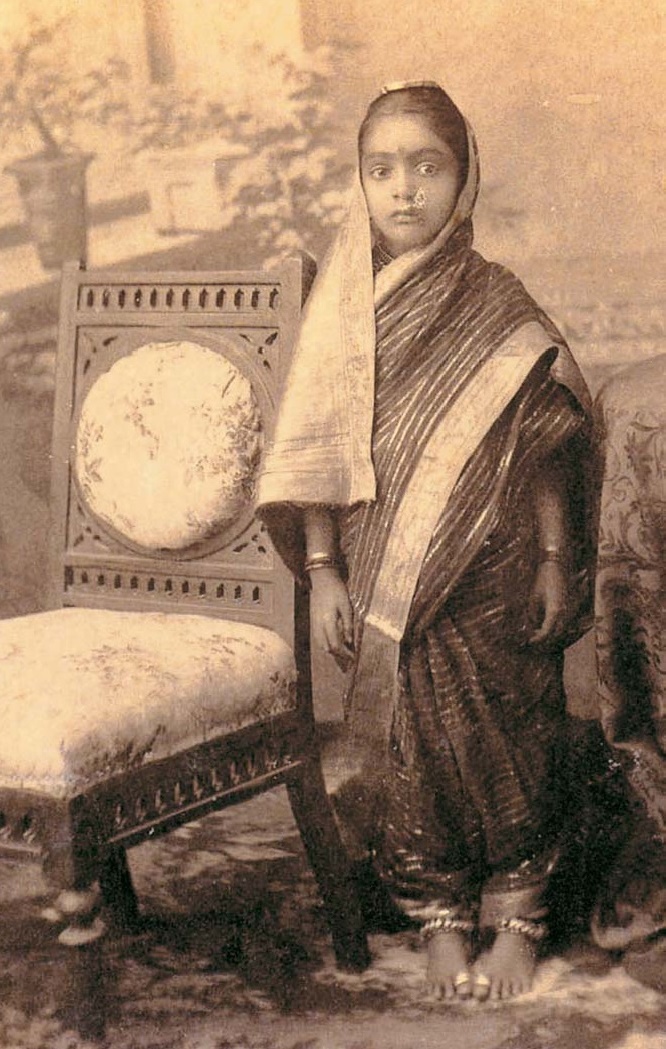

A saree is a single length of unstitched cloth. It has no buttons, no zip, no seams beyond the selvedge and the finished ends, and it is held on the body entirely by tucking, pleating and the friction of fabric against fabric. That simplicity is the reason it has survived for two thousand years and the reason it exists in so many forms: a rectangle of cloth can be worn in a great many ways, and India's regions settled on different ones according to climate, work, caste practice and taste. Anyone who assumes there is one correct way to wear a saree has met only one of them.
Two lengths dominate. The shorter, commonly around five and a half metres, is the everyday saree of most of India today. The longer, usually eight to nine metres, is worn in drapes that pass the cloth between the legs to form trousers, which is why nine yard styles are associated with work, riding, farming and priestly ritual rather than with formality alone. The cloth itself has three designed regions: the field or body, the border running along the length, and the pallu, the decorated end that falls over the shoulder or is drawn over the head. Weavers plan all three on the loom before a single thread is thrown, which is why an authentic regional saree cannot be made by cutting down a different one.
The drapes and where they belong
The style most people picture, with pleats tucked at the front waist and the pallu falling over the left shoulder, is called the nivi drape and is associated with the Telugu country. Its spread across India is surprisingly recent and traceable. In late nineteenth century Bengal, Jnanadanandini Debi of the Tagore household, needing a form of dress that would be acceptable in colonial drawing rooms, combined a saree drape with a fitted blouse and a petticoat, an assembly that became known as the Brahmika style and was taught, copied and eventually standardised through schools, photographs and later cinema. The blouse and petticoat, which many now regard as inseparable from the garment, are part of that nineteenth century adaptation rather than of the older tradition.
The regional drapes are quite distinct. The Maharashtrian nauvari, nine yards, is pleated and passed between the legs and tucked at the back, producing a trouser like garment traditionally worn with the pallu drawn across the chest; it is the dress of Lavani performers and is strongly associated with the memory of Maratha women's mobility. The Tamil madisar is likewise nine yards and is worn by brahmin women for rituals, with recognisably different versions used in Iyer and Iyengar households, in the direction of pleating and the way the pallu is secured. In Bengal, the atpoure drape uses broad box pleats at the front with the pallu brought over the left shoulder and then back over the right, and the household keys knotted into its end are so conventional that the image is a shorthand for the mistress of a house.
Gujarat and parts of Rajasthan and Odisha use a seedha pallu, in which the decorated end comes from back to front over the right shoulder and is spread across the chest, so that the pallu design faces the viewer rather than falling behind. In Kodagu, in the hills of Karnataka, the pleats are tucked at the back and the pallu is pinned at the right shoulder, a practical adaptation for coffee estates and steep ground. Some regional garments are not one piece at all: the Kerala mundum neriyathum is a two piece set, cream cotton with a gold kasavu border, and the Assamese mekhela chador is a wrapped lower cloth with a separately draped upper cloth.
The cloth itself
Regional identity lives as much in weave as in drape, and many of these fabrics now carry geographical indication protection, a legal registration that restricts the name to cloth actually produced in the defined area by the defined method. Kanchipuram silk from Tamil Nadu is woven with the border and pallu made separately and interlocked with the body, a joint strong enough that the saree is said to tear before it parts. Banarasi silk from Varanasi carries brocade in gold and silver zari, with Mughal derived floral and vine motifs. Paithani from Maharashtra uses a tapestry technique for its peacock and lotus pallus. Patola from Patan in Gujarat is a double ikat in which warp and weft are both resist dyed before weaving so that the pattern emerges only when the two align, a process so exacting that a single saree can take many months. Jamdani, woven in the Bengal delta, has supplementary weft motifs added by hand on the loom with no mechanical patterning at all. Assam's muga silk, produced by a semi domesticated silkworm found only in the region, has a natural golden colour that deepens with washing. To these can be added Chanderi and Maheshwari from Madhya Pradesh, Pochampally ikat from Telangana, Baluchari from Bishnupur with its narrative figured pallus, Sambalpuri and Bomkai from Odisha, Ilkal from northern Karnataka and bandhani tie dye from Gujarat and Rajasthan.
The industry behind this is under real pressure. Handloom weaving remains one of India's largest sources of non farm rural employment, but it competes with powerloom copies that reproduce the visual design at a fraction of the price and a fraction of the labour, and with printed imitations of woven motifs. Legislation reserving certain articles for the handloom sector has proved difficult to enforce. Government handloom censuses have recorded declining weaver numbers over successive rounds, and National Handloom Day, observed on 7 August in memory of the launch of the Swadeshi movement in 1905, was instituted in part as a promotional response. Consumer campaigns encouraging people to wear handloom sarees more often have had visible effect in urban markets, though whether they change weaver incomes depends on whether the buyer reaches the weaver or a chain of intermediaries.
Draping knowledge is transmitted the way most craft knowledge is, by being shown. That transmission has thinned as daily dress in much of urban India has shifted, and the regional nine yard drapes in particular are now often reserved for weddings and rituals. Against that, there is a countercurrent: draping classes, detailed video instruction, and a generation of wearers in India and in the diaspora deliberately learning their grandmothers' regional style rather than the default one. A garment that requires no cutting also requires no size, which is part of why it keeps returning.
References
- Ministry of Textiles, Government of IndiaHandlooms and the Development Commissioner for Handlooms
- Geographical Indications Registry, Government of IndiaRegistered Geographical Indications of India
- Victoria and Albert MuseumThe Sari: an introduction
- UNESCOTraditional art of Jamdani weaving
This is a reference article, written from the sources above. It is background, not news reporting.