
The Election Commission: Guarding the Vote
Reference library · 1059 words

The Election Commission of India was established on 25 January 1950, the day before the Constitution came into force, and that date is now marked annually as National Voters' Day. It exists because of Article 324, which vests in it the superintendence, direction and control of the preparation of electoral rolls and the conduct of all elections to Parliament, to state legislatures, and to the offices of President and Vice President. The framers made a deliberate choice here. Rather than leaving elections to the executive of the day, as many countries do, they created a constitutional authority insulated from it, with the Chief Election Commissioner removable only in the same manner and on the same grounds as a judge of the Supreme Court, which requires a special majority of both Houses of Parliament.
For most of its first four decades the commission was a single-member body. In October 1989 two additional commissioners were appointed, an arrangement that lapsed shortly afterwards; it was restored permanently from 1 October 1993, and the commission has since operated as a three-member body in which decisions are taken by majority and the Chief Election Commissioner has no veto. Local body elections are not its responsibility: separate state election commissions run panchayat and municipal polls.
The scale of the operation
The commission conducts what is by a wide margin the largest managed exercise of any kind on earth. In the 2024 general election the register held around nine hundred and seventy million eligible voters, polling took place across more than a million polling stations, and the exercise was spread over seven phases between mid April and the start of June, with counting on a single day. Several million polling personnel, mostly teachers and other government employees requisitioned for the purpose, are trained and deployed, and central armed police forces are moved around the country by special train to secure sensitive constituencies. The commission's operating rule is that no voter should ordinarily have to travel more than two kilometres to vote, and it is applied literally: polling teams walk into forests, are helicoptered to Himalayan hamlets, and cross by boat to river islands. The most quoted illustration is a polling station established in the Gir forest of Gujarat for a single registered voter, a temple priest living inside the sanctuary, which is set up at every election because the rule does not admit exceptions for inconvenience.
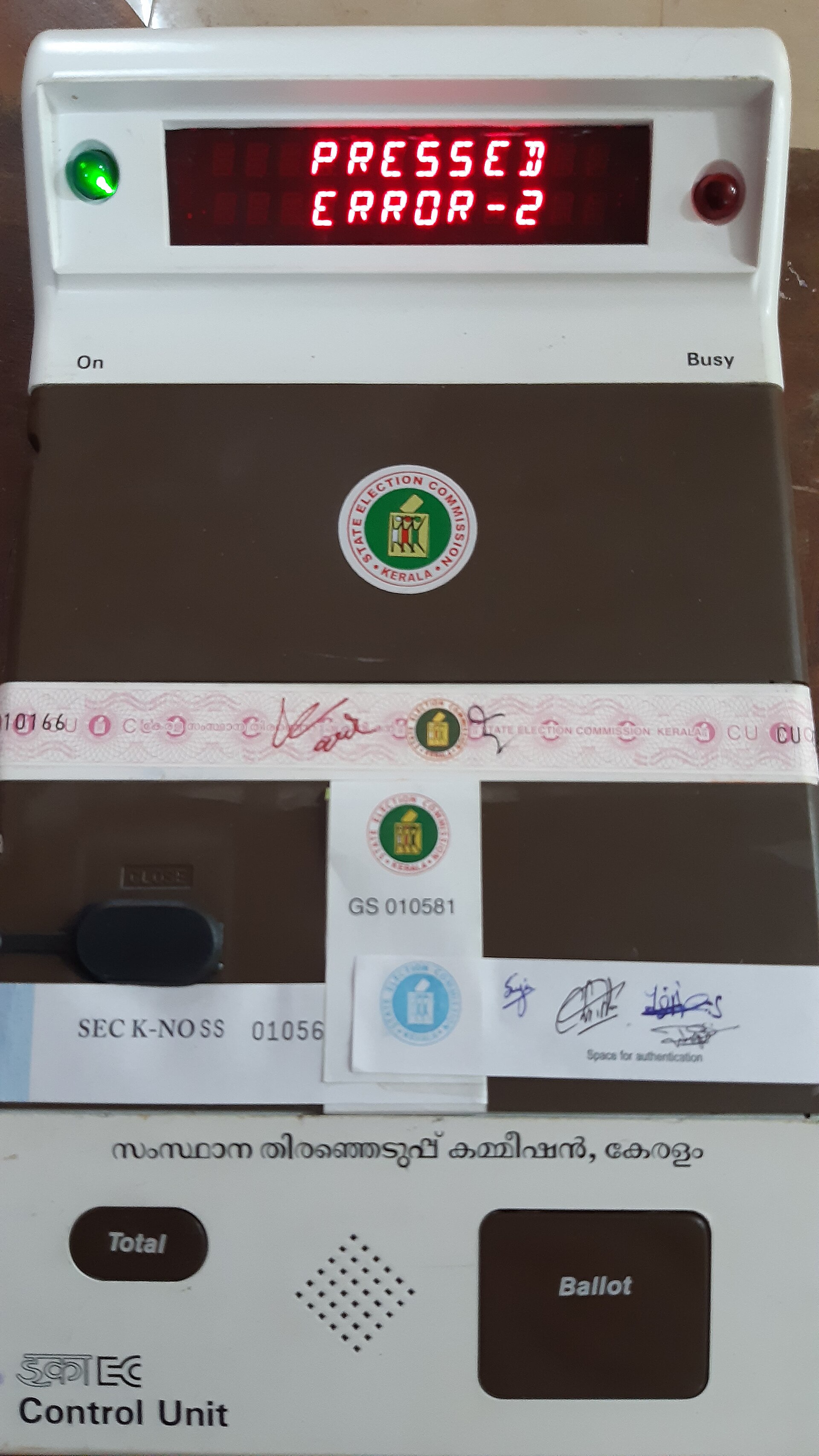
India votes electronically. Electronic voting machines were first used experimentally in a Kerala constituency in 1982, contested in court, subsequently authorised by amendment to the law, and rolled out nationally by the 2004 general election. The Indian machine is deliberately primitive by design: a standalone unit with no network connection, no operating system in the conventional sense, and firmware burned into a one-time programmable chip, paired with a control unit operated by the presiding officer. Since a Supreme Court direction in 2013 the machines have been progressively fitted with a voter verifiable paper audit trail, a printer that displays a slip behind glass for a few seconds before dropping it into a sealed box, first used in a Nagaland constituency and now universal. The commission verifies the paper slips against the electronic count in a sample of polling stations in every assembly segment. Opposition parties have repeatedly questioned the integrity of the machines, and the courts have as repeatedly declined to order a return to paper ballots or full paper counting, finding the challenges unsupported by evidence. The dispute is now as much about trust in institutions as about the technology.
Powers, and the fight over who appoints
The commission's authority became conspicuous under T N Seshan, Chief Election Commissioner from 1990 to 1996, who converted powers that had lain largely unused into active enforcement. He insisted on the observance of the Model Code of Conduct, a set of norms agreed among parties that takes effect the moment an election is announced and restrains ministers from announcing new schemes, transferring officials or using state resources for campaigning. He enforced ceilings on candidate spending, cancelled polls where malpractice was proved, and drove the issue of photo identity cards to voters from 1993. The Model Code has no statutory backing and cannot be enforced by fine or imprisonment, which is precisely why its effectiveness depends on the commission's willingness to name and act against powerful people. The commission does hold hard statutory levers: it registers political parties, allots and adjudicates disputes over election symbols, transfers officials during the election period, and can recommend the disqualification of legislators for holding an office of profit.
How commissioners are chosen has become the sharpest current controversy. The Constitution left appointment to the President, meaning in practice the Union cabinet, subject to any law Parliament might make, and for seven decades Parliament made none. In March 2023 a constitution bench of the Supreme Court held in Anoop Baranwal that this arrangement was unsatisfactory and directed that, until Parliament legislated, appointments should be made on the advice of a panel comprising the Prime Minister, the Leader of the Opposition in the Lok Sabha and the Chief Justice of India. Parliament legislated later that year, and the statute replaced the Chief Justice with a Union cabinet minister nominated by the Prime Minister, restoring a government majority on the selection panel. Critics argue this defeats the purpose of the court's intervention; the government's position is that appointment is an executive function and that the court cannot write the selection process. Litigation continues.
Other criticisms are long-standing. Enormous and largely undisclosed campaign spending has never been brought under effective control, and the electoral bond scheme introduced in 2018, which permitted anonymous corporate donations to parties, was struck down by the Supreme Court in February 2024 as unconstitutional for violating voters' right to information. Paid news, misinformation on messaging platforms, competitive welfare promises and the criminal records of a substantial number of elected legislators all sit beyond what an election administrator can readily fix. What the commission has delivered, across more than seventeen general elections and hundreds of state polls, is the orderly transfer of power in an extraordinarily diverse country where a large share of voters cannot read the names on the ballot, which is why party symbols exist. That is not a small achievement, and it is the reason arguments about the commission's independence are conducted with such heat.
References
- Election Commission of IndiaOfficial website
- Government of India, Ministry of Law and JusticeConstitution of India
- BBC NewsIndia elections coverage
- Encyclopaedia BritannicaElections in India
This is a reference article, written from the sources above. It is background, not news reporting.