
The Epics that Still Shape Everyday Life
Reference library · 1006 words

Two very long poems, composed in Sanskrit and transmitted for centuries before they were written down, remain live cultural material in South Asia in a way that has few parallels anywhere. The Ramayana, traditionally attributed to the sage Valmiki, tells of Rama, prince of Ayodhya, who is exiled to the forest, whose wife Sita is abducted by Ravana, the king of Lanka, and who recovers her with the help of an army led by the monkey Hanuman. The Mahabharata, traditionally attributed to Vyasa, is far longer, and centres on a succession dispute between two sets of cousins, the Pandavas and the Kauravas, which culminates in a catastrophic war on the field of Kurukshetra. The Mahabharata is often described as the longest poem in world literature, running to roughly a hundred thousand verses in its standard form, which makes it many times the length of the Iliad and Odyssey combined.
Dating them is genuinely difficult and scholars disagree. Both are the product of long processes of oral composition and accretion rather than single acts of authorship, and the critical editions prepared in the twentieth century at the Bhandarkar Oriental Research Institute in Pune, for the Mahabharata, and at the Oriental Institute in Vadodara, for the Ramayana, established that manuscript traditions vary considerably across regions. Broadly, most scholarship places the core material in the last few centuries before the common era and the first few centuries of it, with earlier layers behind that. Traditional believers place them much earlier. It is worth being honest that the question of historicity, particularly regarding Rama and Ayodhya, is not merely academic in contemporary India but politically charged.
Why they never became museum pieces
The reason these texts stayed alive is that they were never confined to Sanskrit or to elite readership. They were retold, and the retellings became independent classics. Kamban composed a Tamil Ramayana in the medieval period. Tulsidas wrote the Ramcharitmanas in Awadhi in the sixteenth century, and it is this version, not Valmiki's Sanskrit, that most north Indians actually know. There are Bengali, Odia, Kannada, Telugu, Malayalam, Assamese and Marathi versions, and the stories travelled across Southeast Asia, where the Thai Ramakien, the Javanese and Balinese traditions, and Cambodian Reamker reliefs at Angkor all attest to a long shared inheritance. The scholar A. K. Ramanujan wrote a well known essay observing that there is no single Ramayana but a great many, and that the differences between them matter.
These retellings are not identical in their moral judgements, which is precisely why the tradition remains alive. Some versions treat Ravana with considerable sympathy, particularly in parts of the south and in Sri Lankan tradition. Sita's ordeal by fire and her later banishment while pregnant have been the subject of criticism and reworking for centuries, not only by modern feminist writers. In the Mahabharata, the moral ambiguity is built into the text: the Pandavas, the nominal heroes, win by a series of deceptions, and the poem does not pretend otherwise. Yudhishthira, the eldest, gambles away his brothers and their shared wife Draupadi in a dice game, and the humiliation of Draupadi in the assembly hall is the pivot on which the whole war turns.
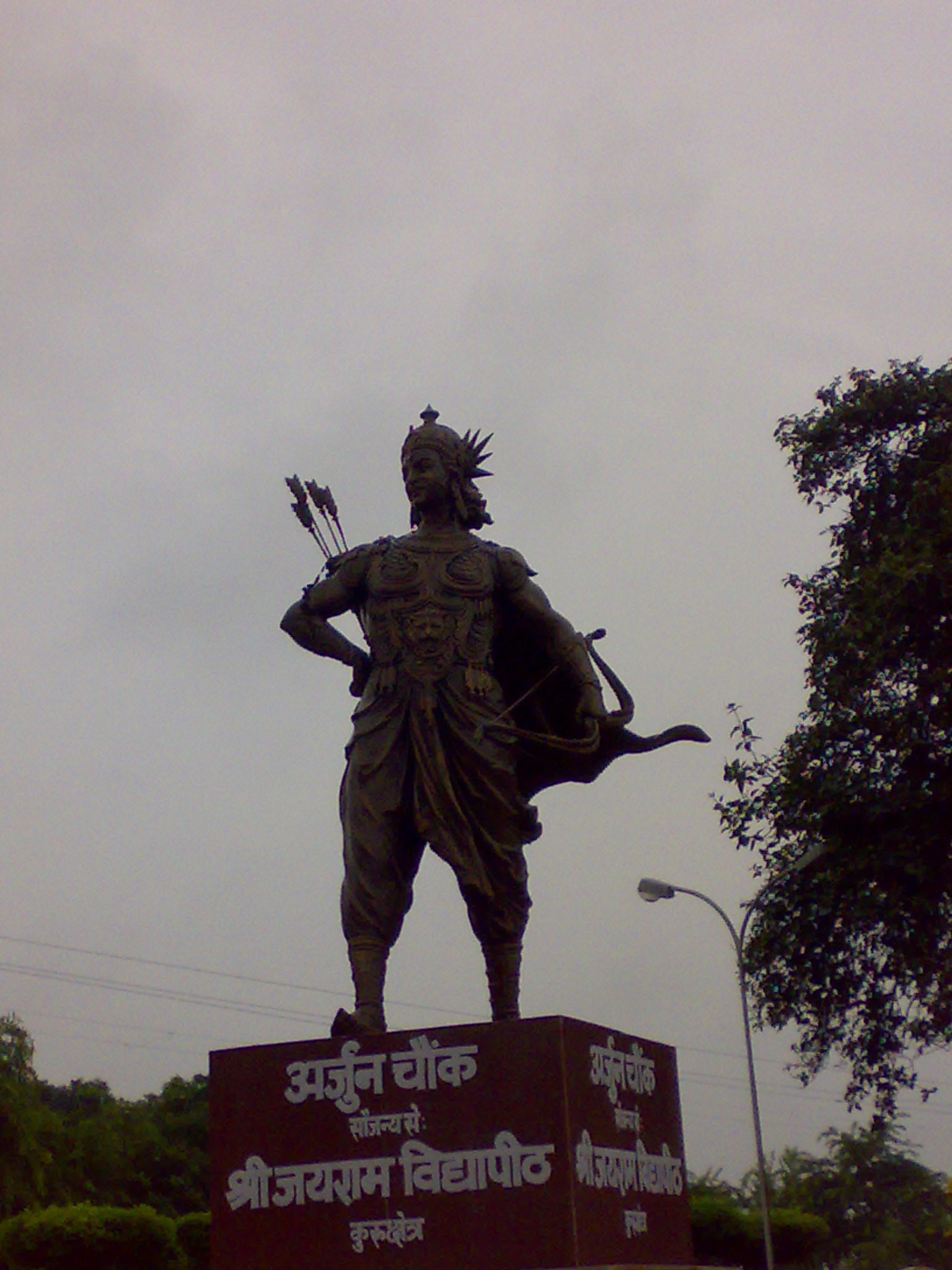
Embedded within the Mahabharata is the Bhagavad Gita, a dialogue of about seven hundred verses between the warrior Arjuna and his charioteer Krishna, delivered on the battlefield as the armies face one another. Arjuna, seeing relatives and teachers on the opposing side, refuses to fight. Krishna's response ranges across duty, action, detachment from the fruits of action, and devotion. The Gita became one of the most widely read and commented upon texts in Indian thought, and acquired an unusual afterlife abroad: it was read closely by Henry David Thoreau and Ralph Waldo Emerson, and Gandhi described it as his constant reference, reading its call to detached action as compatible with non violence, a reading many others have disputed.
The epics in daily life
The presence of these stories in ordinary life is easy to miss if you are looking only for books. Festivals are structured around them. Dussehra, celebrated across much of India, culminates in the burning of effigies of Ravana, and in the weeks before it the Ramlila, a dramatic cycle of episodes from the Ramayana, is performed in towns and neighbourhoods, most famously at Ramnagar near Varanasi, where the performance runs for around a month and moves across the town. Diwali, in much of the north, is explained as the celebration of Rama's return to Ayodhya. Hanuman temples are found in almost every town, and Tuesday is widely observed as his day.
Names carry the epics too. Millions of people are called Rama, Sita, Lakshman, Bharat, Arjun, Krishna, Bhima or Draupadi. Idioms do the same work: a devoted brother may be called a Lakshman, a loyal follower a Hanuman, a fratricidal quarrel a Mahabharata. Television turned this into a mass event in the late 1980s, when Ramanand Sagar's serial Ramayan and B. R. Chopra's Mahabharat were broadcast on the state network Doordarshan and drew audiences on a scale that emptied streets on Sunday mornings. Those serials also, as many commentators have noted, standardised particular visual and narrative versions of stories that had previously varied enormously from region to region, which is a real cultural loss alongside the popularisation.
For readers encountering these works for the first time, the useful thing to hold onto is that they are not scripture in the way the Bible or the Quran are scripture, and they are not simply entertainment either. They function as a shared reservoir of characters and dilemmas that people argue with. A politician invoking Rama, a novelist rewriting the story from Sita's or Draupadi's perspective, a village performance that gives Ravana the best lines: all of these are legitimate moves within a tradition that has always been plural. The tension in contemporary India comes from attempts to fix a single authorised version, which is a departure from how these poems have actually lived for two thousand years.
References
- Bhandarkar Oriental Research InstituteThe Critical Edition of the Mahabharata
- Encyclopaedia BritannicaMahabharata
- Encyclopaedia BritannicaRamayana
- UNESCORamlila, the traditional performance of the Ramayana
This is a reference article, written from the sources above. It is background, not news reporting.