
The Green Revolution and Rural Transformation
Reference library · 1023 words

In the mid 1960s India was importing wheat on a scale that made its food supply a matter of foreign policy. Consecutive monsoon failures in 1965 and 1966 produced severe shortages, and the country depended heavily on concessional American grain shipments under the Public Law 480 programme, which the United States used as political leverage. The situation was intolerable to Indian planners for reasons that were as much about sovereignty as about hunger. What followed over the next fifteen years, usually called the Green Revolution, transformed Indian cereal production, made the country self-sufficient in wheat and rice, and created a set of environmental and social problems that remain unresolved sixty years later.
The technical core was plant breeding. Traditional Indian wheat varieties were tall, and when heavily fertilised they grew taller still, became top-heavy and fell over before harvest, a failure called lodging. That single trait capped the yield response to fertiliser. Norman Borlaug's programme in Mexico had bred semi-dwarf wheats incorporating Japanese dwarfing genes, plants short and stiff enough to carry a heavy grain head without collapsing, and responsive to nitrogen in a way tall varieties were not. Indian scientists including M S Swaminathan at the Indian Agricultural Research Institute in New Delhi arranged trials of Mexican varieties in the mid 1960s and then bred locally adapted versions. A parallel breakthrough came in rice, where the International Rice Research Institute in the Philippines released the semi-dwarf variety IR8 in 1966, widely publicised at the time as miracle rice. Borlaug received the Nobel Peace Prize in 1970 for this body of work.
A package, not a seed
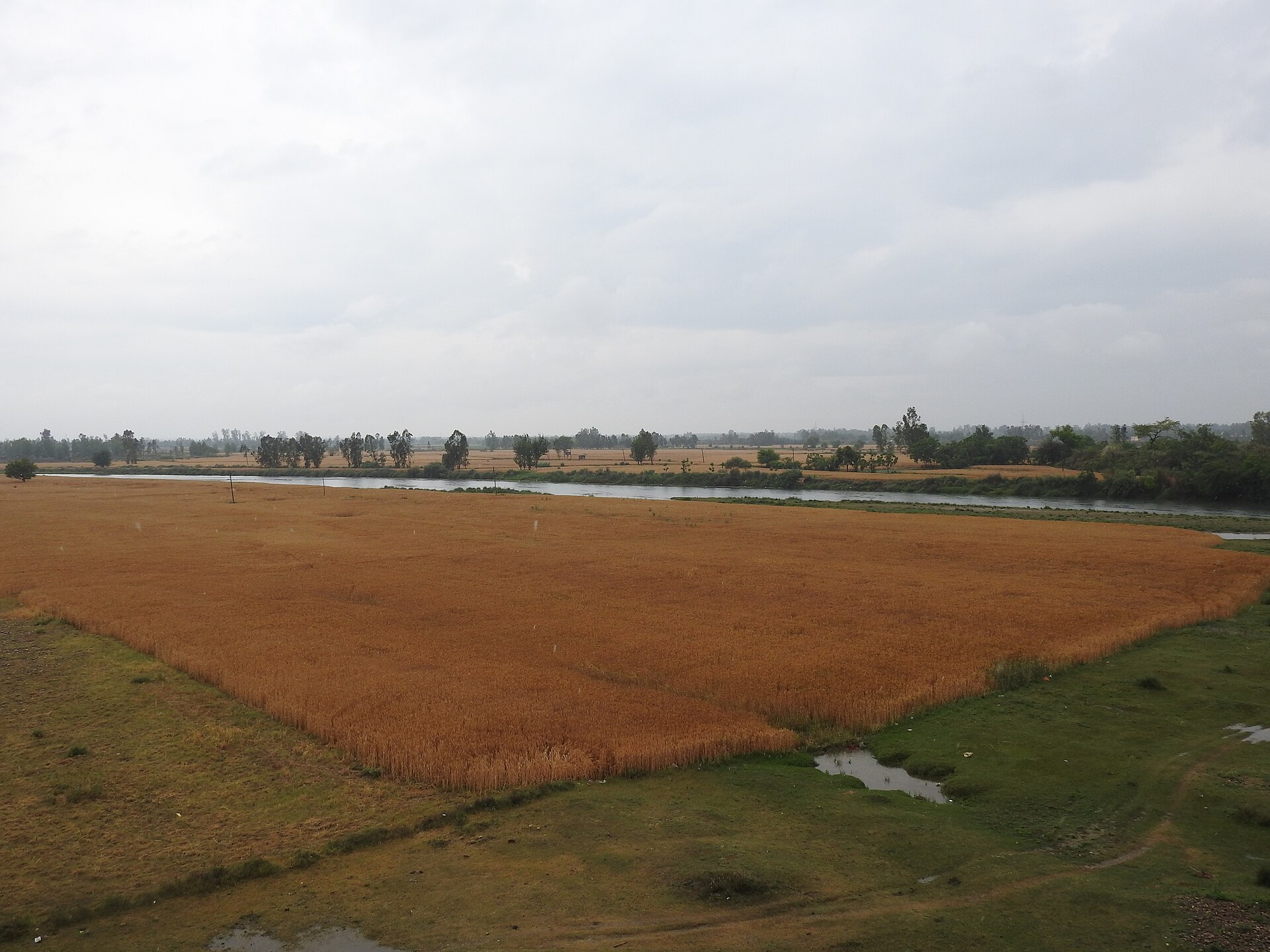
The critical point, and the one most often lost, is that the new varieties were useless on their own. They only outperformed traditional seed when supplied with reliable water, substantial nitrogen fertiliser and pest control, which meant the Green Revolution was really the rollout of a package: seed, irrigation, urea, pesticides, and the credit to buy all of it. The High Yielding Varieties Programme launched in 1966 and 1967 concentrated deliberately on districts that already had assured irrigation, because scattering the package across rainfed India would have wasted it. Punjab, Haryana and western Uttar Pradesh had canal systems, and cheap electricity and subsidised credit allowed farmers to sink tubewells to supplement them. Those regions became the engine of Indian cereal output.
Two institutional decisions made in 1965 mattered as much as the seed. The government established a body to recommend minimum support prices, now the Commission for Agricultural Costs and Prices, and it created the Food Corporation of India to procure, store and distribute grain. Together these guaranteed farmers that if they invested in the package and produced a surplus, there would be a buyer at an announced price. Without that assurance, few would have taken the risk, because a bumper harvest with no procurement simply collapses the local price. Procurement centres, regulated markets and, over time, a dense network of state agencies in Punjab and Haryana turned wheat and paddy into the only crops with a guaranteed outlet. Understanding this explains a great deal of later Indian politics, including why the farm laws passed in 2020 and repealed in November 2021 provoked their most intense opposition precisely in the states most dependent on assured procurement.
What it achieved and what it cost
The achievement was real and should not be minimised. Indian wheat output rose dramatically within a few seasons, rice followed more slowly, and by the late 1970s and into the 1980s India had moved from importing grain to holding buffer stocks large enough to support a national public distribution system. Predictions made in the 1960s that India faced unavoidable mass famine did not come true. Farm incomes in the irrigated northwest rose sharply, rural wages in those districts rose with them, and a supporting economy of tractor dealers, pump manufacturers, fertiliser distributors and agricultural universities grew up around the new system.
The costs accumulated more slowly. Groundwater is the most serious. Punjab's rice cultivation, a crop poorly suited to a semi-arid state, is sustained by pumping from aquifers that have been drawn down for decades, and falling water tables force ever deeper and more expensive borewells. Free or heavily subsidised farm electricity removed any price signal on pumping. Fertiliser subsidy concentrated on urea produced badly imbalanced nutrient application, with nitrogen used generously and phosphorus, potassium and micronutrients undersupplied, degrading soil over time. Continuous rice-wheat rotation narrowed biodiversity and increased pest pressure, and the short window between harvesting paddy and sowing wheat encourages the burning of rice stubble, a practice that contributes materially to the severe autumn air pollution across the Indo-Gangetic plain including Delhi.
The distributional criticism is equally substantial. Because the package required irrigation and capital, its benefits went overwhelmingly to farmers who already had land and water. Eastern India, much of the Deccan and the rainfed and tribal uplands were largely bypassed, widening regional inequality. Within villages, larger landholders adopted first and gained most, while tenants and labourers gained mainly through wages. Rising input costs also tied farmers to annual borrowing, and rural indebtedness became a persistent and in some regions a lethal problem. Critics, most prominently Vandana Shiva, have argued that the whole model substituted an ecologically sound and locally adapted agriculture with a chemical-intensive one that enriched input suppliers. Defenders reply that this argument is easier to make from a position of food security than it would have been in 1966, and that no alternative capable of delivering comparable output at comparable speed was actually on offer.
Both positions contain something true, and the more useful framing is that the Green Revolution solved the specific problem it was designed for, national cereal availability, extremely well, and was never designed to address nutrition beyond calories, soil health, water balance, farm incomes in rainfed regions, or the position of the landless. Indian agricultural policy has been trying to catch up with those omissions ever since, through the National Food Security Act of 2013, through crop diversification and millet promotion, through micro-irrigation programmes, and through repeated and so far inconclusive attempts to reform the procurement system without dismantling the security it provides.
References
- The Nobel PrizeNorman Borlaug, Nobel Peace Prize 1970
- Encyclopaedia BritannicaGreen Revolution
- Indian Council of Agricultural ResearchICAR research institutes
- Food Corporation of IndiaProcurement and buffer stock operations
- Food and Agriculture Organization of the United NationsFAO country profile: India
This is a reference article, written from the sources above. It is background, not news reporting.