
The Gupta Era: A Golden Age Remembered
Reference library · 1082 words

Between roughly 320 and 550 of the common era, a dynasty based in the Ganga plain ruled the largest north Indian state since the Mauryas, minted some of the finest gold coinage produced anywhere in the ancient world, and presided over a period in which Sanskrit literature, temple architecture, mathematics and astronomy each took forms that would define them for the next thousand years. Indian textbooks have long called this the golden age. The label is useful shorthand and also a distortion, and it is worth understanding both the achievements and the reasons the phrase is contested.
The dynasty's origins are obscure. The first two rulers named Gupta and Ghatotkacha appear only as ancestors in later inscriptions. The conventional starting point is Chandragupta I, who took the grand title of maharajadhiraja, great king of kings, around 320, the year from which the Gupta era was later reckoned. His power base was Magadha, roughly modern Bihar, and his marriage to a Lichchhavi princess was commemorated on coinage, which suggests the alliance mattered more than dynastic modesty allowed anyone to forget.
The expansion is credited to his son Samudragupta, and the evidence for it is unusually direct. A pillar at Allahabad, originally erected by Ashoka centuries earlier, carries a long Sanskrit panegyric composed by the court poet Harishena, known as the Prayaga Prashasti. It lists rulers Samudragupta uprooted in the Ganga plain, kings of the south whom he defeated and then reinstated as tributaries, frontier states and tribal republics that submitted, and foreign powers that sought his favour. It also praises him as a musician and poet, and coins show him playing a lyre. Historians read the inscription carefully rather than literally: it is court propaganda, and its geography of conquest tells us about claims as much as about control. But it does establish a workable map of the political world of the fourth century.
Chandragupta II, who reigned from around 375 to 415 and used the title Vikramaditya, extended Gupta authority westward by defeating the Western Kshatrapas, the Saka rulers of Malwa, Gujarat and Kathiawar. That victory gave the empire access to the western seaports and to the Arabian Sea trade, and it is visible in the coinage, where the Guptas adopted the silver denomination the Kshatrapas had used. His reign coincides with the visit of the Chinese Buddhist pilgrim Faxian, who travelled in India roughly between 399 and 414 and left an account describing a peaceful and prosperous countryside, light taxation and few restrictions on travel. Faxian was a monk interested in monastic discipline, not a statistician, and his observations concern the routes he took, but his testimony remains one of the few outside descriptions of the period.
What the period actually produced
The intellectual achievements are the strongest part of the case. The astronomer and mathematician Aryabhata completed the Aryabhatiya in 499, a compact verse treatise which handled square and cube roots, arithmetic and geometric series, quadratic equations, a strikingly accurate value for pi, and a table of sine differences. He stated that the apparent daily rotation of the heavens is caused by the rotation of the Earth on its axis, a position most later Indian astronomers rejected. The decimal place value system with a symbol for zero, which was to transform mathematics globally after transmission through the Arabic speaking world, took recognisable form in this period, although the precise dating of individual sources, including the Bakhshali manuscript, is genuinely disputed.
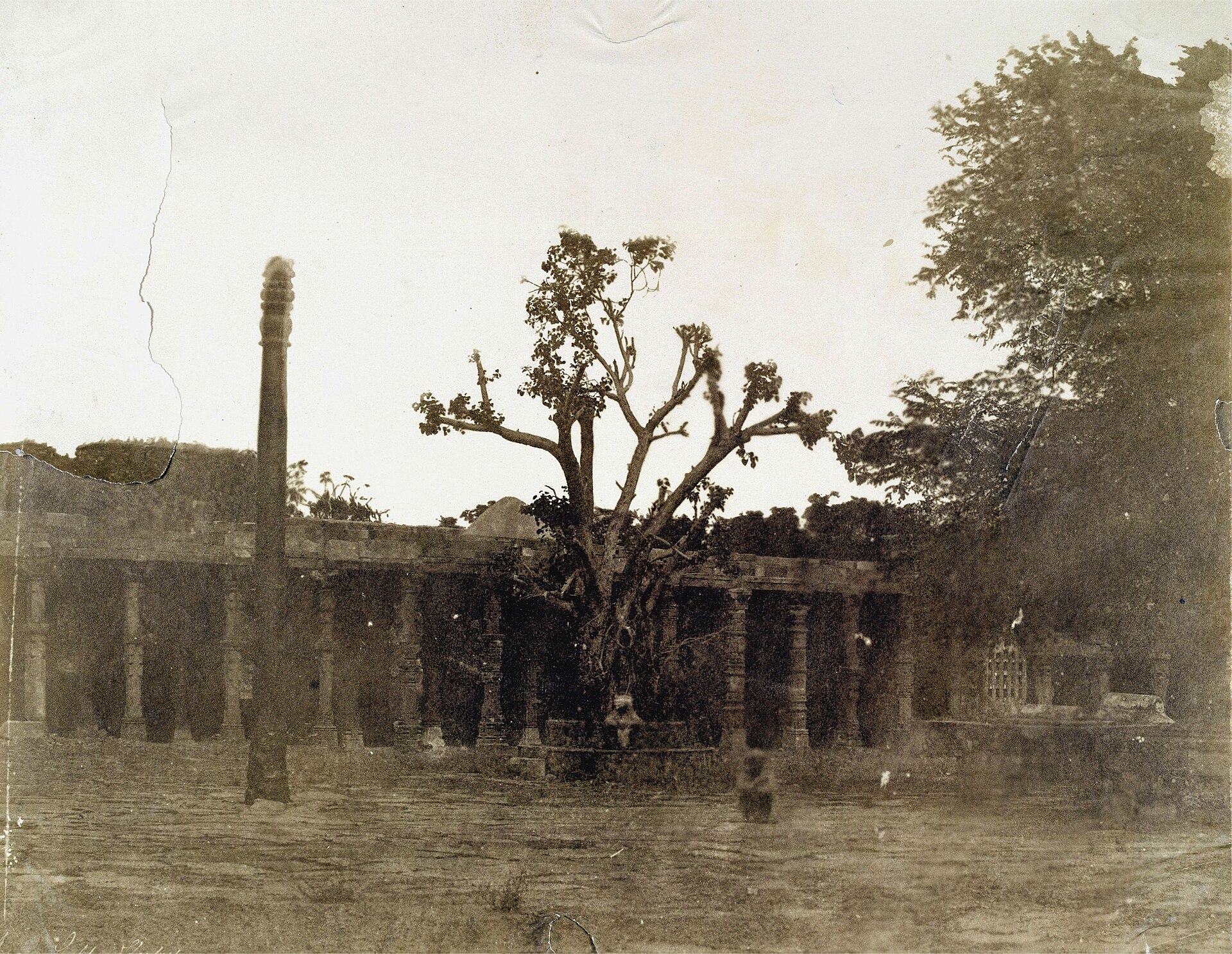
In literature, the era is dominated by Kalidasa, whose date is not certain but is generally placed in the fourth or fifth century. His play Abhijnanashakuntalam and his poems Meghaduta and Raghuvamsha set the standard for Sanskrit kavya. The period also saw the recension of the great epics into something close to their received forms, and the composition or compilation of major Puranas and of legal texts. In art, the Gupta workshops at Sarnath and Mathura produced Buddha images of a restrained, inward looking type that became the model for Buddhist sculpture across Asia. In architecture, the small brick and stone shrines of the period, notably the Dashavatara temple at Deogarh and the shrines at Sanchi and Bhitargaon, represent the beginning of the north Indian temple with a walled sanctum and a superstructure over it. The iron pillar now standing at the Qutb complex in Delhi, which bears an inscription of a king named Chandra and has resisted corrosion for some sixteen centuries, is generally assigned to this period and remains a metallurgical curiosity of real scientific interest.
Why the golden age label is disputed
The empire was not a centralised bureaucracy on the Mauryan model. Gupta rulers governed the core directly through provinces and districts, but much of the territory listed in the inscriptions was held by subordinate kings and chiefs who paid tribute and kept their thrones. From the fifth century onwards, the practice of granting land, often with revenue and administrative rights attached, to Brahmins and religious institutions spread widely. Some historians, following a line of argument associated with R. S. Sharma, see in these grants the beginnings of a decentralised, land based order sometimes described as Indian feudalism, with declining trade and urban decay. Others dispute both the model and the evidence for decline.
The golden age framing itself has a history. It was articulated most forcefully in the early twentieth century, when Indian historians writing under colonial rule had an obvious interest in demonstrating a classical antiquity comparable to Greece and Rome. That framing privileged Sanskrit, courtly and largely Brahmanical culture, and it centred northern India while the same centuries saw significant developments in the Deccan under the Vakatakas, including the later Ajanta caves, and in the Tamil country. It also passed lightly over evidence that caste distinctions hardened, that legal texts of the period prescribed increasingly restrictive positions for women and for those outside the ritual order, and that prosperity, whatever its extent, was unevenly distributed.
The end came through pressure on the northwest. Groups known in Indian sources as Hunas, related to the Hephthalite confederations of Central Asia, pressed into India from the later fifth century. Skandagupta claimed to have repulsed them, but the wars appear to have drained the treasury, and the debasement of Gupta gold coinage over time is consistent with that. By the middle of the sixth century, imperial authority had fragmented into regional kingdoms. What survived was not the state but the cultural template it had formalised, which later dynasties from Kannauj to the Deccan continued to work with.
References
- Encyclopaedia BritannicaGupta dynasty
- Archaeological Survey of IndiaArchaeological Survey of India
- The Metropolitan Museum of ArtHeilbrunn Timeline of Art History: South Asia
- British MuseumGupta coinage collection
This is a reference article, written from the sources above. It is background, not news reporting.