
The Indus Valley: An Ancient Urban Civilisation
Reference library · 1063 words

For most of recorded history, nobody knew it existed. The Indus civilisation left no monumental sculpture of kings, no epic naming its rulers, and a script that has never been read. It vanished so completely from memory that when British engineers building the Lahore to Multan railway in the 1850s needed ballast, they quarried baked bricks from a large mound at Harappa without any idea that they were dismantling a city older than the pyramids of Giza were ancient to the Romans. Only in the 1920s, when Daya Ram Sahni excavated at Harappa and R. D. Banerji at Mohenjo daro in Sindh, did the Archaeological Survey of India realise that the two widely separated sites had produced identical seals. John Marshall announced the discovery of a previously unknown civilisation in 1924.
What has emerged since is the largest of the ancient Bronze Age civilisations by area, spread across what is now Pakistan and north western India, from Balochistan to the Ganga Yamuna divide and from the Himalayan foothills to the coast of Gujarat. Its mature urban phase is dated roughly from 2600 to 1900 BCE, preceded by centuries of village farming settlements at places such as Mehrgarh in Balochistan, where agriculture is attested from the seventh millennium BCE. More than a thousand sites are known. The best studied include Harappa and Mohenjo daro in Pakistan, and Dholavira and Lothal in Gujarat, Kalibangan in Rajasthan and Rakhigarhi in Haryana on the Indian side.
Cities built to a standard
The striking feature of Indus urbanism is uniformity. The major cities are laid out on a broadly rectilinear plan, with wide main streets and narrower lanes, and are usually divided into a raised western sector, conventionally called the citadel, and a lower town. Buildings are made from kiln fired bricks of standardised proportion, in a ratio of roughly one to two to four in thickness, width and length, a ratio that holds at sites hundreds of kilometres apart. Water management is the other signature. Houses had wells and bathing platforms, waste water ran into covered brick drains along the streets, and Dholavira in the Rann of Kutch preserves an extraordinary system of reservoirs cut into rock to capture seasonal runoff in an arid landscape.
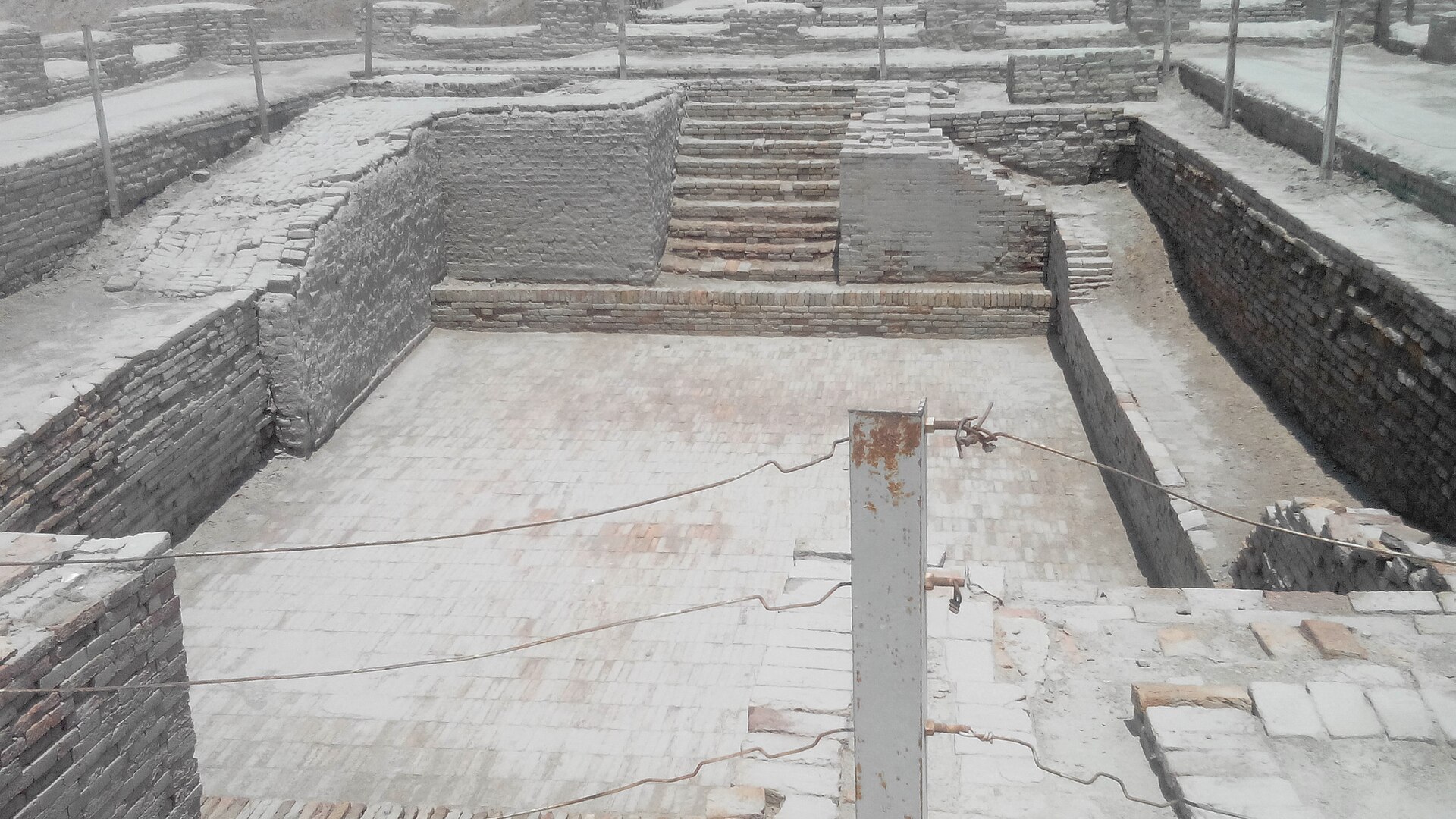
Mohenjo daro contains the structure known as the Great Bath, a watertight sunken tank about twelve metres long lined with bitumen, approached by steps at each end. Marshall interpreted it as ritual, and most archaeologists still do, though nobody can say what the ritual was. Nearby is a large pillared hall and a building long called the granary, an identification that has been questioned because no grain was found in it. This is the recurring difficulty: the material remains are rich and the interpretation is thin, because there is no readable text to anchor it.
Standardisation extends to commerce. Indus weights, cut from chert in neat cubes, follow a consistent system across the whole region, with the smaller denominations doubling in sequence. Seals carved in steatite, usually square and bearing an animal (most often a one horned creature conventionally called the unicorn) above a short line of signs, were pressed into clay sealings on goods. Indus seals and carnelian beads have been found in Mesopotamia, and Mesopotamian cuneiform texts refer to trade with a place called Meluhha, which most scholars identify with the Indus region. Lothal in Gujarat has a large brick basin that its excavator, S. R. Rao, identified as a dockyard, an interpretation still debated by those who read it as a water tank.
The script and the silence
Around four hundred distinct signs have been catalogued, and the corpus consists overwhelmingly of very short inscriptions, typically fewer than six signs, on seals, tablets and pottery. There is no bilingual text, no Rosetta Stone, and no securely identified proper name. Decipherment claims appear regularly and none has been accepted. Proposed underlying languages include an early Dravidian, an Indo Aryan tongue, and a language family now extinct, and the choice made is often correlated with the political commitments of the person making it. A provocative paper by Steve Farmer, Richard Sproat and Michael Witzel in 2004 argued that the signs never encoded speech at all, functioning instead as non linguistic emblems; statistical work by Rajesh Rao and colleagues published in 2009 argued the opposite from the patterning of sign sequences. The question remains open.
Equally striking is what is absent. No structure has been convincingly identified as a palace or a royal tomb. Burials, where found, are modest and show relatively little differentiation in grave goods compared with contemporary Egypt or Sumer. Weapons are present but fortification and depictions of warfare are limited. Some archaeologists infer a society organised through merchant guilds or ritual authority rather than kingship; others suspect that elite display simply took forms that do not survive. Both are inferences from silence.
Decline, and a modern argument
The cities were not sacked. From about 1900 BCE the large urban centres were progressively abandoned, drainage and civic maintenance lapsed, long distance trade contracted and settlement shifted eastward towards the Ganga plains, producing smaller late Harappan and successor cultures. The older idea that invading Aryans destroyed the cities, drawn from a handful of unburied skeletons at Mohenjo daro and from readings of the Rigveda, is no longer supported by the archaeological evidence. Current explanations emphasise environment: a weakening of the summer monsoon indicated by several palaeoclimate records, and the drying or diversion of the Ghaggar Hakra river system along which very many sites are clustered, which some identify with the Sarasvati of the Rigveda.
The civilisation has become politically charged in modern South Asia, because the question of who its people were bears on nationalist arguments about indigenous origins. Ancient DNA published in 2019 from a burial at Rakhigarhi, analysed by Vasant Shinde, Vagheesh Narasimhan, David Reich and colleagues, found an individual with ancestry related to Iranian hunter gatherer lineages that diverged before the spread of farming, combined with ancient South Asian ancestry, and no detectable Steppe pastoralist component. That single genome is compatible with more than one historical reading, and it has duly been claimed by more than one side. What is not in dispute is that this was a literate or at least sign using, planned, hydraulically sophisticated urban society, and that most of what it thought about itself is still locked inside a script we cannot read.
References
- UNESCO World Heritage CentreArchaeological Ruins at Moenjodaro
- Archaeological Survey of IndiaExcavated sites and Harappan archaeology
- Encyclopaedia BritannicaIndus civilization
- UNESCO World Heritage CentreDholavira: A Harappan City
- Harappa.com, Global Heritage and Indus research archiveIndus civilization resources
This is a reference article, written from the sources above. It is background, not news reporting.