
The Making of India's Parliamentary System
Reference library · 1093 words
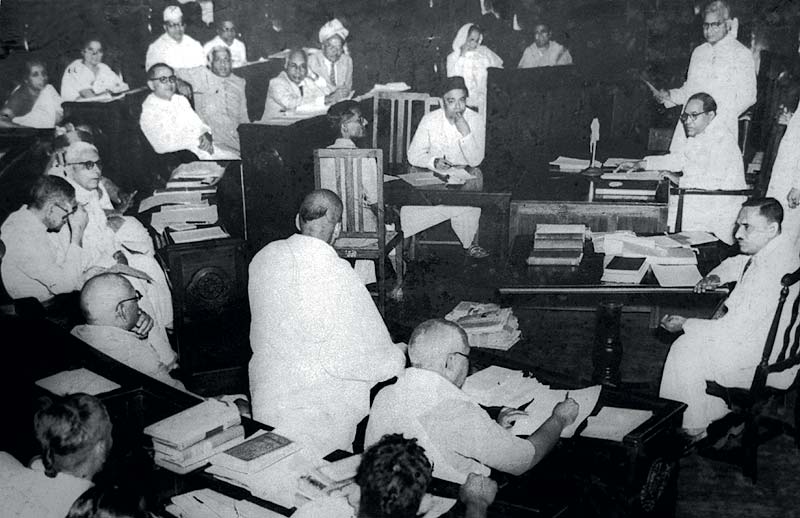

India's Parliament is the product of a deliberate choice made by a body that had every reason to choose otherwise. The Constituent Assembly, indirectly elected in 1946 under the Cabinet Mission plan and first convened on 9 December that year, was drafting for a country with a hundred languages, a devastating partition under way, and no experience of universal suffrage. It could have opted for a strong presidency on the American model, which several members argued would give the new state decisive leadership. It chose instead the Westminster parliamentary system, in which the executive is drawn from the legislature and survives only so long as it holds the confidence of the elected house.
Why Westminster
The reasoning was set out most clearly by B. R. Ambedkar, who chaired the Drafting Committee appointed in August 1947. He framed the choice as a trade off between stability and accountability. A president elected for a fixed term offers more stability, because they cannot be removed between elections; a cabinet answerable to the legislature offers more accountability, because it can be questioned daily and dismissed at any time. For a new democracy in which the executive would hold vast powers over a population with little previous experience of holding rulers to account, the Assembly judged that continuous accountability mattered more.
Familiarity mattered too. Indian politicians had spent decades operating inside the institutions created by the Government of India Acts of 1919 and 1935, with provincial legislatures, ministerial responsibility and an elaborate framework of federal relations. The 1935 Act in particular supplied so much of the structure of the eventual constitution, including the division of legislative powers into lists, that critics have called the document derivative. The Assembly's members generally replied that borrowing what works is not a failure of imagination. The constitution was adopted on 26 November 1949 and came into force on 26 January 1950.
How the two houses work
Parliament consists of the President and two houses. The Lok Sabha, or House of the People, is directly elected for a five year term from single member constituencies on a first past the post basis, the same method used in Britain, Canada and Australia's lower house. Its maximum strength is set at just over five hundred and fifty members. It is the house that matters for the survival of a government: the Council of Ministers is collectively responsible to the Lok Sabha under Article 75, money bills originate there, and a government defeated on a confidence motion must resign.
The Rajya Sabha, or Council of States, is the federal chamber, with a maximum of two hundred and forty five members. Most are elected by the elected members of state legislative assemblies using a single transferable vote, with a small number nominated by the President for distinction in literature, science, art and social service. Crucially it is a permanent body that is never dissolved: one third of its members retire every two years, which means its composition reflects state election results accumulated over six years rather than a single national wave. This gives it a genuinely different political character from the Lok Sabha and has repeatedly forced governments with large lower house majorities to negotiate.
The President is head of state, elected by an electoral college of members of Parliament and of state legislative assemblies whose votes are weighted to balance the states against the union and against each other. The office is largely ceremonial in normal operation: the President acts on the advice of the Council of Ministers, a position made explicit by amendment in the 1970s. Residual discretion exists in genuinely unclear situations, most obviously in deciding whom to invite to form a government when no party has a majority, and those decisions have occasionally been fiercely contested.
Adaptations, innovations and strains
The system has been altered repeatedly, sometimes drastically. The Forty second Amendment of 1976, passed during the Emergency when opposition leaders were in jail, curtailed judicial review and extended the life of the Lok Sabha, and much of it was reversed by the Forty fourth Amendment in 1978 after the Janata government took office. That sequence established something important: the parliamentary framework proved capable of being abused and also of being restored through electoral defeat.
Political defection was the other great structural problem. Through the 1960s and 1970s legislators changed parties so freely that state governments rose and fell within weeks. The Fifty second Amendment of 1985 inserted the Tenth Schedule, disqualifying a member who voluntarily gives up party membership or votes against a party whip, with an exemption for a split involving a third of a legislature party. The Ninety first Amendment of 2003 removed that split exemption, leaving only mergers of two thirds, and separately capped the size of a Council of Ministers at fifteen percent of the house. The anti defection law stabilised governments at a real cost: it concentrated power in party leaderships, since an individual member who votes their conscience against the whip loses their seat. Disputes over disqualification are decided by the Speaker or Chairman, whose own partisan position makes that role controversial, and delays in deciding such petitions have drawn repeated judicial criticism.
Indian practice has also generated its own devices. Question Hour was inherited, but Zero Hour, the period immediately after it when members raise urgent matters without notice, is an Indian innovation with no British equivalent. A system of departmentally related standing committees was created in 1993, giving members a forum to scrutinise ministries in detail away from the theatre of the chamber, and these committees have produced some of the most substantive legislative work of recent decades.
The strains are equally real and openly discussed. Parliament sits for far fewer days each year than it did in the 1950s, and significant bills have been passed after very brief debate or with the opposition absent, which weakens the scrutiny that justified choosing the parliamentary model in the first place. Referral of bills to committees has become less routine. Two structural questions loom. The Constitution (One Hundred and Sixth Amendment) Act of 2023 reserves one third of Lok Sabha and state assembly seats for women, but its implementation is tied to a census and a delimitation exercise. That delimitation is itself the second question: the allocation of seats between states has been frozen since the 1970s to avoid penalising states that reduced their birth rates, and unfreezing it would shift parliamentary weight sharply toward the more populous northern states. Resolving that without fracturing the federation is arguably the hardest institutional problem India's Parliament now faces.
References
- Parliament of IndiaLok Sabha official website
- Parliament of IndiaRajya Sabha official website
- Government of India, Ministry of Law and JusticeThe Constitution of India
- PRS Legislative ResearchParliament functioning and vital statistics
- Encyclopaedia BritannicaIndia: Government and society
This is a reference article, written from the sources above. It is background, not news reporting.