
The Sanskrit Literary Tradition
Reference library · 998 words
.jpg)
Sanskrit is often introduced as a dead language, which is misleading in two directions. It has not been anyone's first language of the household for a very long time, but it was never abandoned either: it was used continuously for scholarship, liturgy, poetry, law and science across roughly three thousand years and across a territory stretching from Afghanistan to Java. Very few languages have that record. Latin is the usual comparison, and it is a fair one, though Latin's literary life was shorter and its geographic reach narrower. Understanding Sanskrit literature means grasping first that it is not one thing but a stack of quite different literatures, separated by centuries and by purpose, sharing a grammar and an alphabet of allusion.
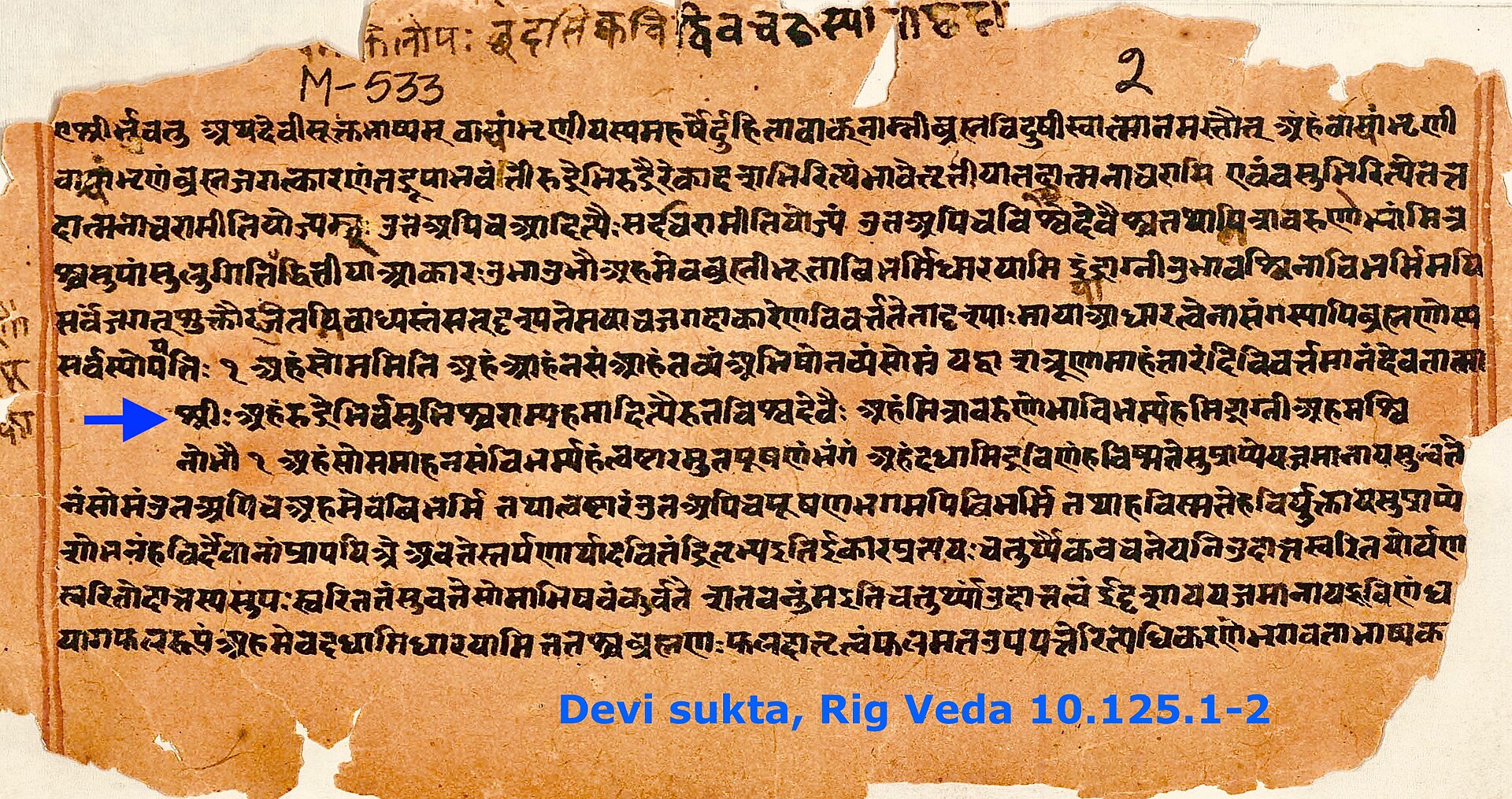
The oldest layer is the Vedic. The Rigveda, a collection of over a thousand hymns arranged in ten books, is generally dated by scholars to roughly the second millennium before the common era, which makes it among the oldest surviving compositions in any Indo European language. What is remarkable is not only its age but its transmission. For many centuries it was not written down at all. It was memorised and recited using elaborate redundancy techniques, in which the same text is chanted in permuted word orders so that any corruption becomes audible, and it was preserved with a fidelity that later manuscript comparison has largely confirmed. This is one of the most successful information preservation systems ever devised, and it was built entirely out of trained human memory.
Grammar as a science
The single most consequential Sanskrit text for the wider world may not be a poem at all. Sometime around the middle of the first millennium before the common era, a grammarian named Panini, working in the northwest of the subcontinent, produced the Ashtadhyayi, a description of the Sanskrit language in roughly four thousand terse rules. It is not a teaching grammar. It is a generative system: a set of ordered rules that, applied correctly, produce every well formed word in the language, with mechanisms for exception, substitution and rule ordering that twentieth century linguists recognised as strikingly close to formal systems developed for computation. Panini's work standardised the language, which is why the term Sanskrit, meaning refined or perfected, distinguishes it from the vernacular Prakrits spoken alongside it. After Panini, Sanskrit largely stopped changing, and that fixity is what allowed a scholar in fifteenth century Kerala to read a text composed a thousand years earlier in Kashmir without difficulty.
The epics form the next great layer and are the works most Indians actually know. The Mahabharata, traditionally attributed to Vyasa, is by common measure the longest poem in world literature, several times the combined length of the Iliad and the Odyssey. It grew by accretion over centuries, absorbing legal material, philosophical dialogue and entire independent narratives, among them the Bhagavad Gita, which sits inside it as a conversation on the battlefield before the fighting begins. The Ramayana, attributed to Valmiki, is shorter, more unified and more obviously a designed poem. Both epics escaped Sanskrit almost immediately, generating retellings in Tamil, Bengali, Hindi, Javanese, Thai, Khmer and dozens of other languages, some of which change the story significantly. Any claim that there is one Ramayana is a claim about authority rather than about literary history.
Courtly poetry and the sciences
The classical period produced kavya, an intensely crafted courtly poetry that prized compression, sound patterning and the layered pun. Kalidasa, usually placed around the fourth or fifth century of the common era and associated with the Gupta court, is its central figure. His play Abhijnanashakuntalam, the recognition of Shakuntala, and his lyric poem Meghaduta, in which an exiled spirit asks a passing cloud to carry a message to his wife, are the standard entry points. When a German translation of Shakuntala reached Europe in the late eighteenth century it caused a genuine sensation among writers including Goethe, and the ensuing European study of Sanskrit led directly to the recognition that Sanskrit, Greek, Latin, Persian and the Germanic and Slavic languages descend from a common ancestor. The Indo European hypothesis, one of the foundational results of modern linguistics, came out of Sanskrit philology.
Alongside poetry ran an enormous technical literature. Sanskrit is the language of the Arthashastra, a manual of statecraft and economic administration attributed to Kautilya; of the Natyashastra, a treatise on drama, dance and music that sets out the theory of rasa, the aesthetic emotion a work is meant to produce in its audience; of astronomical and mathematical works by Aryabhata, Brahmagupta and Bhaskara, in which the decimal place value system and the treatment of zero as a number are worked out; and of medical compendia in the Ayurvedic tradition. Much of this material travelled. Sanskrit mathematical and astronomical work reached the Islamic world in translation from the eighth century onward and from there entered Europe, which is why the digits used in most of the world today are called Arabic numerals in Europe and Hindu numerals in the Arabic world.
The tradition's later history is genuinely contested. One account holds that Sanskrit literary production declined sharply after roughly the twelfth century as regional languages took over the work of literature and as patronage patterns changed with the establishment of Persianate courts. Another holds that this understates a large body of later Sanskrit writing in philosophy, commentary and poetry that simply attracts less scholarly attention. What is clear is that Sanskrit today occupies a contested public position in India. It is one of the languages listed in the Eighth Schedule of the Constitution, it is taught in schools and universities, it remains in daily liturgical use, and a very small number of people report it as a first language. It is also entangled in political arguments about national identity, about which nothing useful can be said briefly except that the arguments are real and that the literature itself is far stranger, funnier and more various than either its promoters or its critics usually allow.
References
- UNESCO Memory of the WorldRigveda
- Encyclopaedia BritannicaSanskrit language
- Encyclopaedia BritannicaKalidasa
- Stanford Encyclopedia of PhilosophyPanini
This is a reference article, written from the sources above. It is background, not news reporting.