
The Spread of Buddhism from India
Reference library · 1103 words

Buddhism is the only major world religion that began in India, spread across most of Asia, and then very nearly disappeared from the country of its birth. Its founder, Siddhartha Gautama, taught in the Ganges plain in what is now Bihar and eastern Uttar Pradesh, most probably in the fifth century BCE, though the dating is debated and scholars have proposed death dates ranging across roughly a century. He set out his teaching, according to tradition, in a deer park at Sarnath near Varanasi, and died at Kushinagar. Within a few centuries the doctrine had reached Sri Lanka, Central Asia and China, and within a thousand years Japan and Tibet, even as it faded in the plains where it started.
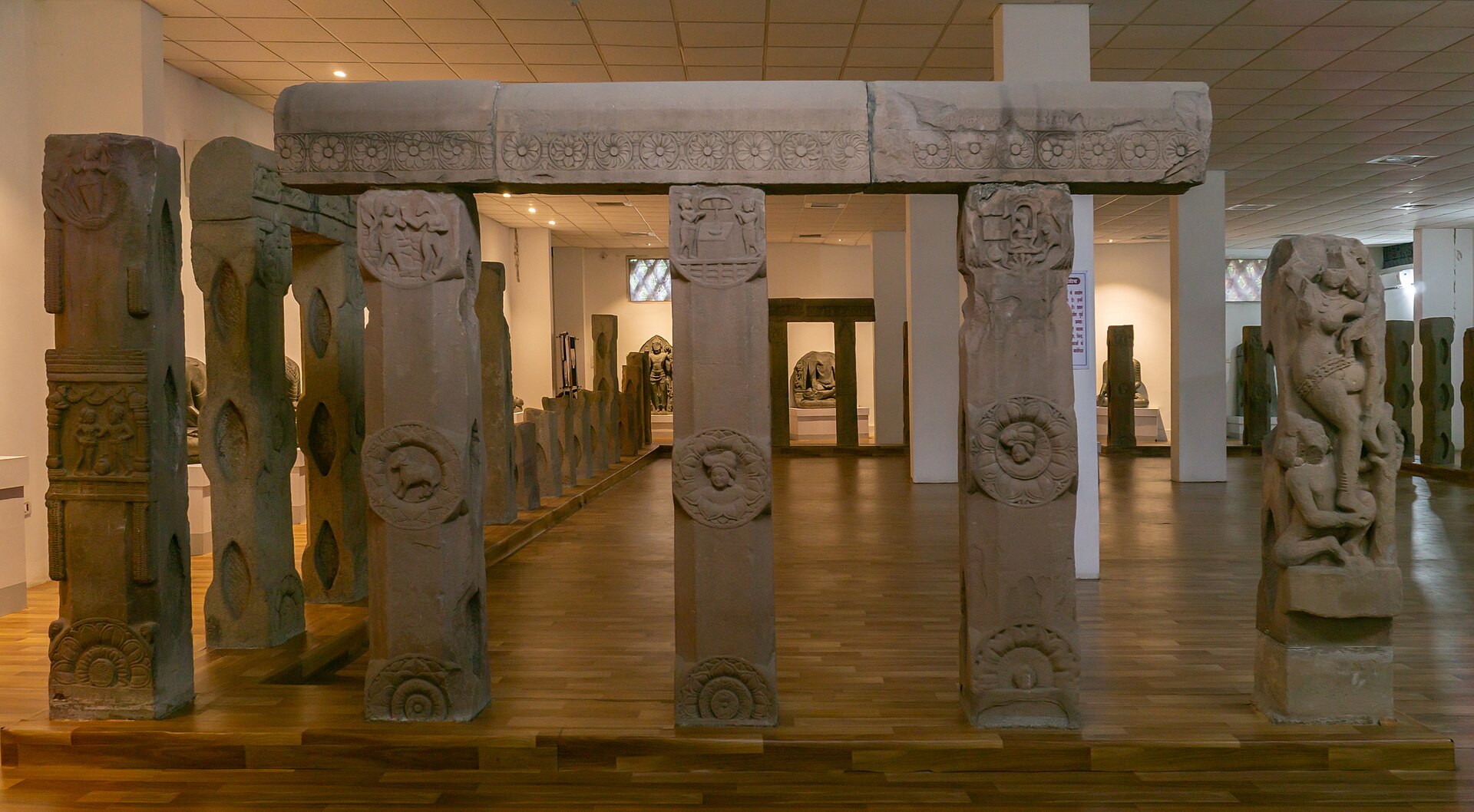
The first great accelerator was political. Ashoka, the third emperor of the Mauryan dynasty, ruled most of the subcontinent in the third century BCE and, after a bloody conquest of Kalinga in what is now Odisha, publicly embraced Buddhist principles. The evidence for this is not literary tradition but stone: Ashoka had edicts carved on rock faces and polished sandstone pillars from Kandahar in Afghanistan to Karnataka, in Prakrit, Greek and Aramaic depending on the local population, setting out a policy of dhamma that emphasised non violence, respect for elders and religious tolerance. One of those pillars, at Sarnath, carries the four lion capital that independent India adopted as its state emblem, and the wheel from the same monument sits at the centre of the national flag. Ashoka also, according to Sri Lankan chronicles, sent missions abroad, including one led by his son Mahinda to the island of Lanka, where King Devanampiya Tissa converted and the Mahavihara monastery was founded at Anuradhapura. Sri Lanka became the conservatory of the Theravada tradition, and it was there, in the first century BCE, that the Pali Canon was committed to writing.
North along the Silk Road, and east by sea
The northern route ran through the trading world of the Kushan empire, which in the first two centuries CE controlled territory spanning present day Afghanistan, Pakistan and northern India and sat astride the caravan routes to Central Asia. Merchants funded monasteries, and monasteries offered lodging and legal shelter to merchants, so the religion travelled with the trade in silk, horses and gems. In Gandhara, around Peshawar and Taxila, sculptors working in a style shaped by Hellenistic contact produced the first widespread images of the Buddha in human form, an innovation that then spread wherever the religion went. Further west, at Bamiyan in central Afghanistan, monks carved two colossal standing Buddhas into a cliff face, which stood until the Taliban destroyed them in March 2001.
From Central Asia the teaching entered China, traditionally dated to the first century CE and associated with the White Horse Temple at Luoyang. The critical work was translation, and it took centuries. Kumarajiva, brought to Chang'an around the year 401, produced Chinese versions of key Mahayana texts whose phrasing shaped East Asian Buddhism permanently. Traffic ran the other way too. Faxian travelled overland to India around the year 400 and returned by sea, and Xuanzang made a famous journey between roughly 629 and 645, studying at the great monastic university of Nalanda in Bihar and carrying hundreds of manuscripts back to China. Xuanzang's account is one of the most valuable sources historians have for the India of that period. From China the religion passed to Korea in the fourth century and from the Korean kingdom of Baekje to Japan in the sixth, arriving bound up with Chinese script and statecraft.
Tibet received Buddhism later and from a different direction, largely directly from India, during the imperial period from the seventh century onward. The founding of Samye monastery in the eighth century and the traditions surrounding the tantric master Padmasambhava mark the establishment of an institutional Buddhism that preserved a great deal of late Indian scholastic and tantric material, much of it now surviving only in Tibetan translation. In maritime Southeast Asia, Buddhism travelled with Indian Ocean trade to the Srivijaya realm in Sumatra and to Java, where the enormous stone mandala of Borobudur was built in the ninth century. Mainland Southeast Asia eventually consolidated around the Theravada tradition transmitted through Sri Lanka, and Bagan in Myanmar, with its plain of thousands of brick temples, records that consolidation.
Why it faded in India, and how it returned
The disappearance of Buddhism from most of India is one of the genuinely open questions in South Asian history, and competing explanations are all partly persuasive. Buddhist institutions in India were unusually dependent on large monasteries with royal and mercantile patronage, rather than on household ritual, which left them exposed when patrons shifted their support. The revival of devotional Hinduism from roughly the seventh century absorbed a good deal of Buddhist practice and philosophy, and the Buddha himself came to be listed in some Hindu traditions as an incarnation of Vishnu, which blurred the boundary. The destruction of the great Bihar monasteries, including Nalanda and Vikramashila, during the Turkic incursions around the year 1200, removed the scholarly institutions and their libraries. And the decline of trade routes that had underwritten monastic wealth removed the economic base. Historians differ sharply on the weight to give each factor, and older accounts that attributed everything to a single violent episode are now generally regarded as too simple.
Buddhism did not vanish entirely. It persisted in the Himalayan belt, in Ladakh, Sikkim, Arunachal Pradesh and among Tibetan communities, and continued in coastal pockets. A deliberate revival began in the late nineteenth century, when the Sri Lankan reformer Anagarika Dharmapala founded the Maha Bodhi Society in 1891 with the specific aim of restoring the Mahabodhi temple at Bodh Gaya, the site of the Buddha's awakening, to Buddhist custody. The site is now inscribed on the UNESCO World Heritage list.
The most consequential modern change came from a different direction entirely. B. R. Ambedkar, the jurist who chaired the drafting committee of the Indian Constitution and who was born into an untouchable community, concluded that caste could not be reformed from within Hinduism. On 14 October 1956, at Nagpur, he formally converted to Buddhism along with an enormous crowd of followers, and died weeks later. The movement he began, sometimes called Navayana Buddhism, reframed the tradition as a social and egalitarian programme, and it accounts for the large majority of India's Buddhists today, concentrated in Maharashtra. India thus now hosts both an ancient Himalayan Buddhism, a network of pilgrimage sites drawing visitors from across Asia, and a modern movement of conversion that is as much about citizenship and dignity as about doctrine.
References
- UNESCOMahabodhi Temple Complex at Bodh Gaya
- UNESCONalanda Mahavihara (Nalanda University) at Nalanda, Bihar
- The Metropolitan Museum of ArtBuddhism and Buddhist Art
- Encyclopaedia BritannicaAshoka
This is a reference article, written from the sources above. It is background, not news reporting.