
The Textile Traditions Behind Every Indian Sari
Reference library · 1012 words
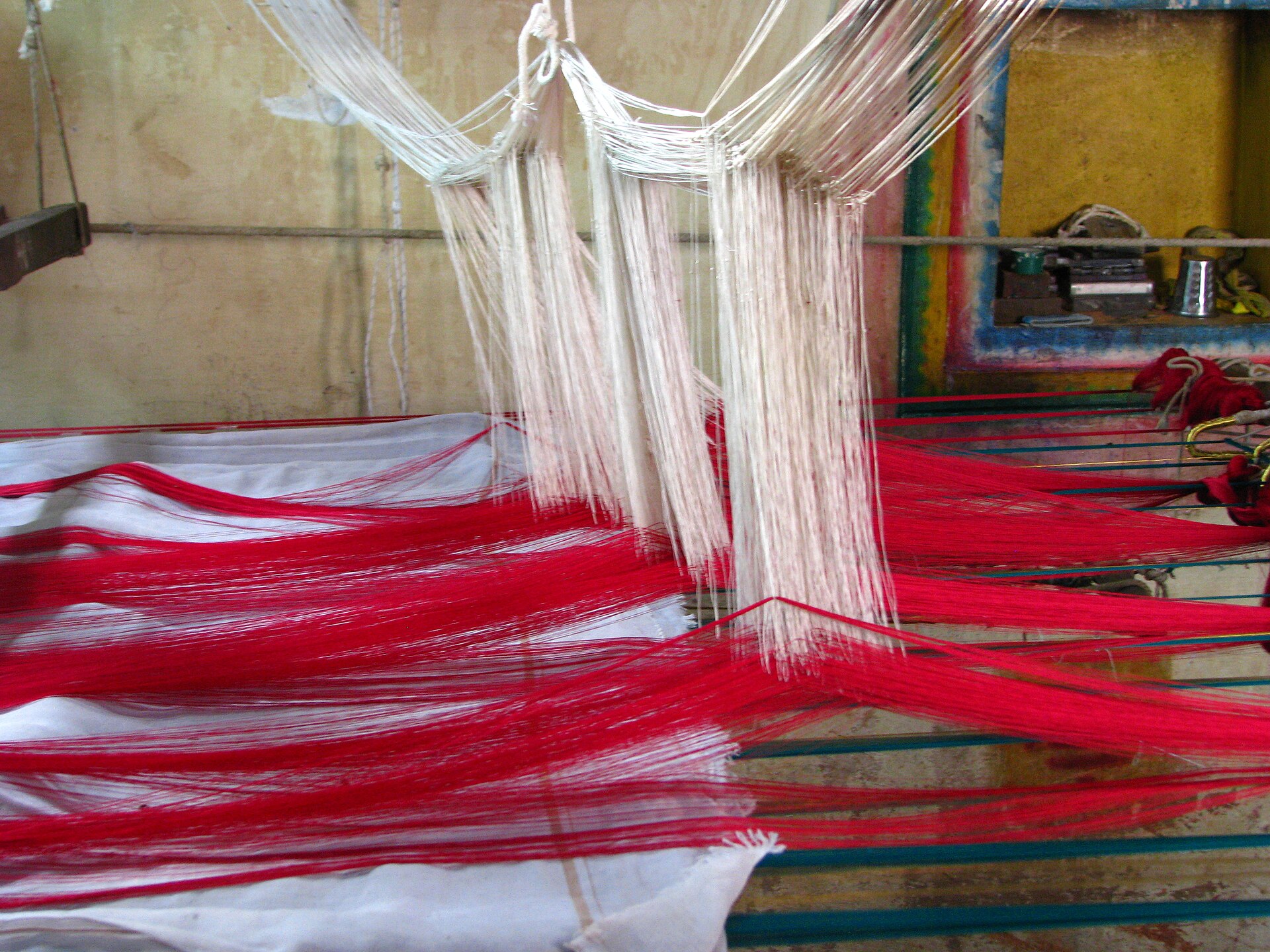

A sari is, technically, one of the simplest garments in the world: a single length of unstitched cloth, generally between five and nine yards long, worn without a needle ever touching it. That simplicity is precisely what makes it interesting. Because the garment imposes almost no construction requirements, all of the design work happens in the weaving itself, and the entire expressive weight falls on three zones: the field or body of the cloth, the border that runs along its length, and the pallu, the decorated end panel that falls over the shoulder. Every regional tradition in India is essentially a different answer to the question of how to treat those three zones, and the answers are technically distinct enough that an experienced eye can name the district a sari came from without reading a label.
The techniques, and why they differ
The oldest technical distinction is between patterns made by manipulating the weave and patterns made by manipulating the dye. Brocade traditions belong to the first family. In Varanasi, the Banarasi sari is woven with supplementary weft threads of silk and metallic zari carried across the ground cloth to build motifs, with named sub-styles depending on how the extra weft is handled: kadhwa, where each motif is woven separately so no float runs behind the cloth, produces a cleaner reverse and takes far longer than the cheaper cutwork method where the floats are woven across and then trimmed away. Varanasi brocades draw heavily on Mughal-era vocabulary, floral trellises, cypress forms, paisley and arabesque, which is a direct legacy of Persianate court patronage.
Kanchipuram in Tamil Nadu approaches the same materials differently. Its signature is korvai, in which the border is woven in a different colour and often a different warp from the body, and the two are interlocked at the loom by hand, thread by thread, producing a join strong enough that the cloth is said to tear before the border separates. The pallu may be attached in the same way, giving the classic three-colour Kanjeevaram. Paithani, from Maharashtra, uses a tapestry technique in which the weft is not carried across the full width at all but turned back within each colour area, so peacocks, lotuses and coconut palm motifs are built up patch by patch with no floats behind them. Baluchari, from Bishnupur in Bengal, devotes its pallu to narrative panels showing scenes from the epics or, in nineteenth-century examples, from courtly and colonial life. Jamdani, historically the Dhaka tradition and still woven on both sides of the Bengal border, inserts discontinuous supplementary weft by hand on a fine muslin ground, producing motifs that appear to float in the cloth; UNESCO inscribed the traditional art of Jamdani weaving on its intangible heritage list in 2013.
The dye-based family works before weaving rather than during it. In ikat the yarn is tied and dyed in sections so that the pattern only appears when the threads are aligned on the loom. Odisha's bandha saris from Sambalpur, Bargarh and Nuapada use weft ikat with characteristic conch, wheel and fish motifs. Pochampally in Telangana produces both weft and combined ikat at scale. The most demanding version is the double ikat patola of Patan in Gujarat, where warp and weft are both resist-dyed in advance so that the two must register against each other as the cloth grows, a process that historically took months and remains confined to a very small number of families. Bandhani, from Kutch and Rajasthan, ties thousands of tiny points into finished cloth before dyeing so that each tied point resists colour and becomes a dot.
An industry, not only a heritage
It is easy to write about all this as pure craft, but handloom weaving is one of India's largest employers outside agriculture, and its economics are difficult. The national handloom census conducted at the end of the 2010s counted roughly thirty-five lakh handloom workers across the country, concentrated heavily in the north-east, West Bengal, Tamil Nadu, Uttar Pradesh, Assam and Odisha, and found that a large majority were women. A very large share of weaving households earn below what most Indian workers earn, and weavers commonly work on order from master weavers or traders who supply yarn and design and take the marketing margin.
The central commercial pressure comes from mechanisation. A power loom can reproduce the look of many handloom designs at a fraction of the cost and time, and Surat's synthetic sari industry produces printed polyester saris in enormous volume at prices no handloom can approach. Computerised jacquard and screen-printed imitations of Banarasi and Kanchipuram designs circulate widely, sometimes sold as the genuine article. India's legislative response has run along two tracks. The Handlooms Reservation of Articles for Production Act of 1985 reserved certain items for exclusive handloom production, though enforcement has always been weak. More effective has been Geographical Indication registration, which since the mid-2000s has given legal protection to the names of specific traditions including Banaras brocades and saris, Kanchipuram silk, Pochampally ikat, Chanderi, Paithani, Sambalpuri bandha, Patan patola and many others. A GI does not stop anyone from weaving a similar cloth; it stops them from calling it by the protected name, and it gives registered producers a collective legal standing they otherwise lack.
What all of this preserves is more than a set of patterns. Each tradition carries its own social use: the off-white and gold kasavu cloth of Kerala worn at Onam and at temple visits, the Maheshwari and Chanderi cottons of Madhya Pradesh associated with an eighteenth-century Holkar court that deliberately established weaving as a state industry, the specific saris a bride is expected to receive in a Tamil, Bengali or Marathi wedding. There are also dozens of regional draping styles that are not the familiar pleated-front nivi drape at all, including trouser-like Maharashtrian and Tamil nine-yard styles designed for movement. It is a reasonable claim that the sari is the most widely worn hand-woven garment left anywhere in the world, and that fact rests on an industry of millions of small looms whose survival is not guaranteed.
References
- Ministry of Textiles, Government of IndiaFourth All India Handloom Census
- UNESCOTraditional art of Jamdani weaving
- Victoria and Albert MuseumThe Sari: an introduction
- Geographical Indications Registry, Government of IndiaRegistered Geographical Indications for textiles
This is a reference article, written from the sources above. It is background, not news reporting.