
The Vedic Age and Its Legacy
Reference library · 1012 words
.jpg)
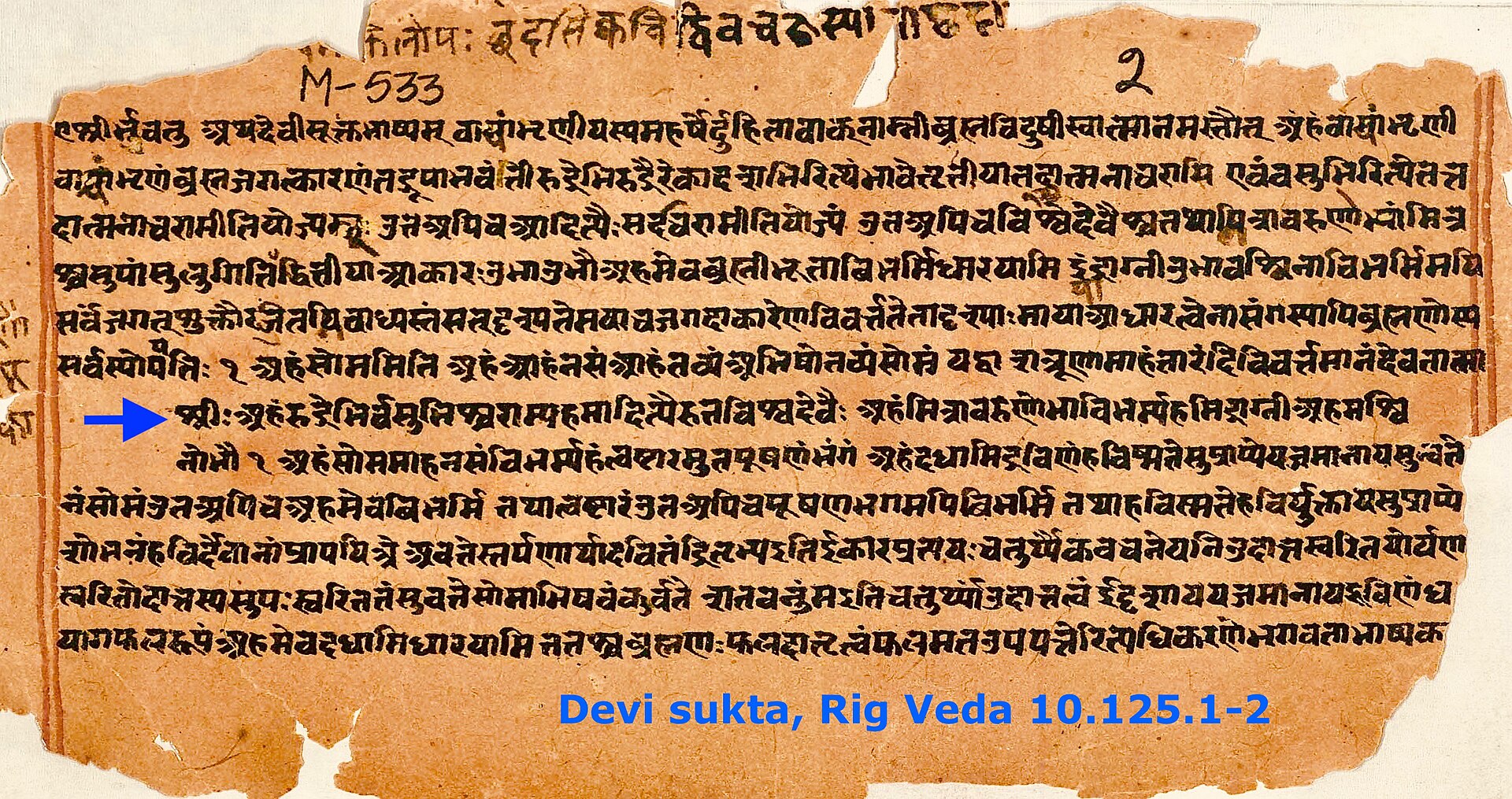
The Vedic age is the period in South Asian history that produced the four Vedas, the oldest surviving body of Sanskrit literature and among the oldest religious texts anywhere still in active use. Most scholars place the composition of the Rigveda, the earliest of the four, in roughly the period between 1500 and 1200 BCE, in the region of the Punjab and the upper Indus, an area the hymns themselves call the land of seven rivers. The other three collections, the Samaveda, the Yajurveda and the Atharvaveda, followed, and around them accumulated a vast secondary literature: the Brahmanas, which explain ritual procedure, the Aranyakas, and finally the Upanishads, the philosophical dialogues composed roughly between 800 and 500 BCE. Together this corpus is the foundation on which most later Indian religious and philosophical thought was built, whether by extension or by argument against it.
What makes the Vedas unusual is not only their age but the way they survived. They were not written down for well over a thousand years after they were composed. They were memorised, and the memorisation was engineered with extraordinary care. Brahmin lineages developed layered recitation schemes, in which the same text is chanted in the ordinary word order, then word by word in isolation, then in overlapping pairs, then in more elaborate permutations that run forwards and backwards through the sequence. Because each scheme constrains the others, an error introduced in one pattern fails to reproduce in the rest, and the corruption is exposed. The result is a text transmitted orally across roughly a hundred generations with a fidelity that written manuscript traditions rarely achieve. UNESCO recognised the tradition of Vedic chanting on its list of the intangible cultural heritage of humanity, and recordings of the surviving recitation schools are now a serious object of study in their own right.
What the hymns actually describe
The Rigveda is not a narrative or a law book. It is a collection of just over a thousand hymns addressed to deities, most of them recited in the context of the yajna, the fire sacrifice. The gods most frequently invoked are Agni, the fire that carries offerings, Indra, the warrior god of storm and victory, and Varuna, the guardian of cosmic and moral order. A pressed plant juice called soma, whose botanical identity remains genuinely unsettled, is the subject of an entire book. The society glimpsed through the hymns is pastoral and mobile, wealth is counted in cattle, chariots and horses matter enormously, and there is no mention of large cities or of an imperial state.
By the later Vedic period the centre of gravity had shifted east, into the plain between the Ganga and the Yamuna. Iron tools appear, settlements grow more permanent, and larger tribal kingdoms such as Kuru and Panchala emerge. The ritual becomes more elaborate and the priestly role more powerful. It is in a late hymn of the Rigveda, the Purusha Sukta, that the four varnas appear for the first time as a description of society, presented as parts of a cosmic body. Whether that hymn describes an existing hierarchy or proposes an idealised one is disputed, but it is the seed of a vocabulary that later Indian social thought would elaborate for millennia.
The Upanishads represent a turn inward. Instead of asking how to perform the sacrifice correctly, texts such as the Chandogya and the Brihadaranyaka ask what underlies the self and the universe, and propose that the innermost self and the ultimate reality are the same. This question, and the various answers given to it, generated the schools of Vedanta and shaped the arguments of Buddhist and Jain thinkers who rejected Vedic authority outright. The Vedic ritual sciences also had unexpected technical consequences: the Sulba Sutras, manuals for constructing sacrificial altars of precise area and shape, contain some of the earliest recorded geometric propositions in India, and the need to fix the calendar for ritual timing drove early astronomical observation. The grammarian Panini, working perhaps in the fourth century BCE, produced in his Ashtadhyayi a description of Sanskrit so rigorous that modern linguists still study its method.
The arguments that are still open
Almost every large question about the Vedic age remains contested. The relationship between the Vedic people and the earlier Indus Valley cities, which had declined by around 1900 BCE, is unresolved. The dominant scholarly position holds that speakers of an early Indo-Aryan language migrated into the subcontinent from Central Asia and that their language is a cousin of Persian, Greek, Latin and the Germanic and Slavic tongues, a relationship first argued publicly by the judge and philologist William Jones in Calcutta in 1786. An alternative position, influential in Indian public debate, holds that Indo-Aryan speech is indigenous and that the Vedic and Indus cultures are one. Recent studies of ancient genomes have added steppe-derived ancestry to the picture in ways most specialists read as supporting migration, but the inference from genes to language and culture is not straightforward, and the identification of the lost Sarasvati river of the hymns with the dry bed of the Ghaggar-Hakra remains argued over. These are not purely academic quarrels: they carry weight in contemporary Indian politics, where claims about origins are claims about belonging.
The legacy is easier to see than the origins. Vedic mantras are still recited at Hindu weddings and funerals across the world, including in diaspora communities in Australia, Britain and North America, usually by householders who do not read Sanskrit but have learned the sounds. The Gayatri mantra, a single verse of the Rigveda, is among the most widely repeated pieces of text on earth. In the nineteenth century the reformer Dayananda Saraswati founded the Arya Samaj in Bombay in 1875 with the slogan of a return to the Vedas, using the corpus as a lever against image worship, caste rigidity and colonial condescension alike. That a set of hymns composed by cattle herders more than three thousand years ago should still be recited daily, quoted in court judgments and argued about in newspapers is itself the most remarkable fact about them.
References
- UNESCOTradition of Vedic chanting
- Encyclopaedia BritannicaVeda
- Stanford Encyclopedia of PhilosophyIndian Philosophy (Overview)
- The Metropolitan Museum of ArtHeilbrunn Timeline of Art History: South Asia
This is a reference article, written from the sources above. It is background, not news reporting.