

Wedding Season Customs Across India
Reference library · 1096 words
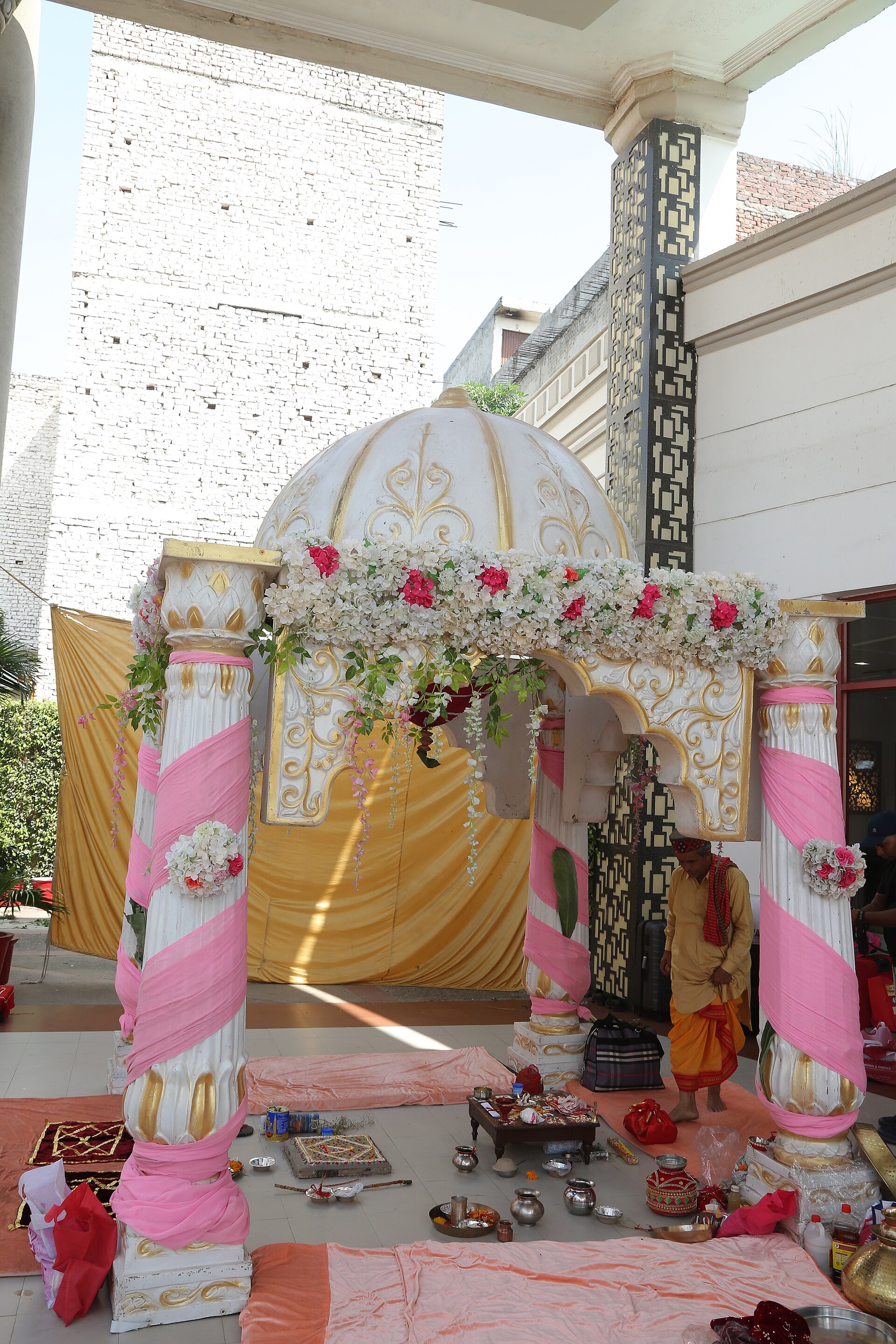

Each November, Indian cities become visibly different. Marquees rise on vacant plots, brass bands rehearse badly in side streets, traffic snarls behind processions, and jewellers, caterers and tent contractors work continuously for weeks. This is wedding season, and it is not a metaphor. Weddings in India cluster into defined windows determined by the traditional almanac, and the industry that serves them, one of the country's largest sources of informal employment, follows that calendar precisely.
Why the season exists
Hindu marriages are usually held on a date judged auspicious by the panchang, the traditional calendar that tracks lunar days, planetary positions and asterisms. Astrologers publish lists of favourable dates well in advance, and families book venues, priests and photographers around them, which is why hundreds of thousands of weddings can occur across the country on a single day and almost none on the day after. Certain periods are avoided outright. The four months from Devshayani Ekadashi in the month of Ashadha to Prabodhini Ekadashi in Kartik, corresponding roughly to the monsoon and often called Chaturmas, are traditionally understood as a time when Vishnu sleeps and auspicious ceremonies pause. Periods when the sun transits into Sagittarius and Pisces, known as Kharmas in the north, are similarly avoided. The result is a heavy concentration from November through early spring, with a second run in the pre monsoon months.
The wedding itself is rarely a single event. In much of northern India it is the culmination of a sequence: an informal agreement between families, a formal engagement, a sangeet evening of music and increasingly of choreographed family dance routines, a mehndi ceremony where the bride's hands and feet are decorated with henna, and a haldi in which turmeric paste is applied to the couple by relatives, a ritual that is simultaneously a blessing, an antiseptic and an excuse for a great deal of mess. Then comes the baraat, the groom's procession, traditionally on a mare, accompanied by drums, a band and dancing relatives, met at the venue by the bride's family. The core religious ceremony involves the exchange of garlands, the giving of the bride by her father, and the couple circling a sacred fire while a priest recites verses, each circuit representing a vow. Afterwards the bride departs with her husband's family in the vidaai, an emotionally charged farewell that remains one of the most affecting parts of any north Indian wedding.
Regional variation is the rule, not the exception
What is described above is one regional tradition among many, and treating it as the Indian wedding is a common error. Tamil Brahmin weddings, for instance, take place in the morning at a precisely calculated muhurtam, often after dawn, and include the kashi yatra, a piece of ritual theatre in which the groom pretends to renounce the world and set off on pilgrimage to Kashi before being persuaded back by the bride's father. The couple sit on an oonjal, a swing, while women sing and circle them. The binding act is the tying of the thali or mangalsutram around the bride's neck, secured with three knots, while nadaswaram and thavil musicians play at a volume that makes conversation impossible.
In Telugu weddings the couple place a paste of cumin and jaggery on each other's heads at the auspicious moment, a gesture read as the bitter and the sweet of life taken together. Malayali Nair weddings are famously brief, sometimes over in minutes, centring on the tying of the thali and the gift of a sari; Kerala's Syrian Christian weddings substitute a minnu with a cross, tied on a thread drawn from the bride's garment. Bengali weddings have their own sequence: gaye holud with turmeric, the shubho drishti when the couple see each other for the first time as the bride is carried in on a low stool, the exchange of garlands, and the application of vermilion. The bride wears shakha and pola bangles of conch shell and red coral, and conch shells are blown throughout. Maharashtrian weddings hold an antarpat, a decorated cloth, between the couple while the assembly chants the mangalashtaka verses, dropping it at the appointed second. Gujarati weddings feature a ritual in which the bride's mother playfully tugs the groom's nose as he arrives, a reminder that he has come to ask for something.
Beyond Hindu practice, a Muslim nikah is a contract: the qazi confirms consent from both parties, the mehr payable to the bride is stated, witnesses sign, and the celebratory walima feast is hosted by the groom's family afterwards. A Sikh Anand Karaj centres on four laavan hymns from the Guru Granth Sahib, the couple walking around the scripture rather than a fire after each is sung, and it is governed by the Anand Marriage Act of 1909, amended in 2012 to allow registration under that Act rather than under Hindu marriage law.
Law, money and pressure
The legal frame is separate from the ceremony. Hindu, Buddhist, Jain and Sikh marriages are governed by the Hindu Marriage Act of 1955; Muslims, Christians and Parsis by their own statutes; and any two Indians, of whatever faith, may marry under the Special Marriage Act of 1954, which requires a thirty day public notice period that has itself been challenged in court for exposing interfaith couples to harassment. Registration of marriages, once loosely observed, was made effectively compulsory following Supreme Court direction in the mid 2000s, and it now matters practically for visas, property and spousal claims.
The economics are formidable. Indian weddings represent one of the largest consumer expenditure events in a family's life, frequently exceeding the cost of a house purchase for middle income families, and demand for gold at weddings is a significant factor in the global bullion market. Wedding spending sustains a vast informal workforce of caterers, tent and lighting contractors, decorators, musicians, drivers and photographers, and its seasonality is visible in economic data. Destination weddings at palaces in Rajasthan and resorts in Goa have become a market of their own.
The costs are not only financial. Dowry has been illegal since the Dowry Prohibition Act of 1961 and remains widespread in practice under other names, gifts, ceremonies, hospitality, and dowry related harassment continues to generate criminal cases each year. Families of modest means take on debt to meet expectations set by weddings they have seen. There is a visible counter current: smaller ceremonies, temple and gurdwara weddings, community mass weddings, and couples who resist the escalation on principle. Whether that becomes a genuine shift or remains a minority position is one of the more interesting open questions about Indian social life.
References
- Encyclopaedia BritannicaHinduism: Marriage and domestic rites
- Government of India, Ministry of Law and JusticeThe Hindu Marriage Act, 1955 and Special Marriage Act, 1954
- Government of India, Ministry of Women and Child DevelopmentDowry Prohibition Act and related legislation
- Victoria and Albert MuseumSouth Asian textiles and ceremonial dress
This is a reference article, written from the sources above. It is background, not news reporting.