
Writing a Constitution for a New Republic
Reference library · 1094 words

The Constituent Assembly of India met for the first time on the ninth of December 1946, in a circular chamber in New Delhi, at a moment when almost nothing about the country it was meant to constitute had been settled. The British had not left. Partition had not been agreed. The Muslim League, which had won most Muslim seats in the elections that produced the assembly, was boycotting it. The princely states, covering roughly two fifths of the territory of the subcontinent, had not acceded to anything. That the same body, sitting continuously through the bloodiest year in modern Indian history, produced by November 1949 the longest written constitution in the world, is one of the more remarkable feats of political drafting anywhere.
The assembly was not directly elected. Under the Cabinet Mission Plan of 1946, members were chosen by the provincial legislative assemblies, which had themselves been elected on a restricted franchise covering perhaps a seventh of the adult population, with seats distributed among Muslims, Sikhs and a general category. The princely states were allotted seats to be filled by nomination. It was therefore an indirectly elected body with a narrow electoral base, a point critics have pressed ever since. After Partition the membership fell to around three hundred. An elderly member, Sachchidananda Sinha, presided over the opening session as temporary chairman, and Rajendra Prasad was elected permanent president on the eleventh of December.
On the thirteenth of December 1946, Jawaharlal Nehru moved the Objectives Resolution, which declared the intention to found an independent sovereign republic guaranteeing to all its people justice, equality of status and opportunity, and freedom of thought, expression, belief, faith, worship, vocation, association and action, with adequate safeguards for minorities and depressed classes. It was adopted on the twenty second of January 1947 and later became the basis of the Preamble. Reading it now, one notices that it does not use the word secular, which was inserted into the Preamble only in 1976.
How the text was made
The real drafting work was done in committees. B.N. Rau, a former judge appointed constitutional adviser, prepared an initial draft after touring the United States, Canada, Ireland and Britain to consult judges and constitutional lawyers. A Drafting Committee was constituted on the twenty ninth of August 1947 with B.R. Ambedkar as chairman, and it produced the draft constitution published in February 1948 for public comment. Ambedkar, a Columbia and London trained economist and lawyer and the most prominent political leader of the Dalit communities, had spent his career attacking the Congress leadership; his appointment to steer the text was a decision that surprised many at the time and that he later described in mixed terms himself. He carried the burden of defending nearly every clause on the floor, and the plain, combative style of those replies is much of what makes the debates readable.
The assembly sat for one hundred and sixty five days across eleven sessions over two years, eleven months and eighteen days. The final text ran to three hundred and ninety five articles, eight schedules and twenty two parts, and it drew openly on foreign models: the parliamentary system and cabinet responsibility from Britain, justiciable fundamental rights from the United States Bill of Rights, non justiciable directive principles of state policy from the Irish constitution of 1937, a strong centre with residuary powers at the union from Canada, and emergency provisions with an ancestry in the German Weimar constitution. The largest single source, however, was the Government of India Act 1935, the colonial statute that supplied the federal structure, the office of Governor, the legislative lists and much of the administrative machinery, sometimes almost verbatim. Members debated this uncomfortably. Ambedkar's answer was that borrowing from a workable administrative statute was not the same as endorsing the regime that wrote it.
The arguments that shaped it
Several questions were genuinely open and were settled by argument rather than consensus. Separate electorates, in which religious communities voted for their own representatives, had been a fixture of Indian politics since 1909 and were abandoned entirely; the assembly concluded, after Partition, that they had entrenched division. Reserved seats and reserved posts for the Scheduled Castes and Scheduled Tribes were retained, initially for ten years, extending the logic of the 1932 Poona Pact into the republic.
Language produced the sharpest split. Advocates of Hindi wanted it declared the national language immediately; southern and Bengali members regarded that as an imposition. The result, sometimes called the Munshi Ayyangar formula, was a compromise embedded in Article 343: Hindi in the Devanagari script would be the official language of the Union, English would continue for official purposes for fifteen years, and Parliament could extend that period, which it duly did. The word national was avoided throughout.
A quieter but consequential change concerned the protection of personal liberty. The draft had guaranteed that no person be deprived of life or liberty without due process of law, on the American model. B.N. Rau, on his American tour, was advised by Justice Felix Frankfurter that the due process clause gave courts an undesirably broad power over legislation, and the phrase was replaced with procedure established by law, borrowed from the Japanese constitution. Indian courts read that narrowly for twenty five years, until the Supreme Court in 1978 effectively reinstated a substantive reading of Article 21. Similarly, the right to property was included as a fundamental right, immediately collided with land reform legislation, generated decades of litigation and amendment, and was finally removed from the list of fundamental rights in 1978.
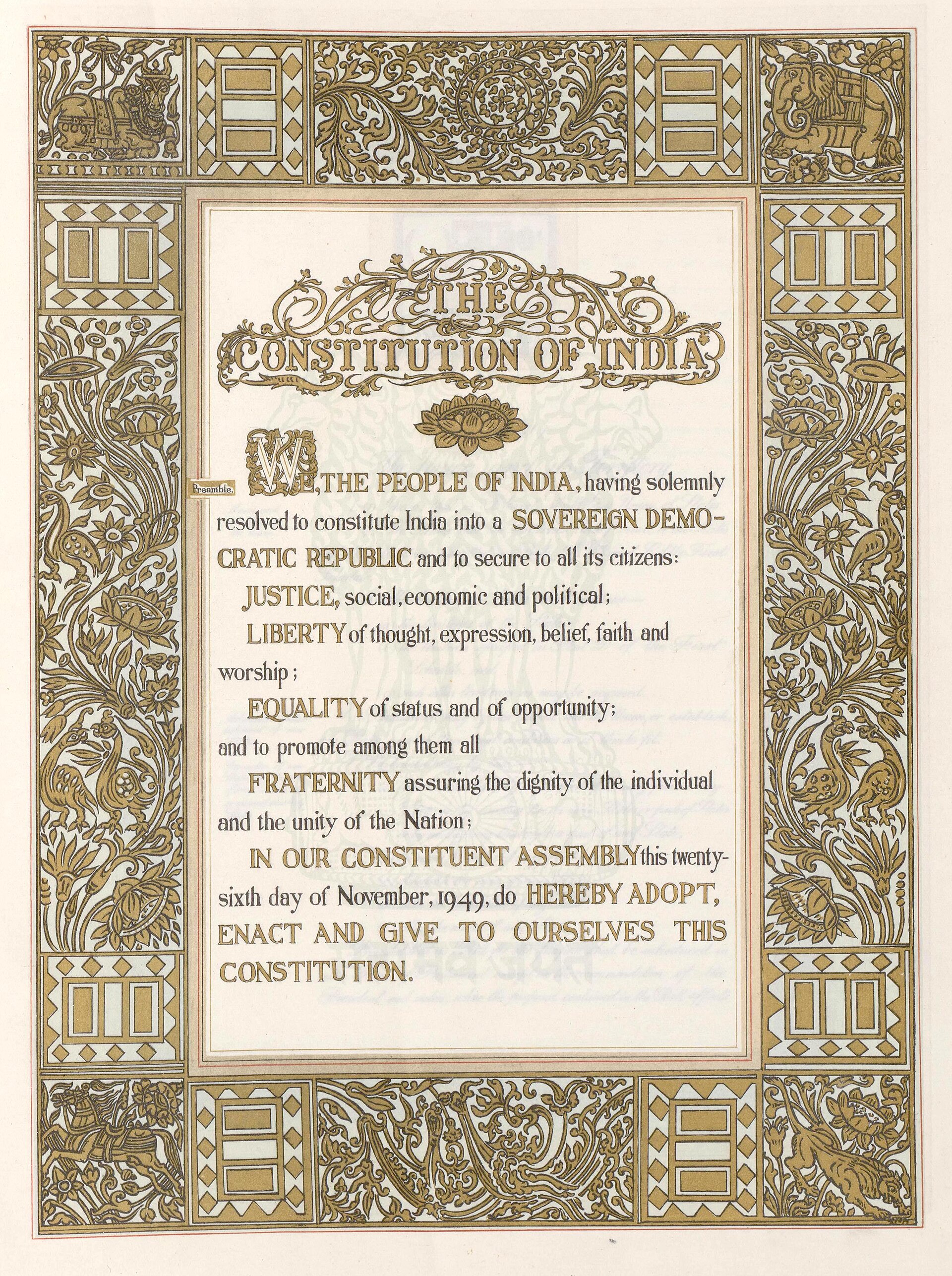
The Constitution was adopted on the twenty sixth of November 1949, now observed in India as Constitution Day, and came into force on the twenty sixth of January 1950, a date chosen because the Congress had declared complete independence as its goal on that day in 1930. The signed copy was handwritten in flowing italic script by the calligrapher Prem Behari Narain Raizada and illustrated by Nandalal Bose and artists of Santiniketan with scenes from Indian history.
In his closing speech on the twenty fifth of November 1949, Ambedkar warned that a constitution is only as good as those who work it, that India was about to enter a life of contradictions with political equality and social and economic inequality, and that Indians should abandon what he called the grammar of anarchy, meaning agitation outside constitutional methods, and should beware of hero worship in politics. Seventy five years and more than a hundred amendments later, those three warnings are still the sharpest things anyone has said about the document.
References
- Legislative Department, Government of IndiaThe Constitution of India
- Parliament of IndiaConstituent Assembly Debates
- Encyclopaedia BritannicaB. R. Ambedkar
- Supreme Court of IndiaSupreme Court of India
- National Archives of IndiaNational Archives of India
This is a reference article, written from the sources above. It is background, not news reporting.