
Zero and Beyond: India's Mathematical Legacy
Reference library · 1100 words

Every time anyone writes a number, they use a technology developed in India. The system of ten digits in which the position of a digit determines its value, and in which a special symbol marks an empty position, was assembled on the subcontinent over several centuries and then carried west through the Arabic speaking world to Europe. That is why the digits are called Hindu Arabic numerals. The achievement is easy to underrate because the result feels obvious, but it is not: Roman numerals cannot be added in columns, Babylonian sexagesimal notation had no consistent placeholder for centuries, and arithmetic before place value was a specialist craft rather than something a schoolchild could do on paper.
Indian mathematics has deep roots in ritual and in astronomy. The Sulbasutras, texts appended to the Vedic ritual manuals and generally dated to the first millennium before the common era, set out the geometry needed to build fire altars of prescribed shape and area, including constructions equivalent to the theorem usually attributed to Pythagoras and a good approximation for the square root of two. Around the same broad period, Pingala's treatise on prosody analysed the possible arrangements of long and short syllables in a verse line, producing what amounts to binomial coefficients and a combinatorial recurrence that later readers recognised as the sequence now named after Fibonacci, together with a positional method of representing patterns that is effectively binary notation.
Zero as a number, not just a gap
The crucial step was to treat zero not merely as a blank in a column but as a quantity that obeys rules. That step is documented in the Brahmasphutasiddhanta, written by Brahmagupta in 628 in what is now Rajasthan. Brahmagupta set out arithmetic for what he called fortunes, debts and nothing, that is positive numbers, negative numbers and zero: a debt subtracted from nothing is a fortune, the product of two debts is a fortune, and zero added to any quantity leaves it unchanged. His treatment of division by zero is unsatisfactory by modern standards, which is unsurprising, since it took European mathematics a very long time to settle that question too. He also gave a general solution method for quadratic equations admitting negative roots, and a formula for the area of a cyclic quadrilateral that generalises Heron's formula for triangles.
Brahmagupta was writing in an established tradition. Aryabhata, born in 476 and associated with the region around Kusumapura near modern Patna, completed the Aryabhatiya in 499. In roughly 120 compressed verses it gives a value for the ratio of a circle's circumference to its diameter accurate to four decimal places, described carefully as approximate; a table of half chords which is the direct ancestor of the sine function, the Sanskrit term jya passing through Arabic transliteration into the Latin sinus; methods for solving linear indeterminate equations; and an astronomical model in which the apparent daily rotation of the stars is caused by the rotation of the earth on its axis. Bhaskara I wrote a commentary on it in 629 that contains the earliest surviving Indian use of a written symbol in place value arithmetic. Later, Bhaskara II, working in the twelfth century, produced the Siddhanta Shiromani, whose arithmetic section, the Lilavati, addresses its problems to a reader in verse and remained a standard textbook for centuries; his work includes the cyclic method for solving Pell type equations, a problem European mathematicians reached only in the seventeenth century.
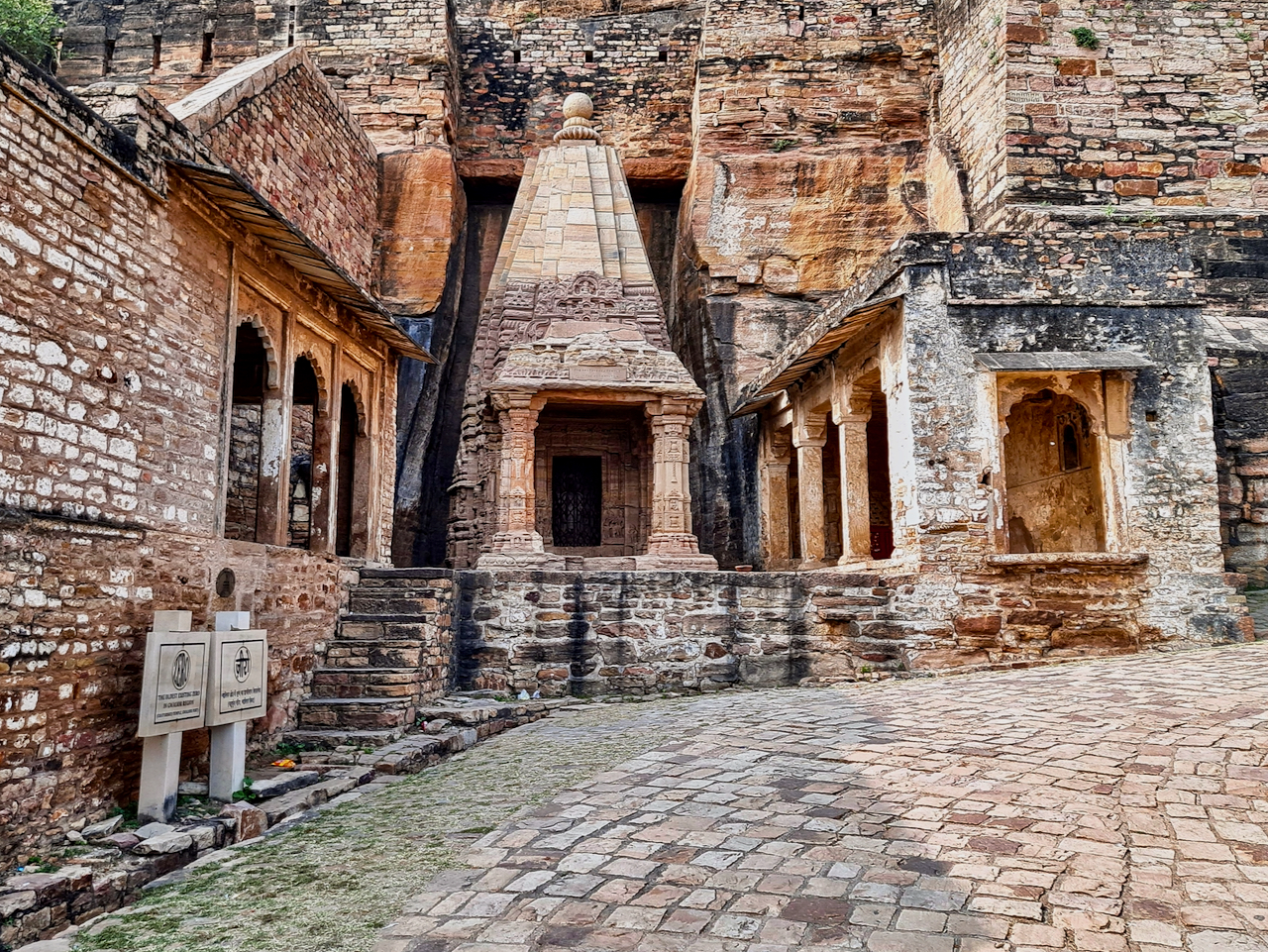
Dating the physical evidence for the zero symbol is genuinely contested. A stone inscription at the Chaturbhuj temple in Gwalior, dated to 876, records land measurements including a figure with a small circle for zero, and is often cited as the earliest securely dated Indian instance. The Bakhshali manuscript, a birch bark mathematical text found near Peshawar in 1881 and held at the Bodleian Library in Oxford, uses a dot as a placeholder; radiocarbon dating published in 2017 returned dates for its folios spanning several centuries, with the earliest in the third or fourth century, and specialists have argued vigorously about whether a composite manuscript can be dated by its oldest leaf. Inscriptions using place value numerals also appear across Southeast Asia in the seventh century, evidence of how quickly the system travelled.
The Kerala school and the modern inheritance
The most remarkable later chapter unfolded far to the south. Madhava of Sangamagrama, working in Kerala around the turn of the fifteenth century, developed infinite series expansions for the sine, cosine and arctangent functions, and a series for the ratio of circumference to diameter, together with correction terms to accelerate their convergence. These are results that appear in Europe two to three centuries later under the names of Gregory, Leibniz and Newton. Madhava's own writings are largely lost and his results are known through the works of his successors, including Nilakantha Somayaji's Tantrasangraha of 1501 and the Yuktibhasa of Jyesthadeva, written in Malayalam in the sixteenth century and notable for supplying demonstrations rather than bare statements. Whether any of this reached Europe, perhaps through Jesuit missionaries active on the Malabar coast, has been argued about for decades; the circumstantial case has been made and no document establishing transmission has been produced, so the honest position is that independent discovery remains the default explanation.
Transmission westward from the earlier period is far better attested. Indian astronomical texts were translated into Arabic in Baghdad in the eighth century, and around 825 al Khwarizmi wrote a treatise on calculation with Indian numerals, surviving mainly in Latin translation, whose title gave European languages the word algorithm. Leonardo of Pisa, known as Fibonacci, learned the system from Arabic sources in North Africa and set it out for a European audience in the Liber Abaci of 1202. Adoption in Europe was slow, contested by reckoning masters who used counting boards.
The tradition did not end with the medieval period, though the institutional continuity was badly broken. Srinivasa Ramanujan, born near Kumbakonam in Tamil Nadu in 1887, worked largely alone with an out of date English textbook, filled notebooks with thousands of results, and wrote in 1913 to G. H. Hardy at Cambridge. Hardy recognised what he was reading, brought him to England, and their collaboration produced work on partitions, highly composite numbers and modular forms. Ramanujan died in 1920 at thirty two, and his notebooks, including the so called lost notebook recovered in 1976, have kept mathematicians occupied ever since, with his mock theta functions turning out in recent decades to connect to areas of mathematics that did not exist in his lifetime. India's National Mathematics Day is observed on his birthday, 22 December.
References
- MacTutor History of Mathematics Archive, University of St AndrewsIndian Mathematics: overview
- Bodleian Libraries, University of OxfordThe Bakhshali manuscript
- Encyclopaedia BritannicaBrahmagupta
- Encyclopaedia BritannicaSrinivasa Ramanujan
This is a reference article, written from the sources above. It is background, not news reporting.